Monday, 23 November 2026

Carolina mantis, Stagmomantis carolina, enjoys a Thanksgiving feast

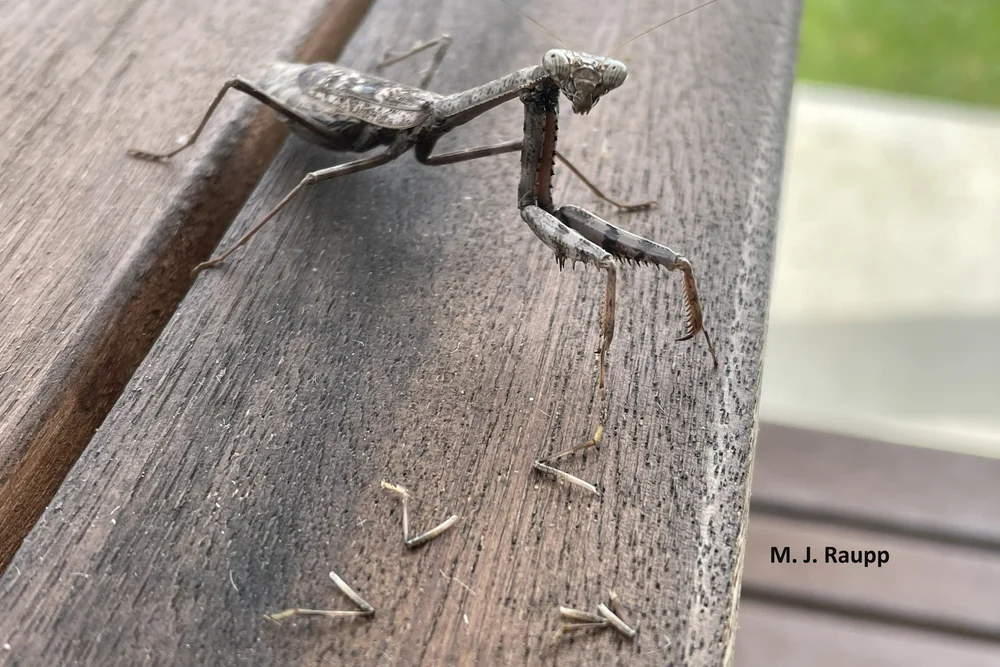
Who me? I swear I didn’t eat a stink bug. I don’t know how all those legs got there!

This week as many gather to enjoy a Thanksgiving feast, a lovely Carolina mantis enjoyed an early Thanksgiving feast on my back porch. A few weeks ago, hordes of stink bugs assembled to invade my home. In Mother Nature’s paradigm of prey and predator interactions, when prey populations build, their predators often follow closely behind. As scores of stink bugs gathered on my windows and walls seeking winter refuge, several Carolina mantises arrived to enjoy the stink bug bounty.
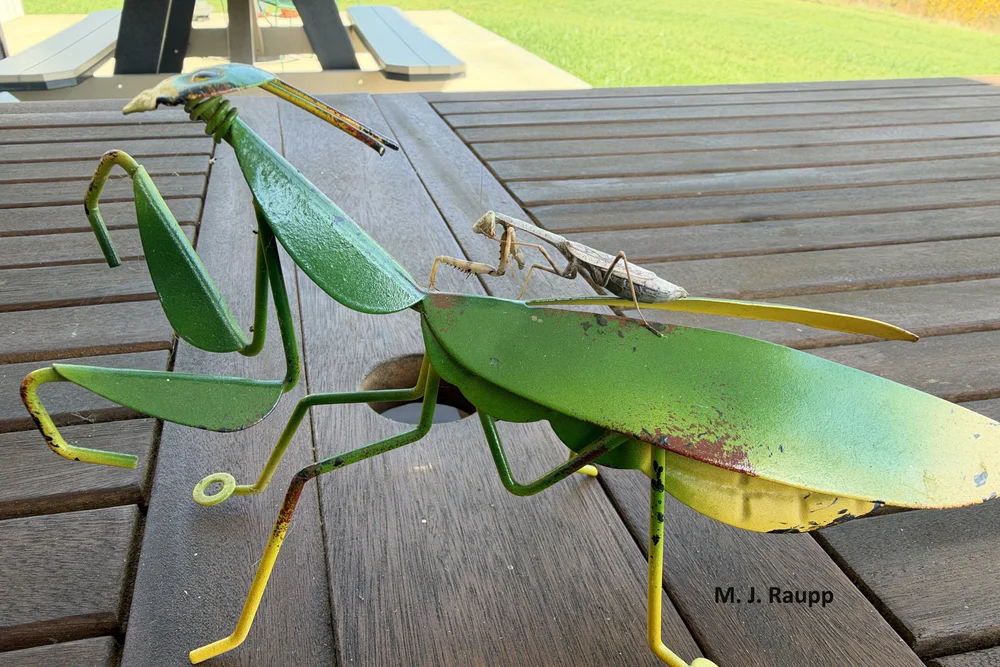
If I hold still the bug geek will think I’m just another ornament.

Late one afternoon while cleaning the picnic table, I noticed a rather pregnant Carolina mantis standing over a collection of legs of a brown marmorated stink bug, telltale remains of her stink bug dinner. After glamming for the camera for a few moments, she turned and slowly sauntered off to digest her meal or, perhaps, to top off her main course with another stink bug for dessert. Carolina mantises are joined by other mantis species including the Chinese mantis, Tenodera sinensis, as predators of invasive species such as brown marmorated stink bugs and spotted lanternflies.

Hordes of stink bugs have been trying to enter my home through the window while others milled about on the picnic table, but soon a Carolina mantis arrived to enjoy an early Thanksgiving feast. The stink bug must have been delicious. In the end all that remained were the legs and feet. I’m thankful for mantises on this Thanksgiving week.  

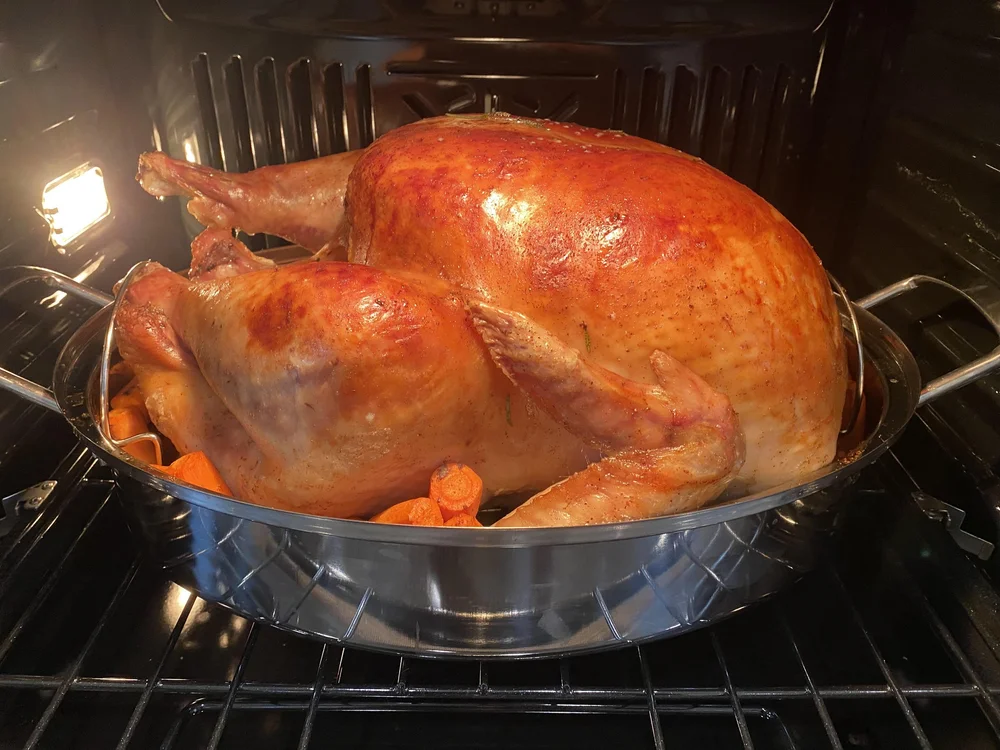
Other than being cute and slaying invasive pests, do mantises have other redeeming features for which we should be thankful? Well, since this is Thanksgiving week, let’s thank the mantis for its help with the turkey dinner. Wait what? Common lore has it that Pilgrams and the indigenous Wampanoag people started the tradition of eating turkey on Thanksgiving, but this may not be quite right. According to Britannica, it is more likely that ducks and geese were consumed at the momentous feast in 1621.

Carolina mantises aren’t the only ones that like to eat brown marmorated stink bugs. Watch as a Chinese mantis feasts on a stink bug and then does a little grooming at the end of the meal.

The tradition of eating turkeys and celebrating Thanksgiving came much later in the 1800’s. In 1863 President Lincoln proclaimed Thanksgiving to be a national holiday. And that delicious moist turkey that many of us eat on Thanksgiving was likely raised on a farm where it consumed a diet primarily of corn, soybean meal, and fat. However, in the wild, turkeys eat seeds, vegetation, and arthropods. The diet of young turkeys (called poults) is comprised of many kinds of arthropods like grasshoppers, crickets, and I’m guessing mantises. So, on this Thanksgiving, let’s give thanks to mantises for eating stink bugs and other invasive insects and for providing high protein food for the wild turkeys that flourish in our land.

Bug of the Week wishes you a bountiful and pleasant Thanksgiving!
Acknowledgements

The interesting article “Feeding Ecology of Merriam's Turkeys (Meleagris gallopavo merriami) in the Black Hills, South Dakota” by Mark A. Rumble,  “US Poultry Industry Manual - turkey feeding and nutrition”  and “Why Do We Eat Turkey on Thanksgiving?” by John M. Cunningham, Britannica, were consulted for this episode.

Monday, 16 November 2026

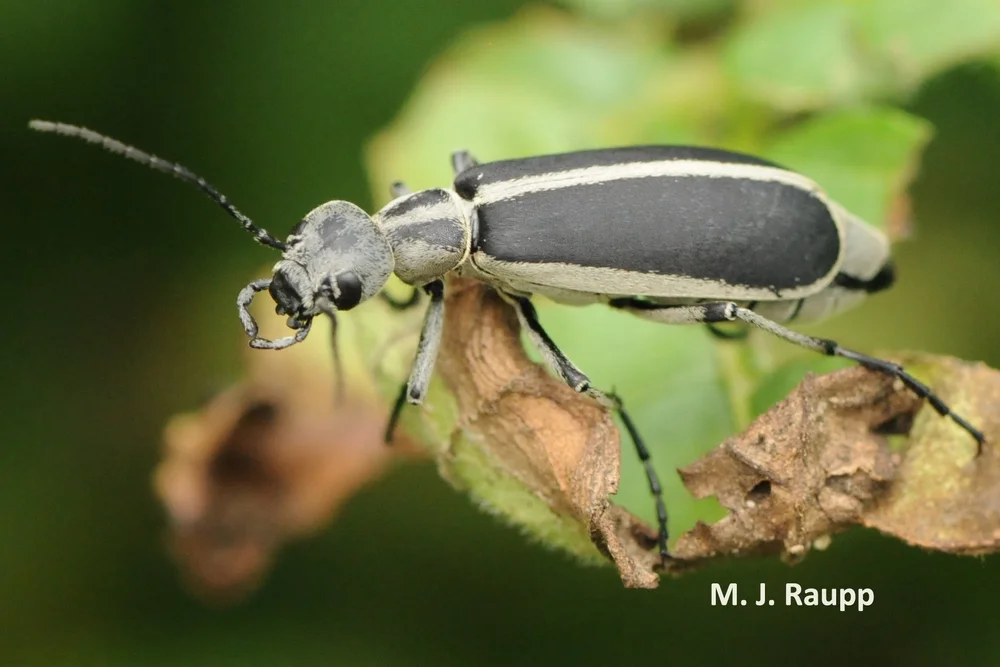
WARNING: black and margined blister beetles, Epicauta pensylvanica and Epicauta funebris, do not touch or eat

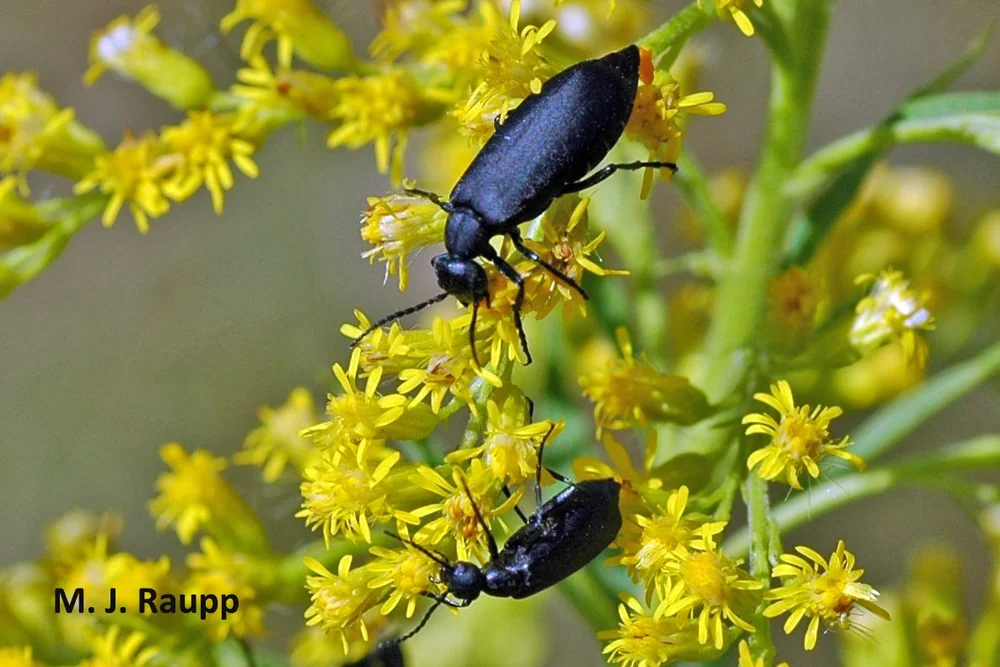
Black blister beetles often appear in clusters dining on goldenrods late in summer and autumn.

A few weeks ago, as meadows in the DMV finished their spectacular floral displays, members of the aster family put on their finest performances. Goldenrod is one of the richest late-season sources of nectar and pollen for dozens of insects. A walk on the wild side revealed bevies of black blister beetles, Epicauta pensylvanica, cavorting on brilliant goldenrod amongst the bees and flies. These lovely beetles are not to be taken lightly. If handled roughly, crushed against your skin, or worse yet consumed, blister beetles release blood laced with potent irritants called cantharidin. Cantharidin, a ten carbon, three ringed compound, is classified as extremely hazardous. Upon contacting skin, cantharidin can raise nasty looking blisters.

Margined blister beetles, like their cousins black blister beetles, contain noxious cantharidin and should not be handled and certainly not eaten.

Blister beetles are also the source of the medicinal compound called Spanish fly. The term Spanish fly refers to a particularly beautiful European species of blister beetle, Lytta vesicatoria, from which cantharidin is extracted. Much lore surrounds cantharidin as potions of love, healing, and death. Spanish fly was used as a medicinal in America’s revolutionary era. The father of our nation, George Washington, had a most disagreeable encounter with the Spanish fly. After taking ill, President Washington was near death on December 14, 1799. As was common medical practice at the time, Spanish fly was applied to his neck to draw out inflammation. The Spanish fly therapy and four bloodlettings on the same day proved a bit too much for our ailing founding father and he expired.  

Love potions concocted with Spanish fly are said to be potent aphrodisiacs. One remarkable tale I stumbled across described a gathering hosted by the infamous Marquis de Sade. To liven things up a bit, the Marquis slipped the guests a little Spanish fly on some sweets. Unfortunately, he miscalculated the effective dose and rather than arousing his guests, several were poisoned and became violently ill.

Potato leaves provide a tasty meal for a female margined blister beetle and apparently inspire amorous behavior in a male. After being rebuffed several times by kicks of the female’s leg, perhaps persistence and a few gentle nibbles behind her head will pay off for this hopeful suitor. On the flowerhead of a late blooming wingstem, a margined blister beetle munches fruiting structures of the blossom. But please, don’t handle or eat these beautiful blister beetles.

As seen here, blister beetles forage on plants in meadows and gardens and they have been inadvertently baled in hay and fed to horses and other farm animals. Horses are especially sensitive to cantharidin and consuming beetles can be lethal. As we learned a few weeks ago, wonderful wingstem, Verbesina alternifolia, is a dynamite attractor not only for moths and butterflies, but also for blister beetles including the margined blister beetle, Epicauta funebris. In addition to posing threats to humans and livestock, blister beetles are sometimes important pests of eggplants, potatoes, tomatoes, and beets. If you see blister beetles on plants near your home or in the meadow in the waning days of autumn, resist the urge to handle or eat them unless you desire a blistering experience.

Acknowledgements

Bug of the Week gives a shout out to the Robinson Nature Center for growing goldenrods that provided inspiration for this episode. Interesting insights were provided in “Blister Beetle Management in Alfalfa” by Kevin Rice and “For the love of insects” by Thomas Eisner.


Monday, 9 November 2026

Opilionids, the most dangerous spiders on earth, right?

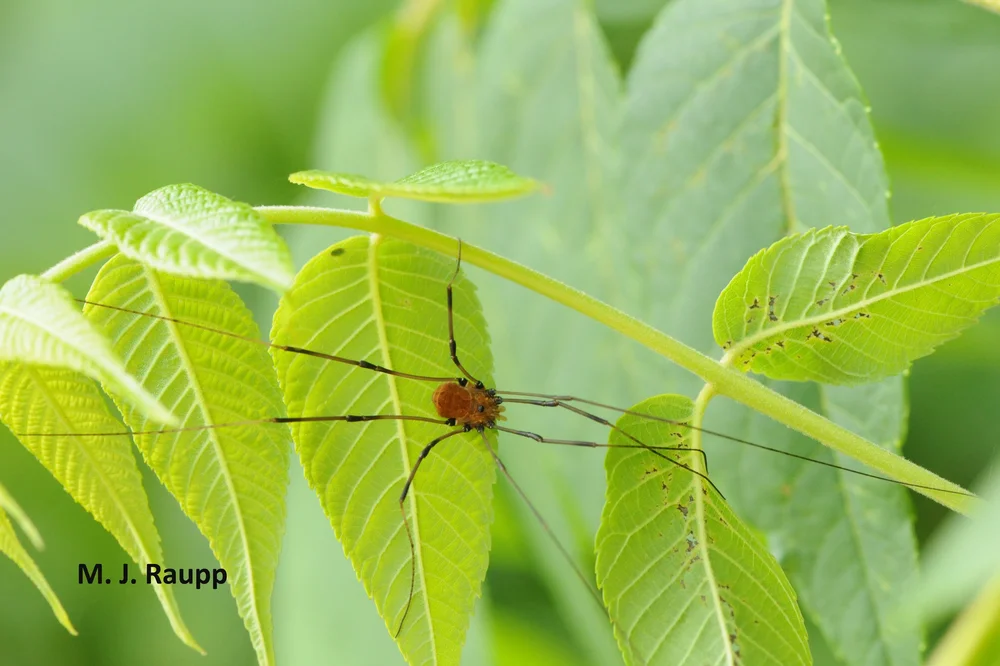
It’s easy to see why opilionids are called daddy-longlegs.

On Halloween eve on a sidewalk outside my home, I spotted a creepy daddy-longlegs feasting on the remains of a dastardly brown marmorated stink bug. These interesting arthropods are at the heart of the urban legend proclaiming daddy-longlegs as the most venomous of all spiders. A corollary of the legend is that although daddy-longlegs are venomous, their fangs are too tiny to pierce human skin. Like many urban legends this one persists, but fortunately it is baseless. Here’s why.

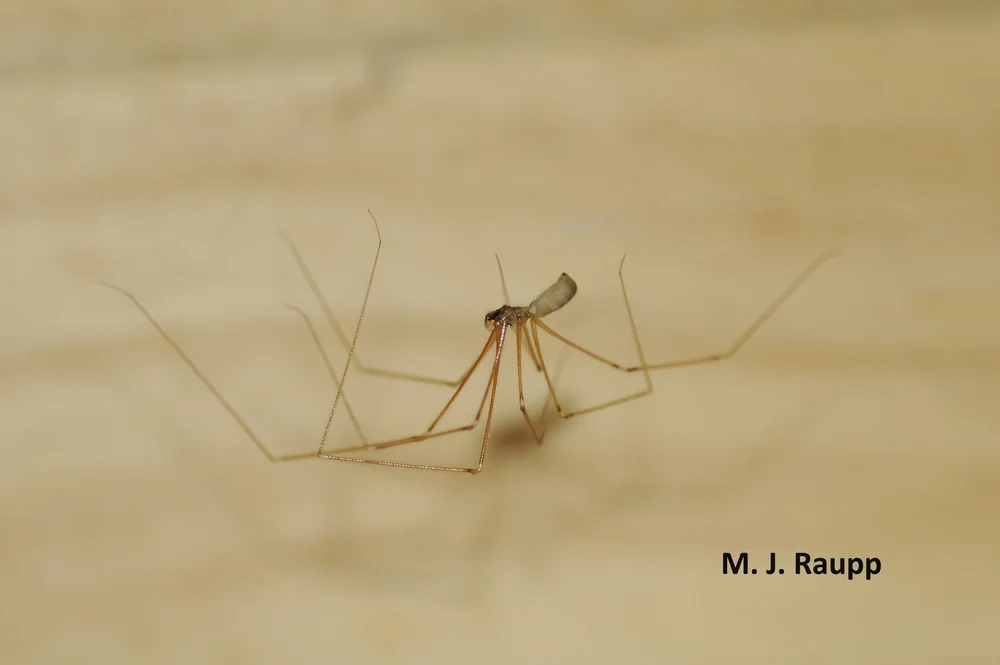
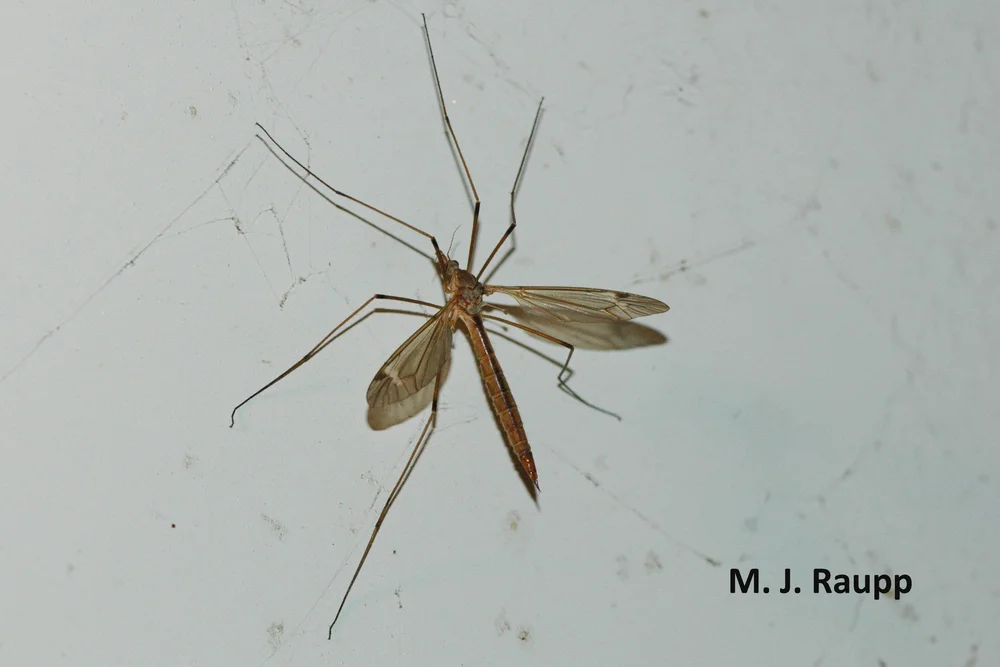
Let’s start with nomenclature. First, daddy-longlegs is a moniker applied to at least three different kinds of arthropods. According to spider expert Dr. Rick Vetter, daddy-longlegs refers to long-legged spiders in the family Pholcidae, to an entirely different arachnid called an opilionid (a.k.a. harvestmen), and to a primitive fly called a crane fly. We met pholcids rocking out in corners of a room in a previous episode. Crane flies are sometimes misidentified as giant mosquitoes and have appeared in Bug of the Week as well. But let’s talk about harvestmen and opilionids.

Pholcid spiders, like this cellar spider, are also known as daddy-longlegs.

The business of harvestmen being dangerously venomous is incorrect on two accounts. First and foremost is the fact that they lack venom glands. No venom glands, no venom. Their arachnid relatives, spiders, including pholcid spiders, subdue prey with potent venom delivered via fangs. Harvestmen lack fangs so the business of tiny fangs is also out the window. Harvestmen feed primarily on decaying vegetation or animals, but they may also be opportunistic predators. I have seen them snacking on hapless cicadas that failed to successfully shed their nymphal skin. Harvestmen are often seen in moist woodlands on vegetation, stumps, or leaf-litter where they search for food and mates. Harvestmen are easily distinguished from their spider relatives. Instead of the two easily seen body regions (cephalothorax and abdomen) characteristic of spiders, the distinction between body segments is indistinct and harvestmen appear to have a single pill-shaped body. If you want to get close enough to look them in the eye, harvestmen have at most two eyes whereas spiders may have as many as eight.

Watch as an opilionid munches on the remains of a brown marmorated stink bug. On the surface of a small rock near a riverbank a handsome opilionid dines on the shriveled body of a stonefly, aquatic insect jerky. This pretty daddy-longlegs enjoys what appears to be the carcass of a small fly or bee. A pair of appendages called pedipalps are used to manipulate its meal.

Despite their lack of fangs and venom, opilionids possess clever tricks to help them avoid being eaten by ground dwelling predators. Specialized glands along the margin of the harvestman release noxious quinones that are mixed with fluids regurgitated from its digestive tract. The harvestman smears the stinky concoction along its margins, forming a chemically deterrent barrier around its perimeter. This chemical defense has been shown to deter ants, spiders, and frogs and to make nosy bug geeks wish they hadn’t messed around with an opilionid.     

With remarkably long legs, some crane flies are also called daddy-longlegs.

To learn more about daddy-longlegs and the venom-myth please visit the following UC Riverside website: https://spiders.ucr.edu/daddy-long-legs  


Acknowledgements

Bug of the Week thanks Larry and his son for sharing their interesting observations of harvestmen and providing inspiration for this episode. “Chemical defense of an opilionid (Acanthopachylus aculeatus)” by Thomas Eisner, Carmen Rossini, Andrés González, and Maria Eisner, and “Chemical defense in harvestmen (arachnida, opiliones): do benzoquinone secretions deter invertebrate and vertebrate predators?” by Glauco Machado, Patricia C. Carrera, Armando M. Pomini, and Anita J. Marsaioli were used as references for this episode.


Monday, 2 November 2026

Happy reunion for Jorō? Jorō spider, Trichonephila clavate, vs spotted lanternflies, Lycorma delicatula, and brown marmorated stink bugs, Halyomorpha halys

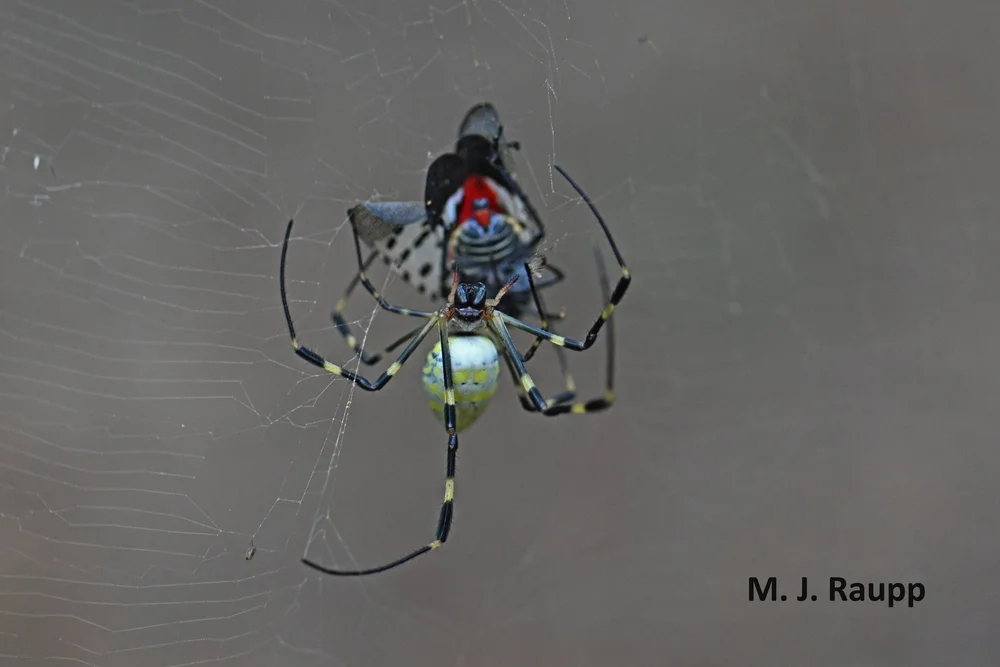
A very pregnant Jorō spider prepares to sink her fangs into a spotted lanternfly.

Earlier this year we caught up with the Jorō spider and learned about its ability to colonize and thrive in many different habitats including busy urban locations. At the time of this writing according to iNaturalist, Jorō now occupies locations in more than a dozen states, and here in the DMV Jorō has been sighted in several locations in Virginia and in Howard, Anne Aurndel, Prince Georges, and Baltimore Counties in Maryland. On a recent visit to what I call ‘the enchanted forest of Jorō spiders’, I was amazed to see how the density of these large spiders in a small woodlot had grown from just a few scattered webs to so many it was hard to walk in the forest without bumping into a web. Subscribers to Bug of the Week will recall that in recent weeks we learned about the fondness of several native spiders like the spotted orb weaver, black and yellow garden spider, and common house spider for dining on spotted lanternflies. Well, given the deluge of spotted lanternflies that have been plaguing the DMV recently and the successful ability of Jorō spiders to establish and thrive in the DMV, it only seemed logical to reunite these two old acquaintances from Asia to see what might happen.

After collecting a jar full of lanternflies from my back porch, I visited the forest of Jorō spiders and gently placed a lanternfly in the sticky spiral threads of the web. Unfortunately, the spider moved swiftly from the center of the web to the thrashing lanternfly before I could start my camera. However, Jorō clearly knew what to do with the lanternfly and proceeded to munch on the lanternfly’s wings with its fangs. In short suspense, the lanternfly was subdued and immobile. In a rare moment of clarity, having recently posted a story about home invasions by brown marmorated stink bugs, I wondered what might happen if this other invader from Asia, the stink bug, was reunited with its former predator, the Jorō. After procuring some stink bugs and finding another Jorō that looked hungry, I placed the stink bug in the web. As before, when entangled in the web of the Jorō, vibrations of the web by the stink bug quickly drew the spider to its hapless victim which was fanged and subdued in short order.  After capturing her prey, the spider clipped some threads and retreated to the center of her web with the stink bug.

Jorō spiders build enormous webs. I visited the forest of Jorō spiders and gently placed a lanternfly in the sticky spiral threads of the web. In a flash, the spider moved from the center of the web to the thrashing lanternfly. Jorō clearly knew what to do with the lanternfly and proceeded to munch on the lanternfly’s wings with its fangs. In short suspense, the lanternfly was subdued and immobile. I wondered what might happen if the brown marmorated stink bug was reunited with Jorō. I placed a stink bug in the web. Once entangled, vibrations of the web by the stink bug quickly drew the spider to its victim. The spider fanged and subdued the stink bug in short order and retreated to the center of her web with her meal. Final score: Jorō 2, invasive pests from Asia 0.

As noted by many scientists, beyond being large and maybe a bit scary, Jorō spiders are unlikely to pose any health threat to people or pets. According to expert Rick Hoebeke, the risks to humans and pets are small due to the puny size of Jorō’s fangs, which are unlikely to pierce our skin. Jorō spider expert Andrew Davis provided these calming words in a recent interview "This spider is not going to harm people, and it’s only going to hurt you if you try to pick it up."  The major remaining concern is how Jorō will impact our current ecosystems. As with all non-native species that arrive in our land, it is difficult to predict what impact they will have on our ecosystems, but experts suggest that beyond their somewhat scary mien they may give our indigenous large orb weavers like the black and yellow garden spider, marbled orb weaver, and spotted orb weaver a run for their money. In locations in other parts of the country where Jorō is established, it often becomes the most abundant and dominant orb weaver. However, rapidly expanding Jorō spiders are on a collision course with two major crop pests, spotted lanternfly and brown marmorated stink bugs. As we have seen here, Jorō certainly knows what to do with these non-native pests. What will Jorō mean for our native spiders and several of our non-native pests with which it shares a historical link at the dinner table? Only time will tell.

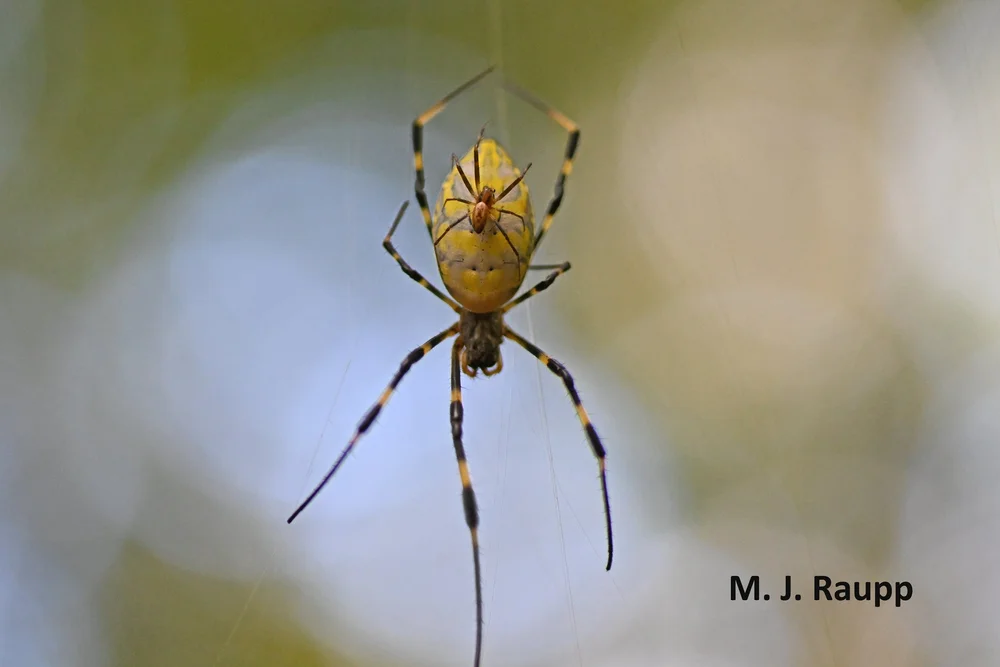
In the world of spiders, males are often much smaller than their mates. See the tiny male Jorō riding on the back of his enormous mate.

Acknowledgements

Bug of the Week thanks Rick Hoebeke for identifying Jorō as it arrived in the US and for providing insights into the ways of these large, beautiful spiders. Fascinating studies entitled “Veni, vidi, vici? Future spread and ecological impacts of a rapidly expanding invasive predator population” by David R. Nelsen, Aaron G. Corbit, Angela Chuang, John F. Deitsch, Michael I. Sitvarin and David R. Coyle,  “Physiological evaluation of newly invasive Jorō spiders (Trichonephila clavata) in the southeastern USA compared to their naturalized cousin, Trichonephila clavipes” by Andrew K. Davis and Benjamin L. Frick, “Nephila clavata L Koch, the Jorō Spider of East Asia, newly recorded from North America (Araneae: Nephilidae)” by E. Richard Hoebeke, Wesley Huffmaster, and Byron J Freeman, “The Life Cycle, Habitat and Variation in Selected Web Parameters in the Spider, Nephila clavipes Koch (Araneidae)” by Clovis W. Moore, “Startle responses of jorō spiders (Trichonephila clavata) to artificial disturbance’ by Andrew K. Davis and A. Anerao, and “How Urban-Tolerant Are They? Testing Prey–Capture Behavior of Introduced Jorō Spiders (Trichonephila clavata) Next to Busy Roads” by Andrew K. Davis, Kade Stewart, Caitlin Phelan and Alexa Schultz, were used in writing this episode. Inspiration for this episode came from Director Ron Harris (with Westside Films) and Executive Producer Zoë Barracano.

To see other large orb weavers and differentiate them from the Jorō spider, please click on this link: https://resources.ipmcenters.org/view/resource.cfm?rid=27877

To hear more about the Jorō spider and calm your fears about it, please click on this link to watch Jorō guru David Coyle’s take on this spider:  https://youtu.be/zhO_bwwg-E4?si=nhd9au-t-HRCmw6b