Monday, 26 October 2026

Butterflies and moths in orange and black love wingstem, Verbesina alternifolia: Ailanthus webworm moth, yellow-collared scape moth, pearl crescent butterfly, and Monarch butterfly

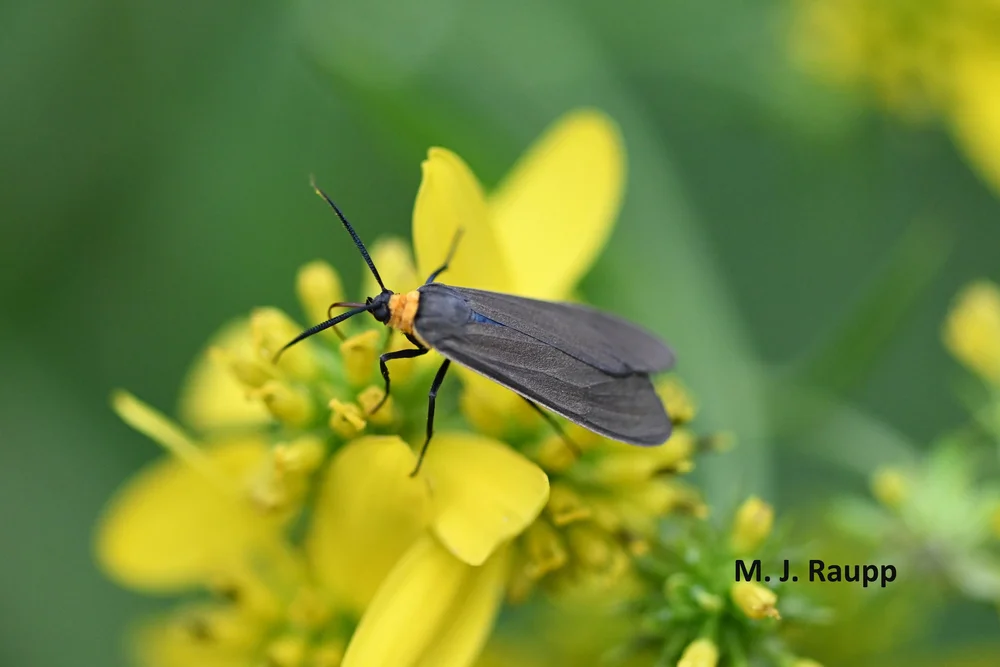
The pretty, yellow-collared scape moth is just one of many moths and butterflies dressed in Halloween colors of orange and black that visit nectar-rich wingstem.

This week we return to the tradition of visiting beautiful and fascinating insects bedecked in the Halloween colors of orange and black. The origins of Halloween began in the time of ancient Celts when summer ended and the time of harvest gave way to approaching winter. The start of the Celtic New Year on November 1 was a scary time, as spirits of the dead returned to earth on the eve of October 31 to visit family and engage in frightening tricks. Orange and black became the colors of Halloween, orange representing the color of harvest and later the Jack O’ Lantern, and black symbolizing the color of death. This week we meet butterflies and moths that advertise their potential lethality by displaying bright colors of orange and black like beautiful milkweed tiger moths and monarch butterflies we met in previous episodes.

To meet some of these beauties we visit a native herbaceous perennial, wingstem, Verbesina alternifolia, one of the most dependable attractors of pollinators. Since early August here in the DMV, wingstem has been busy providing nectar and pollen to a dazzling array of bees, wasps, beetles, butterflies, and moths. So, this week of Halloween, let’s briefly visit four showy Lepidoptera dressed in orange and black who make regular appearances on wingstem.
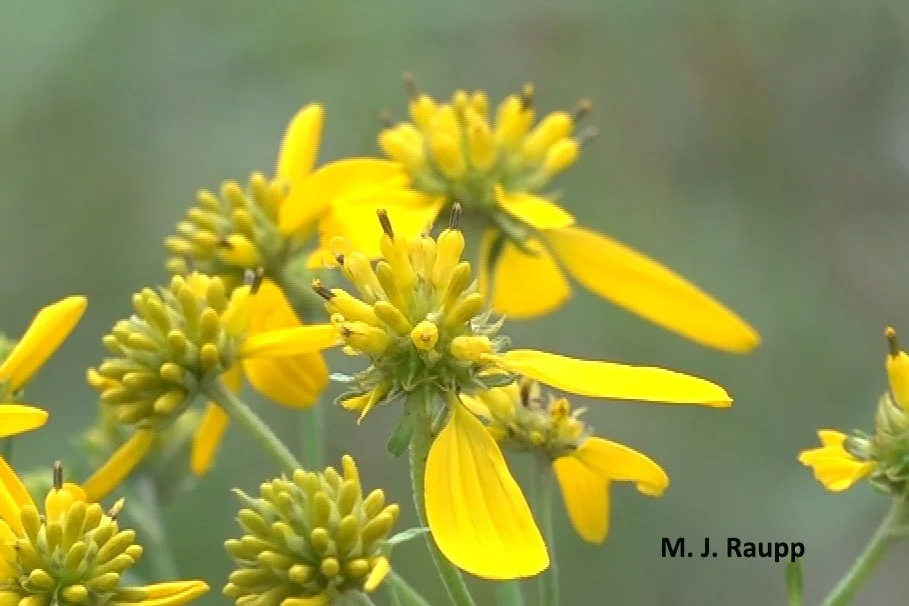
Wingstem, a beautiful native member of the aster family, is a dazzling attractor to an array of bees, wasps, beetles, butterflies, and moths during late summer and autumn.

The Ailanthus webworm moth dresses in a spectacular robe of white, orange, and black. Its brilliant contrasting colors are believed to advertise its distastefulness to predators by virtue of its ability to sequester noxious compounds from Ailanthus foliage consumed when it was a caterpillar. Unlike many nocturnal moths, Atteva aurea is a daytime visitor to wingstem. The female lays eggs in clusters on the leaves of the invasive Tree of Heaven, Ailanthus altissima. Caterpillars known as ailanthus webworms hatch from the eggs and build a communal web, from which they forage on the leaves. Small trees may be almost completely enshrouded by the nests of the webworm, and they may sustain almost complete defoliation. So efficient are the caterpillars at munching leaves of Ailanthus that some consider them a biological control agent for the invasive Tree of Heaven.
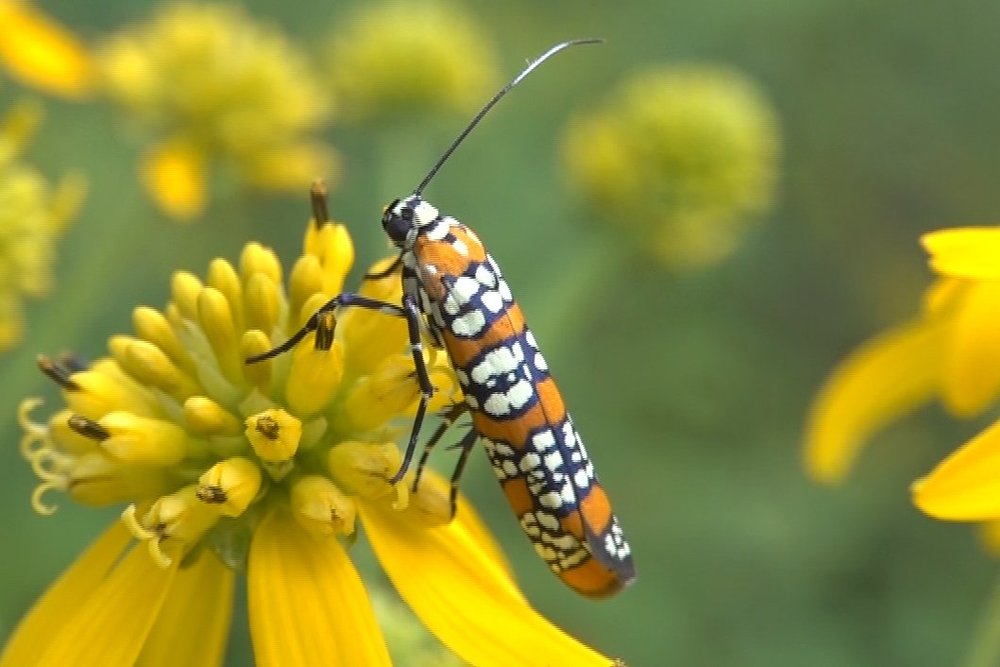
Ailanthus webworm moths wear colors of orange and black to warn predators that they might not be a happy meal.

Another bold visitor to wingstem is the beautiful yellow-collared scape moth. This member of the tiger moth clan is a common visitor to gardens and meadows in late summer and autumn. Dressed in classic black with a bright orange or yellow collar, this moth may be seen feeding during the day, as well as after sunset. Scientists suggest that the scape moth’s warning coloration may be related to the presence of noxious alkaloids obtained from members of the aster family on which moths feed. The yellow-collared scape moth lays her eggs on grasses and sedges. The rarely seen scape moth caterpillars feed at night.

Just in time for Halloween, let’s visit some gorgeous moths and butterflies dressed in orange and black as they visit one of the premier native pollinator plants - wingstem. First up is the Ailanthus webworm moth. As the name implies, caterpillars of this beauty eat leaves of invasive Tree of Heaven. Our next visitor, the yellow- collared scape moth is a daytime feeder whose larvae eat leaves of sedges and grasses. The beautiful pearl crescent butterfly is a huge fan of wingstem and her caterpillar offspring dine on asters. Before beginning her long journey to the overwintering forests of Mexico, this pretty monarch butterfly tanked-up on wingstem in my meadow. Hope her trip is filled with treats and no tricks.    

Another beauty in orange and black is the delightful pearl crescent, Phyciodes tharos. These small, active members of the brush footed butterfly clan may have as many as three generations in Maryland and up to six generations in Georgia and Florida. Adult pearl crescents feed on the nectar of a wide variety of plants including milkweed, dogbane, and Black-eyed Susan, as well as other members of the aster family in addition to wingstem. However, when it comes to food for her young, the female pearl crescent favors asters above all, where she deposits up to 700 eggs over the course of her lifetime. In temperate states like Maryland, hardy pearl crescent caterpillars brave the winter in a hibernation-like state called diapause and complete their development in spring when warm weather and succulent leaves return.
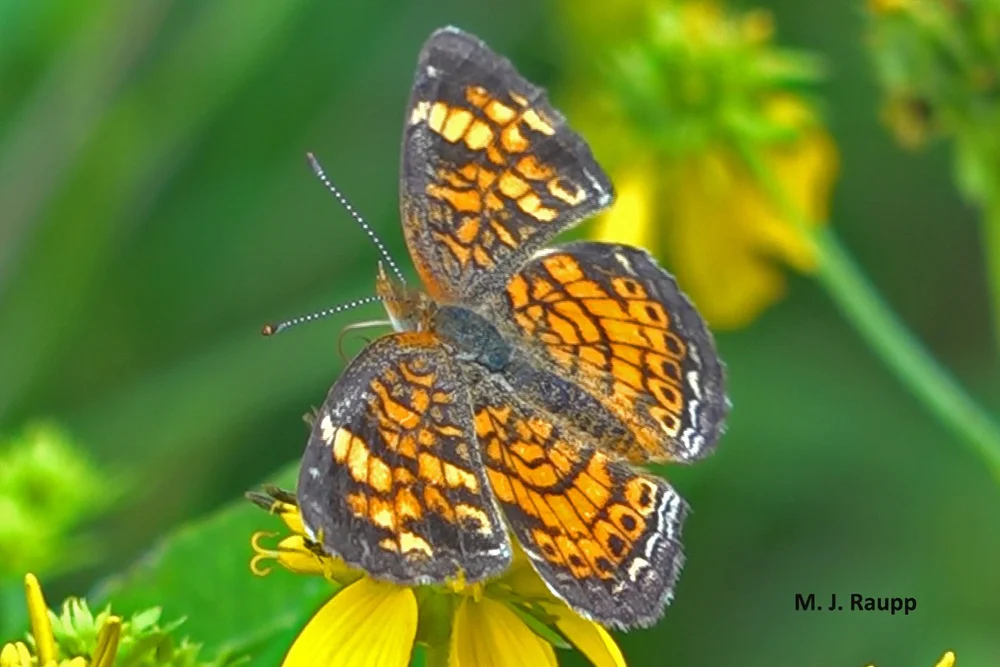
Pearl crescent butterflies are regular visitors to wingstem.

Finally, our friend the monarch butterfly stopped by to tank-up on the carbohydrate rich nectar of wingstem before beginning its long journey to the overwintering forests in Mexico.  
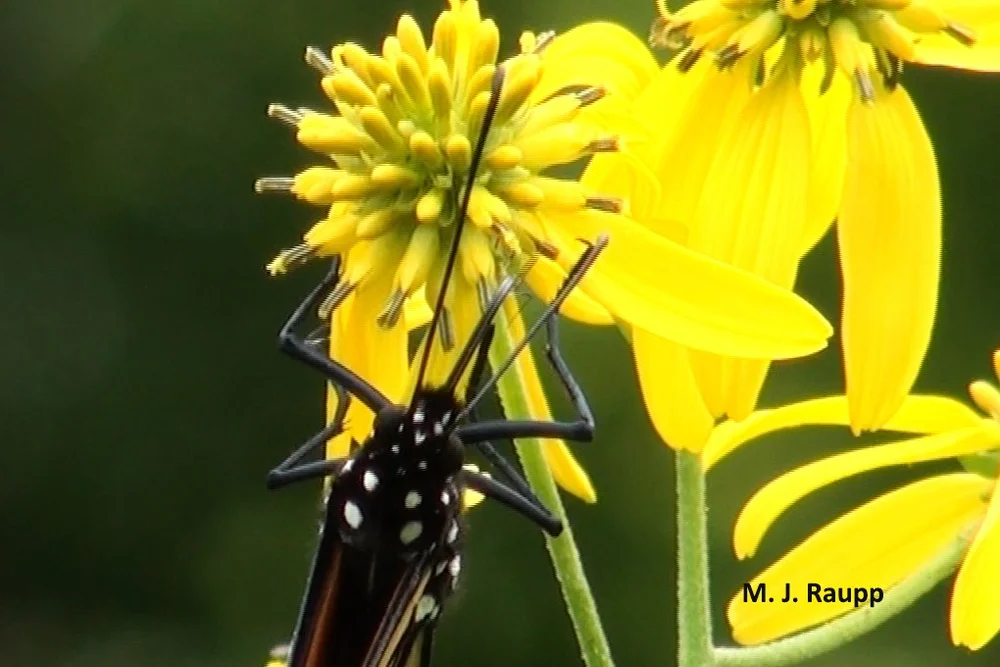
This monarch butterfly stopped to tank-up on wingstem nectar before heading south for the winter.

Acknowledgements

Interesting references used for this Bug of the Week include “Ecology of the center city, Philadelphia” by K. D. Frank, “The Insects: An outline of entomology” by P.J. Gullan and P.S. Cranston, “Assessing potential biological control of the invasive plant, tree-of-heaven, Ailanthus altissima” by J. Ding, Y. Wu, H. Zheung, W. Fu, R. Reardon, and M. Liu, “Sound strategy: acoustic aposematism in the bat–tiger moth arms race” by  Nickolay I. Hristov and William E. Conner, and “Secret weapons” by Thomas Eisner, Maria Eisner, and Melody Siegler were used in preparation of this story.

Bug of the Week wishes all of you a happy, fun, and safe Halloween!


Monday, 19 October 2026

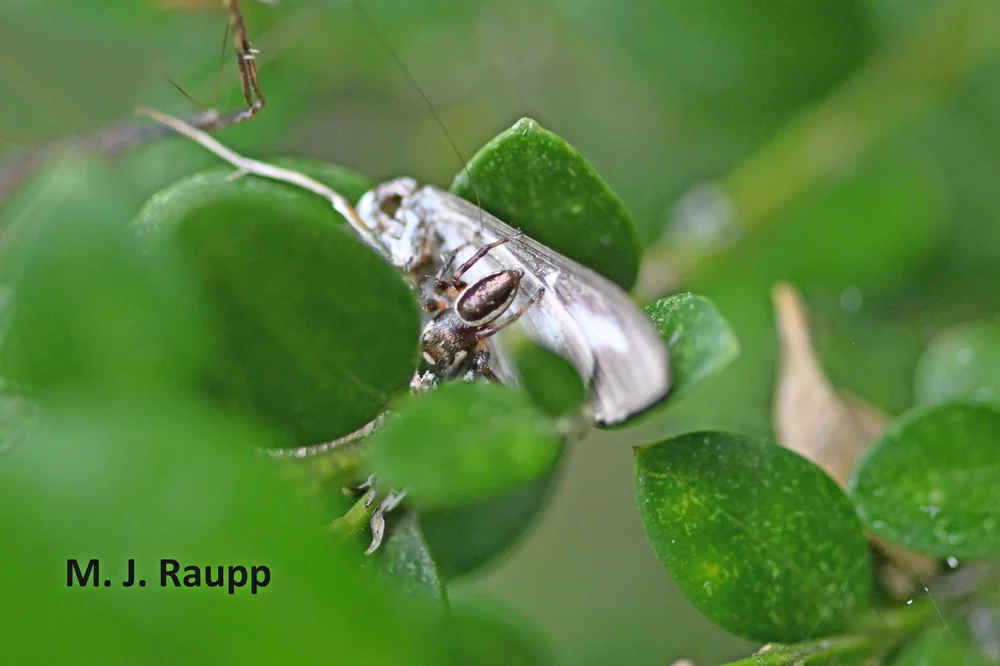
Attack of the bronze jumping spider, Eris militaris, on box tree moth, Cydalima perspectalis. But spider beware of a thread-legged assassin bug, Emesaya brevipennis

Like many invaders from afar, the box tree moth is subject to attack by native predators in the invaded realm including the DMV. Here you see a bronze jumping spider feeding on a hapless box tree moth.

In last week’s episode, we caught up with the fast-moving box tree moth (BTM) as it spread its path of destruction to historic boxwoods in the DMV. While observing and photographing BTM at an antebellum mansion in western Maryland, I discovered an adult BTM laying motionless on a branchlet of boxwood. Upon closer inspection, I discovered a handsome bronze jumping spider nestled in the leaves consuming the soft tissues of the moribund moth. This beautiful jumping spider belongs to the family called Salticidae. The Latin root for this clever clan of spiders is saltare which means “to jump.”  These hunting spiders do not build orb webs like black and yellow garden spiders and spotted orb weavers we met in previous episodes. Instead, using exceptionally large forward-facing eyes, they react strongly to visual cues, stalk their prey, and with catlike speed pounce upon their victim and immobilize it with powerful fangs. Compound eyes and fangs are often striking iridescent shades of metallic greens and blues.

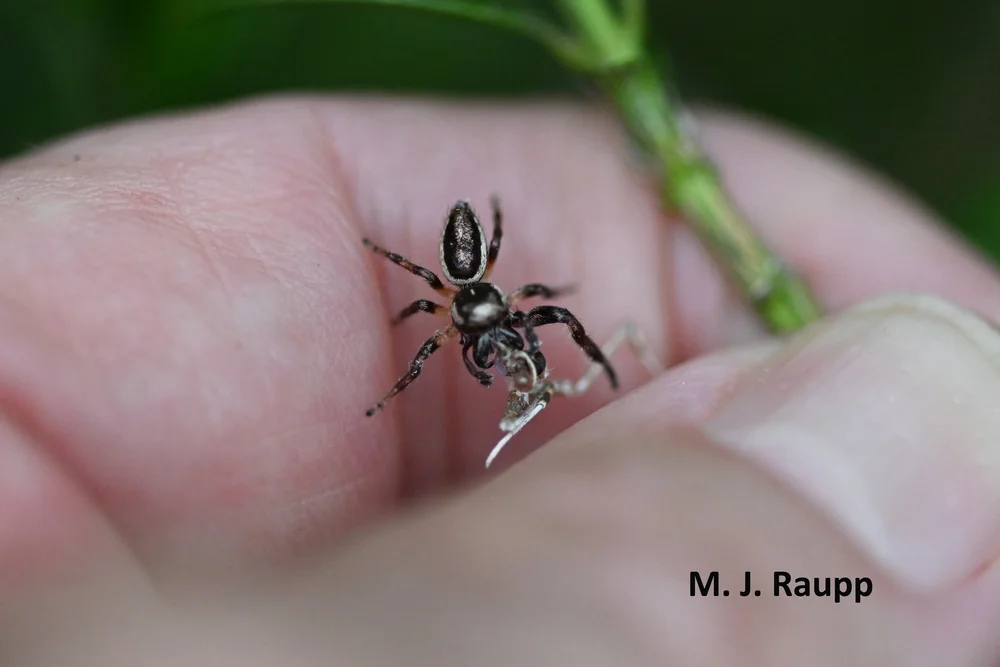
After its box tree moth snack was disturbed by a bug geek, this charming bronze jumping spider clambered onto my hand with parts of the moth still clinging to its fangs.

This act of predation against BTM was encouraging until a stealthy assassin appeared on the scene. Check out the video. Lurking near the jumping spider and its prey was a thread-legged assassin bug named Emesaya  brevipennis. This rascal might pose a threat to the beneficial jumping spider. Scarce accounts of the behavior and ecology of this assassin bug suggest that Emesaya may consume the victims of spiders or attack and eat spiders. Look out jumping spider! Thread-legged assassin bugs have also been reported to eat small flies and each other.   

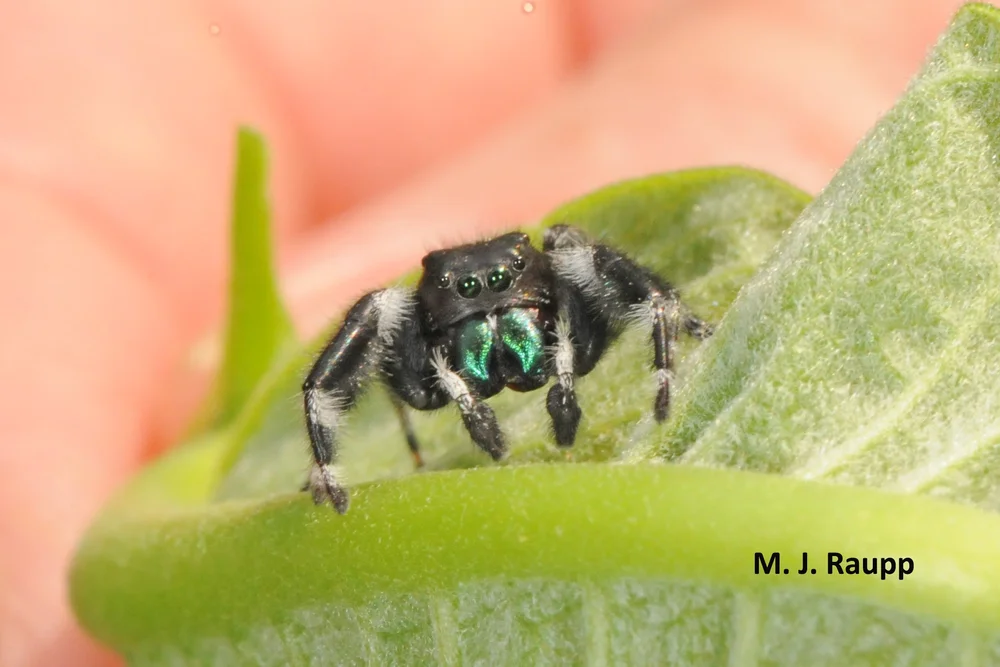
Recently, I happened to catch a glimpse of a handsome bronze jumping spider feasting on the belly of a box tree moth. What I didn’t expect to see was a sneaky thread-legged assassin bug lurky nearby. You can see it at the left of the screen.  This slender assassin bug could spell trouble for our helpful spider. Scientists have reported this assassin to rob spiders of their prey or worse yet, directly attack and kill spiders. After I shooed the assassin bug away, the jumping spider glammed for the camera showing off its amazing iridescent emerald eyes. Looks like Mother Nature’s team of beneficial predators is starting to put a beatdown on this new invader to North America.  

Is this act of predation good news for the dastardly BTM? You bet, but this is not entirely surprising. As we have seen, indigenous natural enemies, predators, parasitoids, and pathogens often rise-up to help put beatdowns on invaders like brown marmorated stink bugs and spotted lanternflies when these invaders arrive in the US. In a previous episode we traced the invasive history of BTM, first of Europe and now of North America. Recent studies of the BTM in invaded European countries including France and Romania found their native predators, including spiders, beetles, true bugs (Hemiptera), and birds, waging war on BTM. Several species of parasitic flies and wasps also attack and kill BTM eggs and caterpillars. Pathogens also take their toll on BTM in Europe and Asia with many bacteria and fungi infecting and killing BTM.  Let’s hope that Mother Nature quickly summons her team of beneficial predators, parasitoids, and parasites to help hold BTM at bay.   

Jumping spiders have enormous eyes and fangs that are often iridescent colors of green or blue like the fangs of this handsome bold jumping spider.

  Acknowledgements

These interesting articles were used to prepare this episode of Bug of the Week: “Observations on the Life History and Behavior of the Thread-Legged Bug Emesaya brevipennis (Say), (Hemiptera: Ploiariidae) L.” by Harley P. Brown and David W. Lollis, “Research for native parasites and predators of the box tree moth Cydalima perspectalis , in natural boxwood forest in France” by Emeline Morel, Mathilde Capelli, Marinede Bodard, Etty Colombel, Thomas Michel, and  Elisabeth Tabone, and “Zoophagous entomofauna and entomopathogenic agents reported on Cydalima perspectalis (Walker, 1859) in north-eastern of Romania” by Ionuţ B. Hulujan, Teodora Florian, Vasile C. Florian, and Ion Oltean.


Monday, 12 October 2026

Catching up with a fast-moving pest in the DMV and Eastern United States: Box tree moth, Cydalima perspectalis

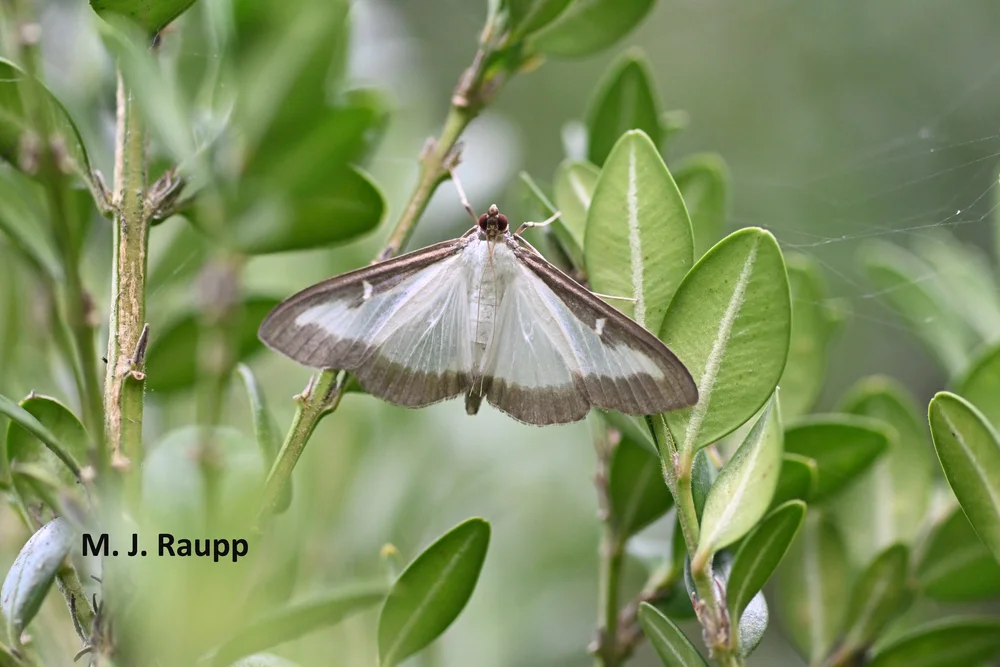
At the time of this post, adult box tree moths are on the wing in the DMV depositing eggs on leaves of boxwoods.

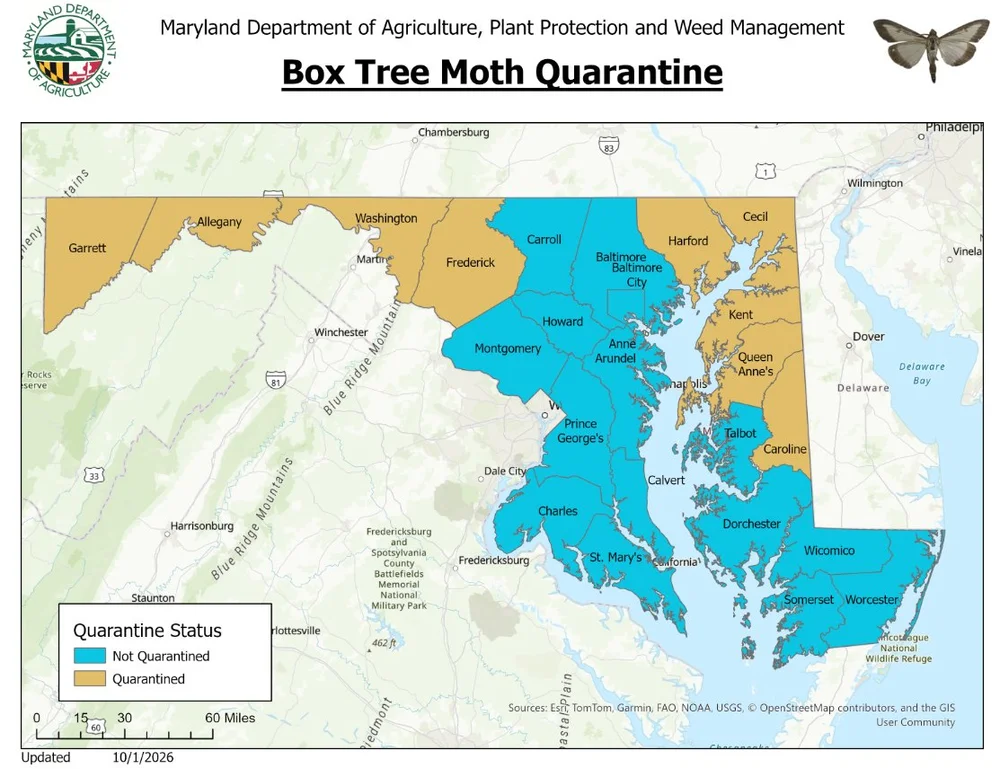
In August last year, we reported the discovery of a new invasive pest called the box tree moth (BTM) in Fort Frederick, Maryland, just across the Potomac River from West Virginia. From this first detection in Washington County last year, BTM has now been found in six counties: Washington, Caroline, Cecil, Kent, and Queen Anne's Counties. In addition to these six counties, three additional counties, Frederick, Garrett, and Allegany have been placed under quarantine orders by the State of Maryland. This pattern is mirrored by the rapid spread of BTM in the Eastern United States. The first US detection of box tree moth was in New York in 2021, and it has now spread to Delaware, Kentucky, Maryland, Massachusetts, Michigan, Ohio, Pennsylvania, Virginia, West Virginia, and New Jersey.

Counties in Maryland under quarantine for box tree moth. Retrieved from Maryland Department of Agriculture September 25, 2026.

Let’s revisit the episode from August 2025 to learn more about this killer of boxwoods.

“From the time of our earliest European colonists, boxwoods have been important components of ornamental landscapes. Boxwoods grace iconic landscapes in the DMV including George Washington’s home at Mount Vernon, the “Box Walk” at  Dumbarton Oaks,  the National Boxwood Collection at the United States National Arboretum, as well as hundreds of public and private gardens and landscapes in our region. However, boxwoods are one of the most problem-prone plants in our landscapes. Already beset by exotic pests including leafminers, spider mites, and pathogens such as boxwood blight, boxwoods in the DMV and throughout our country now face a new, lethal non-native invader, the box tree moth. Like many of our new invaders, box tree moth is native to Asia and is found in China, Japan, and Korea. Probably due to the movement of ornamental plants, it entered Europe and was first discovered in Germany in 2007. It now occupies more than 30 Eurasian countries. It jumped across the Atlantic to Canada, where it was detected in 2018, and arrived in the United States with shipments of nursery plants from Canada in 2020 and 2021. Prior to July 2025 it spread to Delaware, Massachusetts, Michigan, Ohio, Pennsylvania, West Virginia, and New York. Yes, the DMV was surrounded and sure enough, it was detected in Clarke and Loudoun Counties in Virginia and three locations in Washington County in Maryland during the latter half of July and early August.

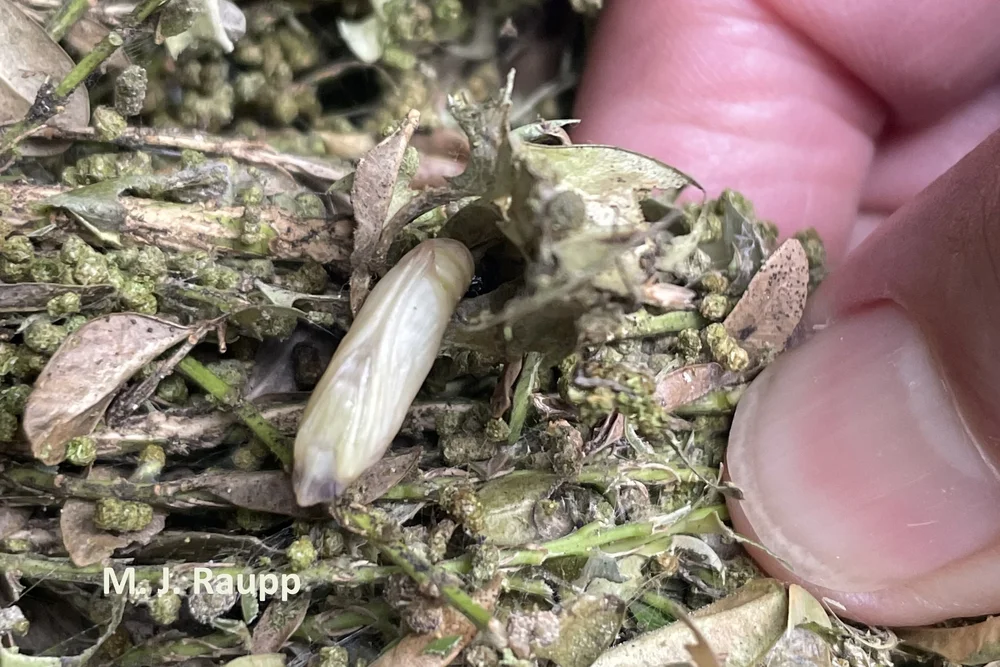
On a recent visit to an antebellum mansion, ancient boxwoods were under attack by box tree moths. Adult moths like this one had recently emerged from ghostlike pupae hidden in the foliage. During summer and early autumn adults lay several batches of translucent eggs in ranks of 5 to 20. Eggs hatch and tiny caterpillars remove patches of tissue from the surface of leaves. Caterpillars that are not yet fully developed will form refuges called hibernacula, in which they survive the winter. In spring, caterpillars resume their carnage defoliating leaves, webbing leaves together, and littering foliage with excrement called frass. Left untreated they can destroy large hedges in a matter of months. Video by M. J. Raupp and Laura Nixon

What’s the worry? If undetected, an infested boxwood can support a rapidly expanding population of leaf-eating caterpillars capable of completely defoliating large boxwoods. In addition, they create large silken webs littered with frass that accumulates on plants and surfaces below.

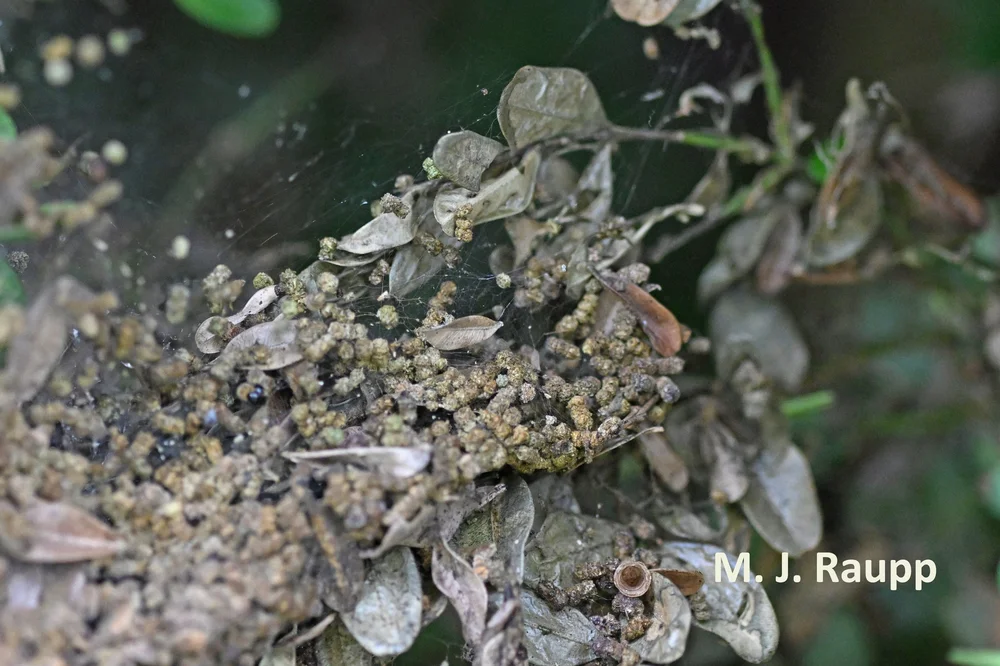
Accumulations of frass on boxwood leaves and the ground beneath the plants is a sign that your boxwood may be infested with box tree moth caterpillars.

Left unchecked, box tree moths can destroy a mature boxwood hedge in a matter of months. Image credit: Jeff Semler, UME

How is this possible? Adult boxwood tree moths lay multiple clutches of 5 to 20 eggs. Larvae that hatch from the eggs are voracious herbivores that first remove green leaf tissue as youngsters and later consume entire leaves. And if this was not bad enough, after leaves are consumed, they feed on woody tissues, thereby girdling stems and branches, and hastening boxwood death. One generation of this carnage is bad enough, but box tree moth will have many generations in the DMV. In other locations, as many as 4 or 5  generations may occur annually depending on temperature regimes.

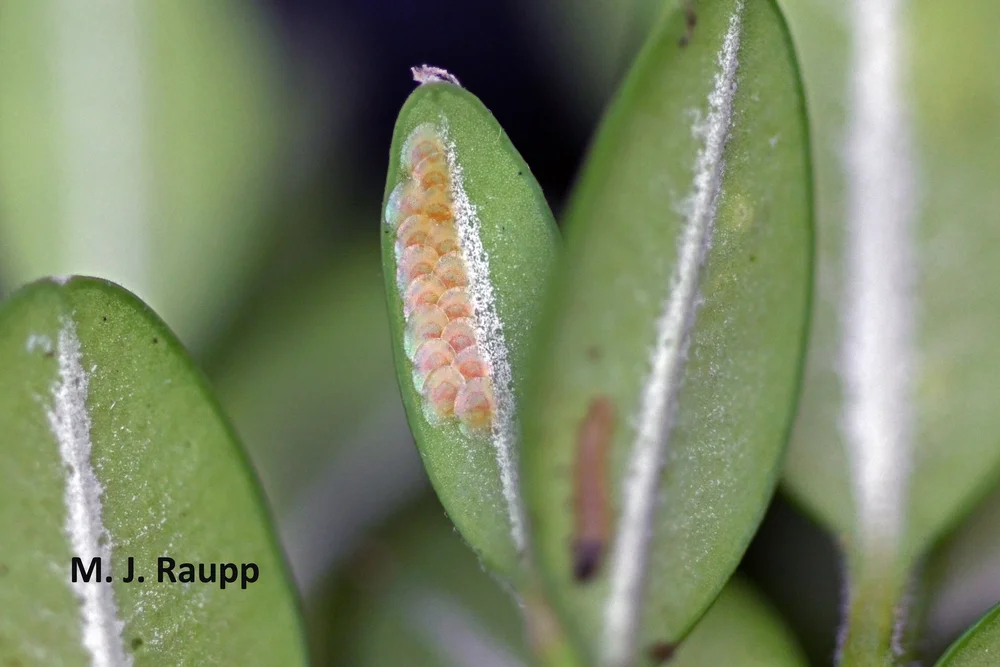
Eggs of box tree moth are pale yellow, translucent, and deposited in ranks of five to twenty on boxwood leaves.

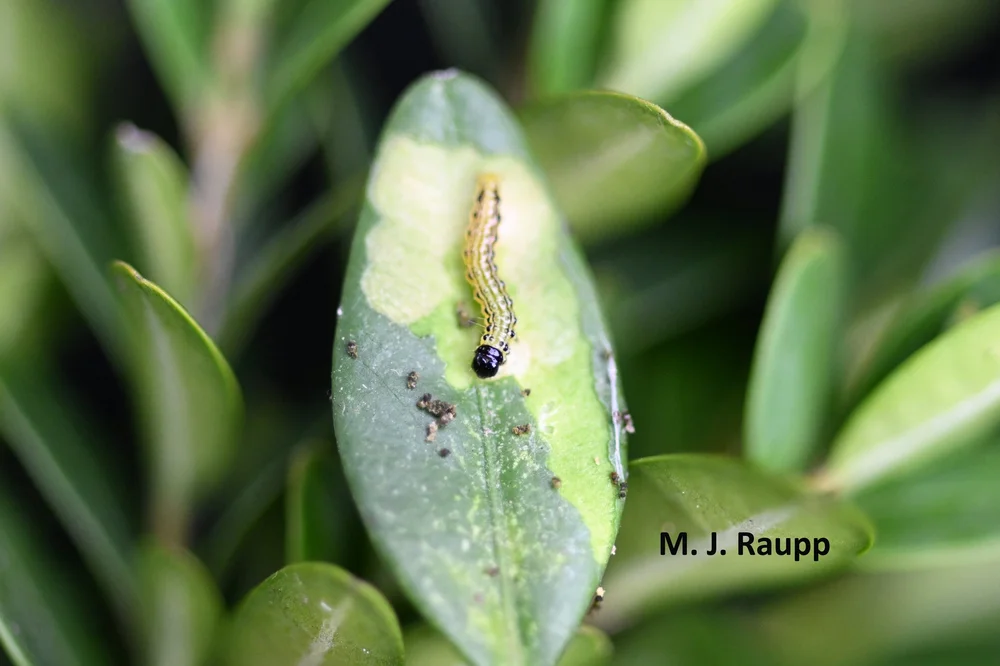
What should you look for? Discoloration, a change in the color of leaves from vibrant green to dull brown or gray, and defoliation, the loss of parts or entire leaves, are often the first and most easily recognizable clues that your boxwoods may be infested with box tree moth. Since no native moth or butterfly has caterpillars that readily eat leaves of boxwoods, the presence of large numbers of strikingly colored black, green, and yellow striped caterpillars with black heads is a dead giveaway for the presence of box tree moths. However, several other arthropod pests and diseases can cause discoloration, defoliation, and dieback on boxwoods. Fortunately, Joe Boggs of The Ohio State University has compiled a wonderful pictorial guide to diagnosing boxwood pests and diseases including symptoms and signs of box tree moth.

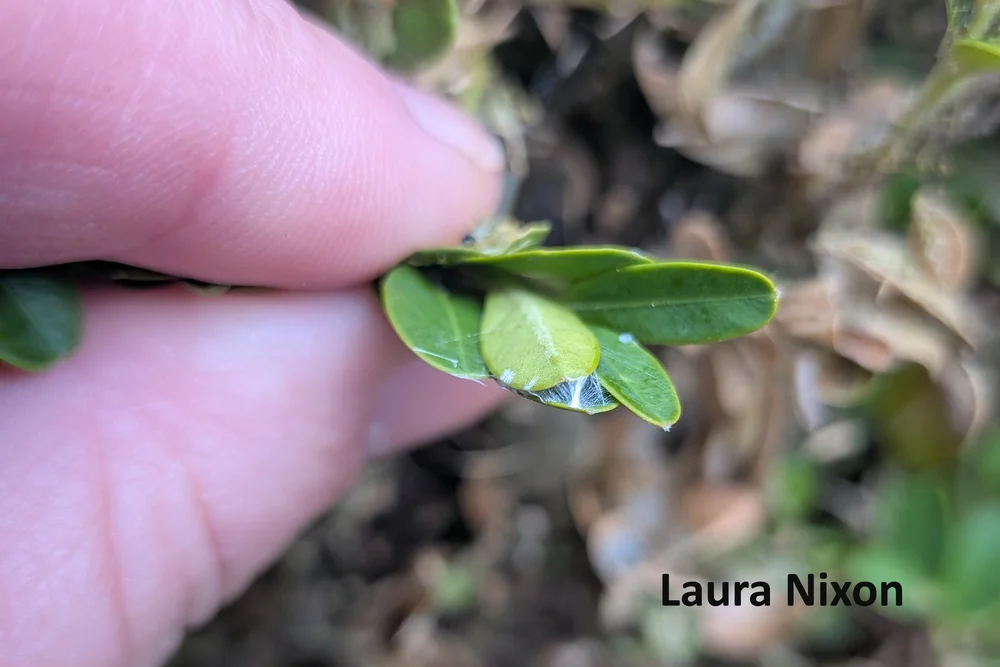
Newly hatched caterpillars of box tree moth create tiny white patches on boxwood leaves as they remove leaf tissues.

The final annual generation of adult box tree moths emerged from ethereal pupae hidden in the foliage of boxwood leaves in late summer here in the DMV.

What should you do if you find box tree moth in Maryland? The Maryland Department of Agriculture is presently engaged in a program to limit the spread of box tree moth. If you suspect you have this pest, the Department of Agriculture recommends the following:

·         If you suspect your boxwoods may be infested with the box tree moth, please contact via email the Plant Protection and Weed Management program at ppwm.mda@maryland.gov. Please attach a picture in your email.

·         Allow Maryland or Federal agricultural officials to inspect your boxwood plants and place detection traps.

·         Any infested material should be doubled bagged in plastic bags and placed in the trash.

·         Nursery owners should monitor their boxwoods and implement safeguards to limit pest risk. All licensed nurseries should report BTM detections to the Maryland Dept of Agriculture Nursery Inspection Program or reach out to their nursery inspector.

Moving forward, what might the future hold for the box tree moth and us? Unfortunately, like emerald ash borers, brown marmorated stink bugs, spotted lanternflies and many other non-native pests of our landscape plants, the box tree moth is likely here to stay. However, Mother Nature in cooperation with humans often has a solution for these invaders. Indigenous natural enemies, predators, parasitoids, and pathogens often rally and put a beat-down on these non-native pests. Clever scientists search and discover natural enemies from afar and after exhaustive evaluation release them to reduce populations of invaders here in the US. Researchers develop chemicals to detect, attract, trap, and kill non-native pests. Even today several insecticides are available to kill caterpillars. Some of these contain active ingredients like Bacillus thuringiensis, a.k.a. BT, and spinosad which are dynamite for controlling caterpillars but safe enough to be used in organic food production. If you want to learn more about insecticides that can be used to manage box tree moth caterpillars, click on this link. With diligence, ingenuity, good science, and help from Mother Nature, we will find ways to manage this new noxious invader.”  

In fall, caterpillars not yet fully developed form refuges in leaves called hibernacula to survive winter’s chill. Image credit: Laura Nixon

Acknowledgements

We thank Jeff Semler and Paula Shrewsbury for providing images and Laura Nixon for deep insights into box tree moth here in the DMV. “The fast invasion of Europe by the box tree moth: an additional example coupling multiple introduction events, bridgehead effects and admixture events” by Audrey Bras, Eric Lombaert, Marc Kenis, Hongmei Li, Alexis Bernard, Jérôme Rousselet, Alain Roques, and Marie‑Anne Auger‑Rozenberg was used as a reference for this episode. The inspiration for this episode came from Phyllis and Rod, who allowed us to photograph their boxwoods and caterpillars. Please visit Box Tree Moth by Madeline Potter, UMD Extension, to learn more about this pest and to find additional sources of information.


Monday, 5 October 2026

The emperor’s surprising fondness for sweet and salty delights: Hackberry emperor, Asterocampa celtis

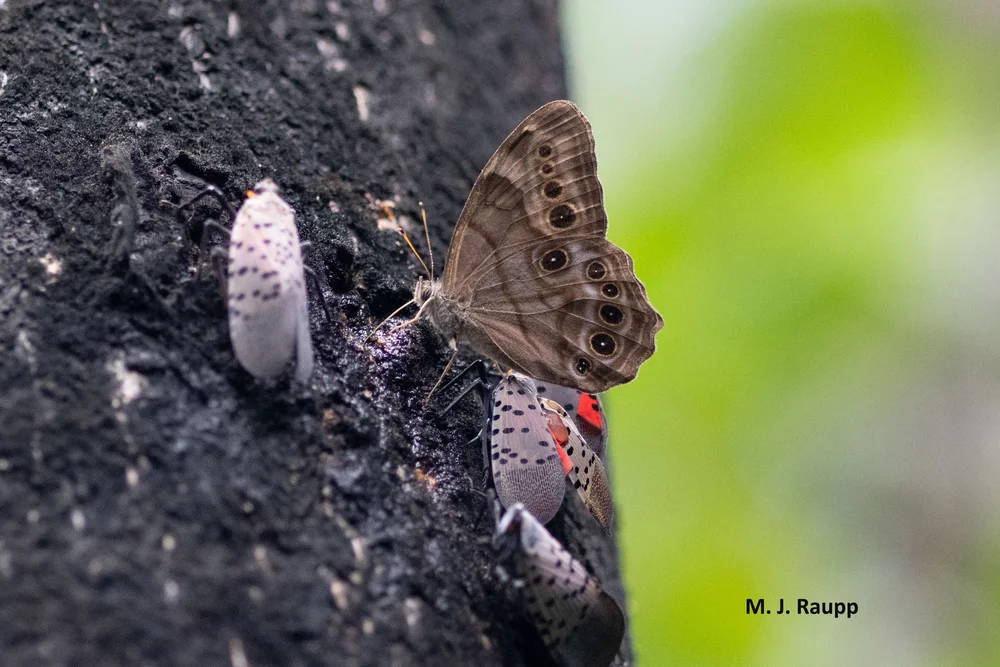
On the sooty mold-blackened trunk of a Tree of Heaven, an emperor butterfly sips sugary honeydew excreted by a band of sap-feeding spotted lanternflies.

As the name implies, the frisky hackberry emperor butterfly is a North American native whose larvae feed on wonderful native hardwood trees called hackberries. On a recent foray to visit invasive Tree of Heaven and dastardly spotted lanternflies, I was entertained by lovely hackberry butterflies who shared their secrets for collecting vital nutrients from two unlikely sources.  These two nutrients are sugar and salt.

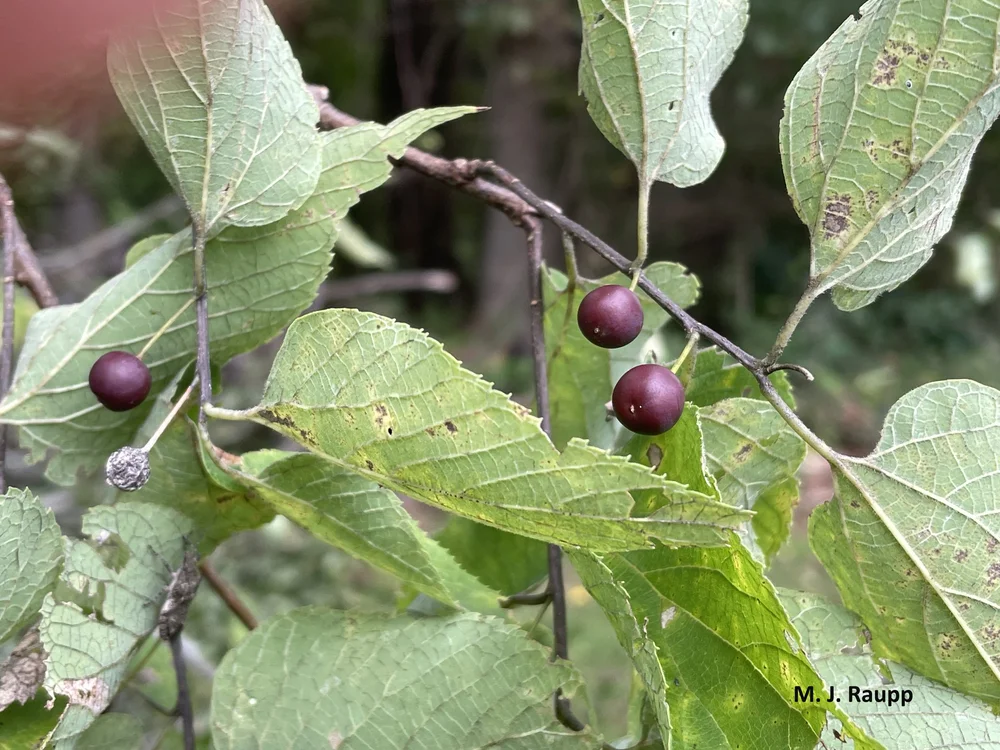
Hackberry leaves are the source of food for larvae of the hackberry butterfly. Tree lore has it that hackberry is a corruption of hagberry, a name given by European colonists to the American Celtis tree due to the resemblance of the hackberry fruit to the fruit of the European cherry tree, Prunus padus.

Let’s think about sugar for a moment. Seems we just can’t live without it. Here’s why. The raw material for cellular respiration and the production of energy for both animals and plants is the sugar molecule, glucose. In addition to sugar, another element vital to life in both butterflies and humans is sodium. This key element is needed for physiological processes ranging from the contraction of muscles and firing of nerves to maintaining the fluid balance of body tissues. Our friends, the butterflies, obtain sugar from the nectar of plants they pollinate. While carbohydrates abound in nectar, it turns out that nectar is notoriously low in other essential nutrients, one of which is sodium. One consequence of consuming a diet rich in nectar is the need to find supplemental sources of sodium to make up for the relative lack of sodium in the nectar of plants. To solve this sodium shortage, butterflies have evolved clever strategies to acquire salt. One of these behaviors is known as puddling. Puddling butterflies place their proboscis on a substrate like wet soil or mud and imbibe sodium rich fluid found on substrate’s moist surface. We met several species of butterflies puddling in a previous episode.

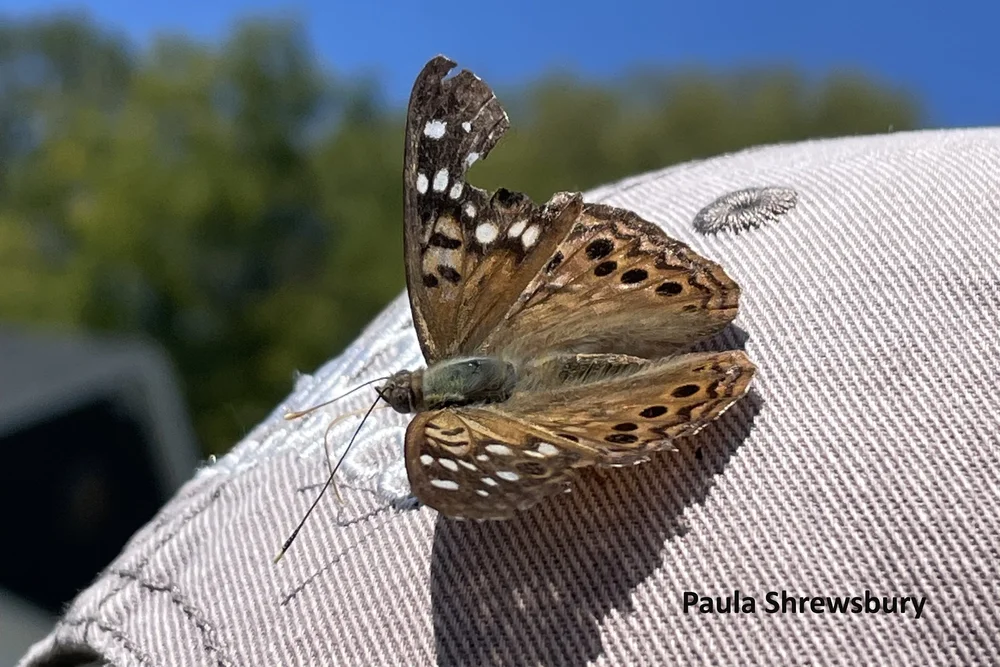
As they feed on plant sap, spotted lanternflies excrete copious amounts of a sugary waste product called honeydew. In their quest for sugar, butterflies like this pretty hackberry emperor take advantage of the sweet bounty provided by the lanternfly. But butterflies cannot live by sugar alone. Sodium is a key element needed by animals for a variety of life processes. This weather-worn emperor tasted my salt-laden hat before it moved to my shirt. Watch as its proboscis moves across my sweat-soaked shirt to lap up sodium and other vital nutrients. Pretty cool on a hot day that an invasive species and sweaty human can team up to help feed a native butterfly.  

When I arrived at the Tree of Heaven, I learned that floral nectar was not the only source of sugar used by the busy emperor butterfly. Festooning the bark of the Tree of Heaven were scores of diabolical spotted lanternflies. The bark of the trees was slippery wet with vast amounts of sugary waste product called honeydew, excreted by the lanternflies as they fed on plant sap. In addition to attracting vast numbers of stinging insects including wasps, hornets, and honey bees, emperor butterflies find lanternfly honeydew to be an excellent source of sugar.  To my surprise I saw several emperors lapping up the sweet honeydew, taking full advantage of the sugary bounty. 

An emperor with a wing likely tattered by a bird strike enjoys a salty treat from my sweat-soaked hat. Image credit: Paula Shrewsbury, UMD

As I quit the tropical heat and humidity of the forest and emerged into blazing sunshine, my colleague noticed one tattered emperor feeding on my sweat-drenched hat. Later, it imbibed salty liquid from my soggy shirt. During this encounter, the salt-seeking emperor displayed a complete lack of apprehension while I shoveled soil and picked rocks from the garden. The drive for salt appears to be strong and capable of overcoming the fear of proximity to a large, potentially dangerous animal. Butterfly experts have discovered that the quest for salt is sometimes stronger in male butterflies rather than females. It turns out that during copulation, in addition to transferring sperm, a male butterfly may donate a large dose of sodium to his mate, obviating the need for her to seek additional sources of sodium. What a guy! And on a humid, hot, late summer day in the DMV, having sweet and salty treats sounds like a pretty good idea.  

Acknowledgements

Bug of the Week thanks Dr. Shrewsbury for photographing the emperor butterfly on my head. The fact-filled article “Nutrient acquisition across a dietary shift: fruit feeding butterflies crave amino acids, nectivores seek salt” by Alison Ravenscraft and Carol L. Boggs was consulted in preparation for this story.