Monday, 20 April 2026

Zebras make a spring debut along the Potomac: Zebra swallowtail butterflies, Eurytides marcellus

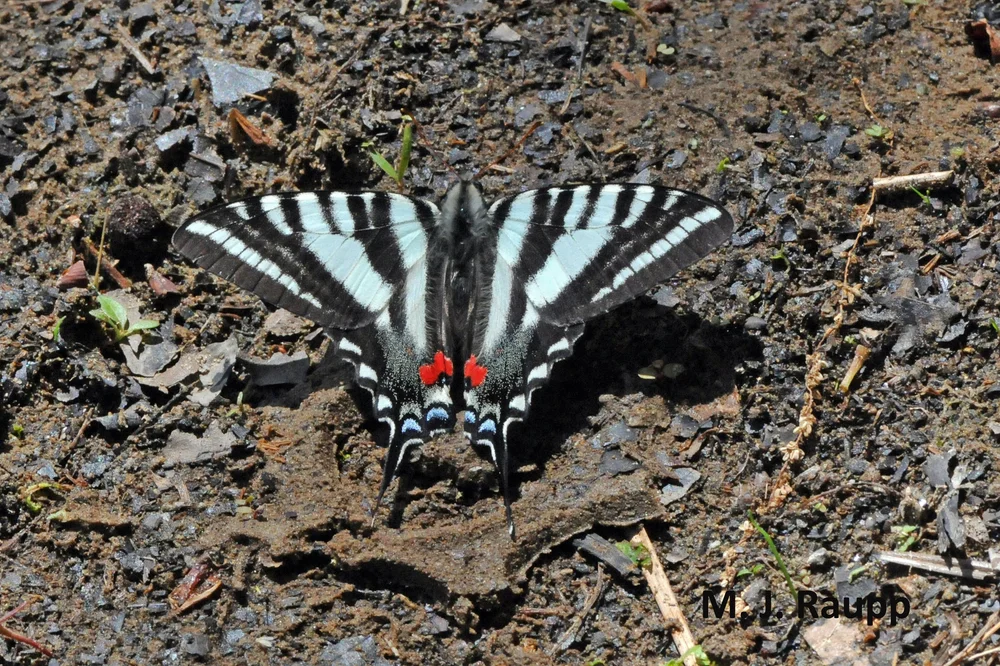
On a warm early spring day along the banks of the mighty Potomac River, zebra swallowtails “mudpuddle” to obtain sodium and other minerals necessary for life.

In last week’s episode, we met fierce six-spotted green tiger beetles roaming the trail along the C & O canal in western Maryland. While catching glimpses of these predators, a steady stream of gorgeous zebra swallowtails cruised the bike trail and muddy riverbank. The parade of zebras along the Potomac and other rivers in the DMV is linked to the presence of pawpaws lining these tributaries. Like so many members of the butterfly clan, zebras depend on a rather limited menu of plants that serve as food for their progeny. Zebra butterflies specialize on members of the genus Asimina, the pawpaws.     

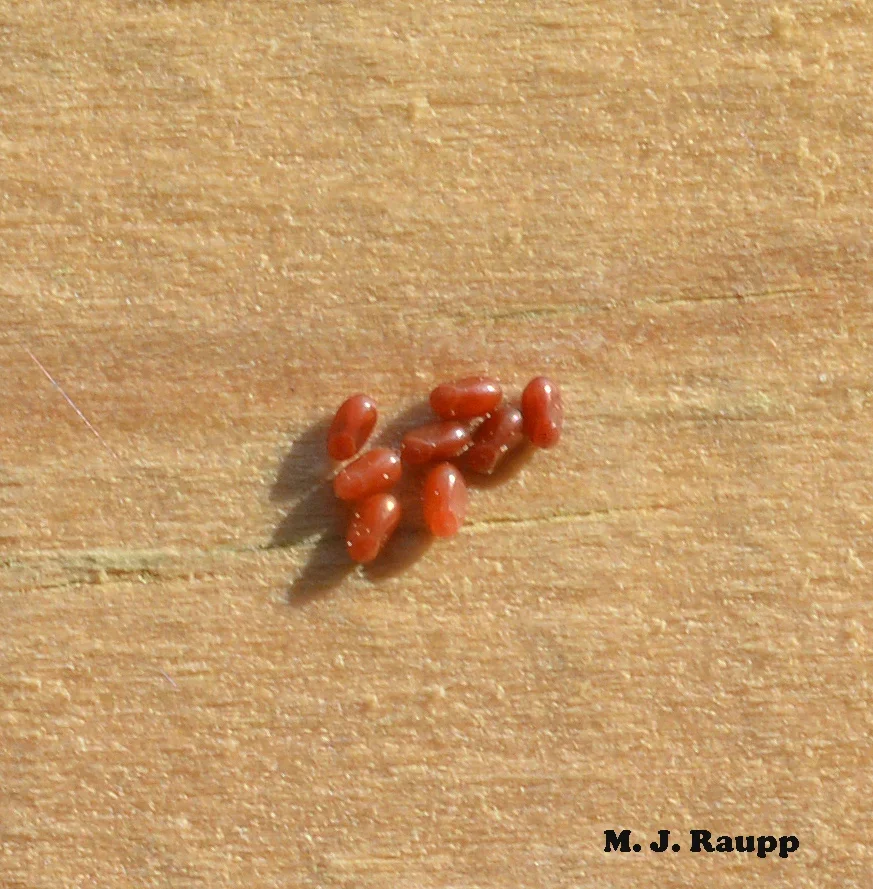
On a warm, early spring day along the banks of the mighty Potomac River, zebra swallowtails “mudpuddle” to obtain sodium and other minerals necessary for life. Watch as the zebra probes the soil with her proboscis. Later on as spring turns to summer, eggs laid by the female zebra hatch and caterpillars feed on pawpaw leaves. Caterpillars of the zebra swallowtail are elusive. After searching hundreds of pawpaws, I finally discovered an almost fully developed larva taking a stroll along a pawpaw branch. Lucky me.

Along the banks of the Potomac and other tributaries of the Chesapeake grow small forests of beautiful native pawpaw trees. A walk amongst these winsome understory trees sets one to wondering why their luxuriant green leaves often go virtually unmolested by leaf-eating insects and vertebrates during the growing season. Even rapacious white-tailed deer shun these plants. Pawpaw has evolved a clever defense, a noxious group of chemicals called annonaceous acetogenins. These bioactive compounds, found in both leaves and bark, likely make them unpalatable to a diverse array of hungry herbivores.

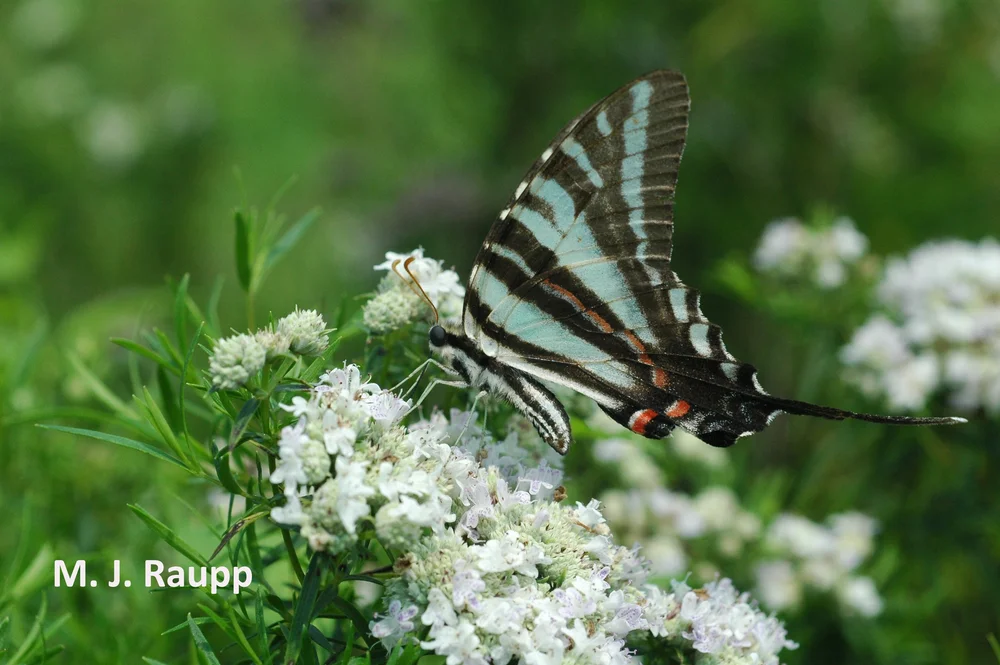
Zebra swallowtails consume carbohydrate rich nectar to power their search for pawpaws, the food for their young.

In addition to nasty metabolic effects, acetogenins are known to produce a potent emetic response in vertebrates. Ah, but herbivorous insects often discover ways to deal with defenses thrown at them by plants. In previous episodes we learned how monarch caterpillars turned the tables on milkweeds and used defensive compounds produced by milkweeds for their own defense against predators. A similar story holds for the zebra swallowtail butterfly. Sophisticated chemical analysis revealed that zebra swallowtail caterpillars and adult butterflies contained annonaceous acetogenins similar to those found in pawpaws. Scientists believe that these compounds originate in the leaves of pawpaw, are stored in the tissues of caterpillars as they eat leaves, and are passed along to the adult butterfly. The presence of acetogenins likely helps protect both the beautiful butterflies and their larvae from the beaks and teeth of hungry predators.

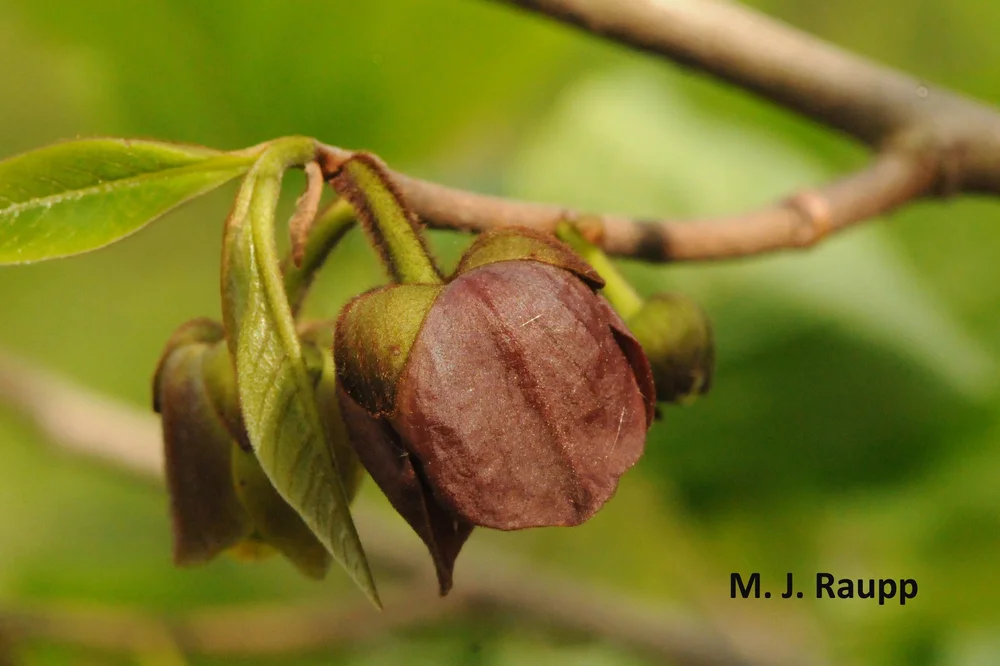
With a faint fragrance akin to carrion the beautiful blossoms of pawpaw are pollinated by flies and beetles rather than bees.

During the next month or so, find a moment for a walk along the Potomac or other nearby rivers where pawpaws abound. Be sure to keep an eye open for zebra swallowtails and spend a few moments searching pawpaw leaves for magnificent zebra caterpillars. And in autumn, don’t miss the chance to savor the delicious fruits of the pawpaw tree.

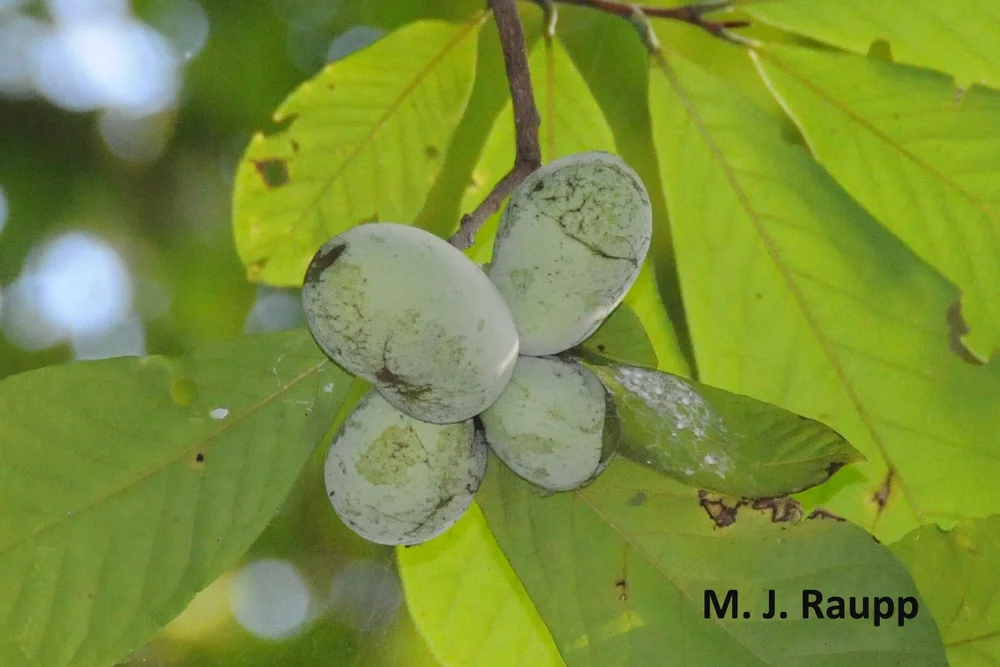
Along the Potomac and Patuxent Rivers in the DMV, delicious pawpaws appear in late summer. Pawpaw is one of the largest edible fruits produced by any native North American tree.

Acknowledgements

Bug of the Week thanks Pete Seeger whose rendition of “Way down yonder in the pawpaw patch” inspired this episode. The great read, “Chemical Defense in the Zebra Swallowtail Butterfly, Eurytides marcellus, Involving Annonaceous Acetogenins” by John M. Martin, Stephen R. Madigosky, Zhe-ming Gu, Dawei Zhou, Jinn Wu, and Jerry L. McLaughlin was consulted in preparation for this episode. 


Monday, 13 April 2026

A tiny fierce predator makes its spring debut: Six-spotted green tiger beetle, Cicindela sexguttata

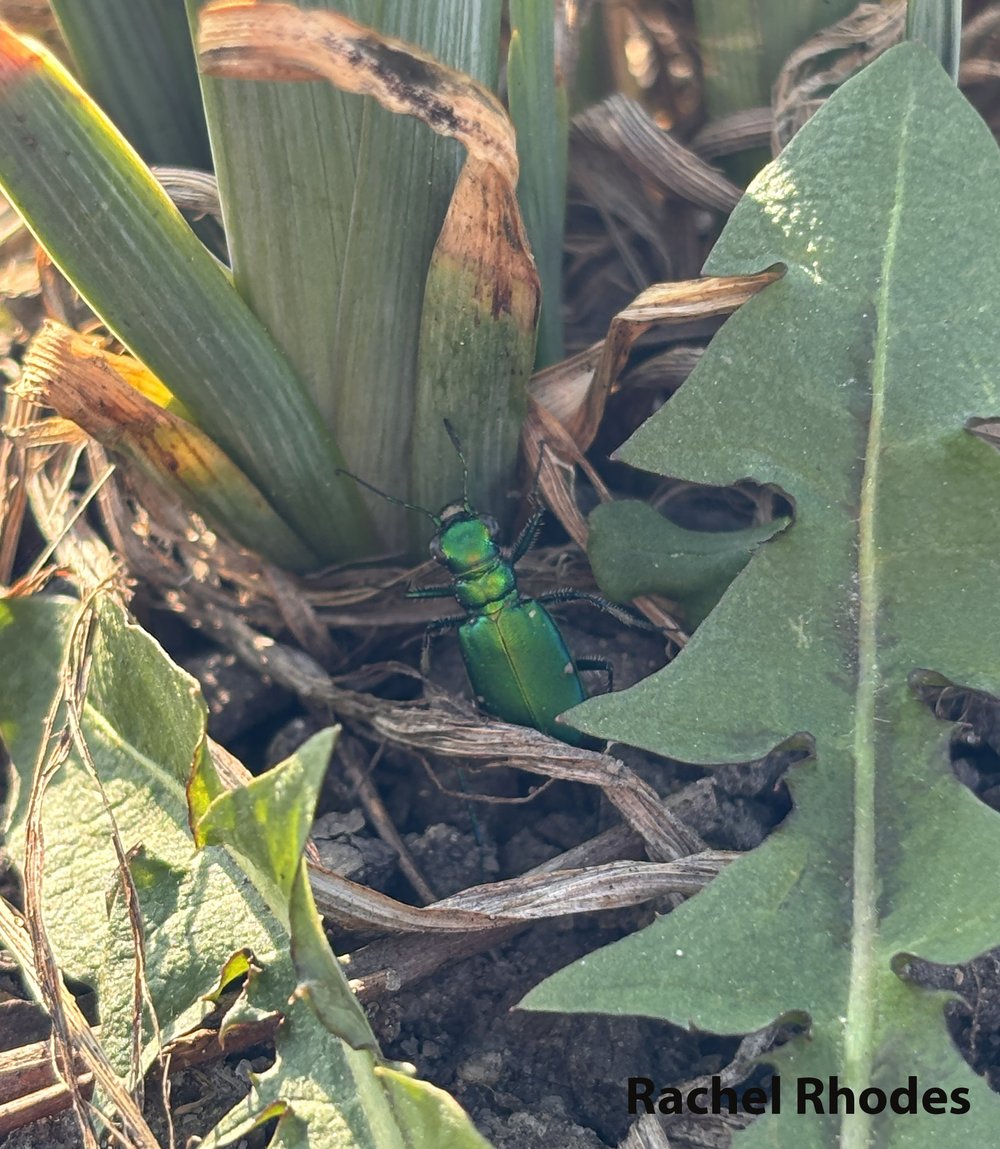
When six-spotted green tiger beetles appear in the flower bed, you know spring has arrived. Image credit: Rachel Rhodes

Over the past two weeks several parts of our country experienced record warmth for the month of April. Here in the DMV one of the sure signs that spring has truly arrived is the appearance of one of the most beautiful insects in Mother Nature’s panoply of six-legged wonders, gorgeous six-spotted green tiger beetles. One of our eagle-eyed extension agents in Queen Anne’s County, MD, sent me an image of a pretty tiger beetle hunkered down amongst the vegetation in her flower bed. Last week, while peddling along the C & O canal in Washington County, MD, busy green tiger beetles scattered away from my oncoming bike.

A while ago I saw this little beauty prowling around my garden. Look at the way those jaws snap open and closed. I surely wouldn’t want to be a little bug in the way of this hungry predator. To see these guys in action in the wild, I went to a sunny bike trail in western Maryland. Tiger beetles were all over the place.  Watch what happens when a bicycle approaches the beetle. That’s what I call a rapid escape. Let’s slow it down by 95% and see how that tiger beetle gets out of the way. Wow, that was fast. I guess all tiger beetles aren’t so quick on their feet. Look what happened to this one that couldn’t get out of the way of a bicycle. These bicycle trails can be dangerous places for tiger beetles to hang out. Maybe we need signs to warn cyclists of tiger beetles crossing.

Six-spotted green tiger beetles range from southern Canada to Texas and are commonly observed in the eastern half of the US. Predators as both larvae and adults, the name “tiger” suits them well. They are awesome hunters. The exceptionally long legs of adults provide lots of ground clearance and enable bursts of speed as they dash across trails and forest floors. Large eyes enable them to peruse their surroundings for signs of movement and potential meals. Unlike praying mantids that are “sit and wait” predators, tiger beetles actively stalk, pursue, and capture their victims. One amusing trick to play with these hunters is to spot one at a distance and toss a pebble or a small twig near the beetle. This often triggers an inquisitive charge as the beetle scrambles to see if a potential meal has entered its ambit.

Several years ago, I invited a handsome tiger beetle called Tommy into my kitchen to have a caterpillar snack. At first, Tommy seemed startled by a tent caterpillar that ventured just a little too close. A few moments later, I discovered Tommy behaving more like his “tiger” namesake as he snacked on the rear-end of the caterpillar. Watch as his sharp paired mandibles (jaws) and the second pair of mouthparts called maxillae move back and forth to ingest his tasty treat.

Like their feline namesake, the tiger beetle has powerful jaws used to capture, subdue, and consume its victim. Each jaw is armed with several stout teeth. The jaws grasp, pierce, slice, and crush. Just behind the jaws, a second pair of mouthparts called maxillae help shove pieces of flesh into the maw of the beetle’s digestive tract. Tiger beetles are carnivores as both adults and juveniles. The female tiger beetle lays eggs singly on the ground. Upon hatching, the immature stage, the larva, constructs an underground burrow. From this lair, the larva stealthily awaits dinner. As a hapless insect or spider strolls by, the larva springs from the hole like a jack-in-the-box and impales its victim with stiletto-like jaws. The prey is drawn into the burrow and eaten. Strange hook-like structures found on its abdomen help anchor the beetle larva in its burrow.

The strange tiger beetle larva lives in an underground lair and captures unsuspecting prey that stray too near.

As generalist predators and members of Mother Nature’s hit squad, tiger beetles consume pests in our gardens and landscapes and provide the important ecological service of biological control. Tiger beetles are tough to capture without a net, but if you catch one, be careful; they have powerful jaws and can give you a little nip. These diminutive tigers will be common along sunny bike trails and paths over the next few months. If you have some free time, take a walk in the forest or ride along one of the many beautiful bike paths here in the DMV to catch a glimpse of these tiny awesome predators.

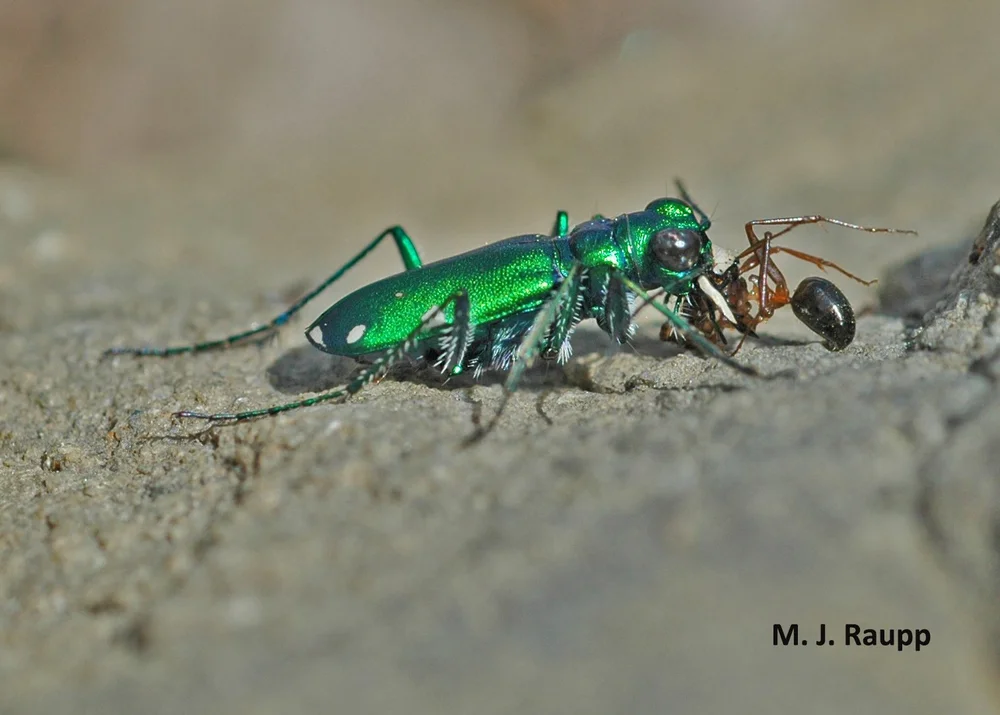
Tough luck for an ant on my garden wall.

Acknowledgements

“An Introduction to the Study of Insects” by Borrer, De Long, and Tripplehorn, and iNaturalist were used as resources for this episode. Thanks to Rachel Rhodes for sharing her image of a tiger beetle that inspired this episode.


Monday, 6 April 2026

With a stinky exodus underway, not all stink bugs survived a “severe” winter in some parts of our country: Brown marmorated stink bug, Halyomorpha halys

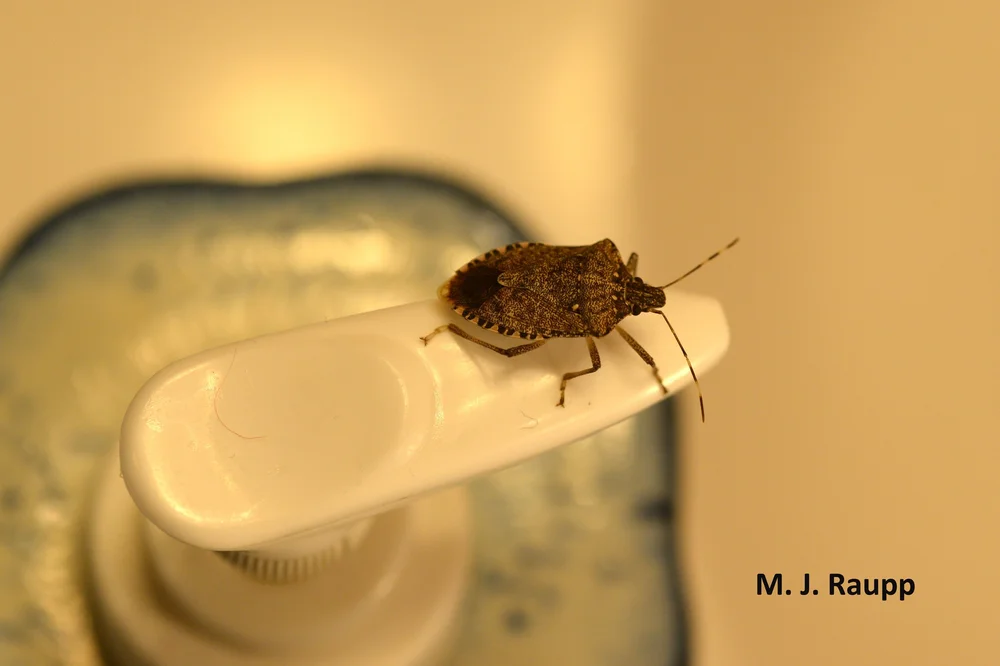
In the bathroom on the hand soap, really? Stink bugs are on the move.

Each year as winter’s chill retreats and springlike temperatures climb into the 60s and 70s, many insects including stink bugs make their presence known both outdoors and inside our homes. Why all the activity at this time of year? The answer lies in age-old patterns of life crafted by insects in temperate zones to survive the ravages of winter. As we learned in previous episodes of Bug of the Week, many insects evolved clever adaptations such as antifreeze proteins and cryoprotectants that enable them to survive temperatures far below freezing. No such luck for other insects such as brown marmorated stink bugs (BMSB). BMSBs are classified as chill-susceptible, meaning they are intolerant of cold temperatures. Their survival in unprotected locations declines dramatically as temperatures drop near and below freezing (32 degrees Fahrenheit), as they did with the unrelenting polar vortex last winter. To survive in urban and suburban settings stink bugs depend on human-made structures for winter survival.

Millions of folks throughout the nation were treated to invasions of stink bugs last autumn as the horde sought refuge in homes, schools, and office buildings. Some people mistakenly believe that stink bugs enter buildings in winter to get warm, but this is not the case. In the natural world where stink bugs evolved over millions of years, there were no McMansions. Stink bugs sought winter refuge in sheltered spots beneath the bark of trees or in rocky crags. Protected from the onslaught of winter, stink bugs chilled out and entered a state akin to hibernation where their activity declined as they awaited the return of favorable temperatures and springtime food. Lengthening days and warm temperatures signal the return of leaves, flowers, and fruit. With the return of warmth and food sources, stink bugs answered Mother Nature’s wake-up call and moved from their refuges to the greening landscape. Ah, but humans build structures and provide other places for stink bugs to survive. Inside attics or beneath the siding of homes where stink bugs sheltered for the winter, warm days convince stink bugs that spring has arrived and that it is time to return to the wild to seek food and pursue the biological imperative of finding mates and reproducing. With many stink bugs wandering about, it appears that my home, like many others, proved to be an excellent choice for surviving the rigors of winter.

With the arrival of warm spring days, brown marmorated stink bugs that invaded homes in autumn try to escape to the world outdoors. Their appearance on computer screens, appliances, furniture, and calendars attest to their luck in choosing the thermal refuge of my home for overwintering. Stink bugs that invaded my unheated tool shed chose poorly. Prolonged periods of subfreezing temperatures resulted in high levels of mortality in the shed. Could severe cold in many parts of our country last winter translate into fewer stinkbugs this summer? 

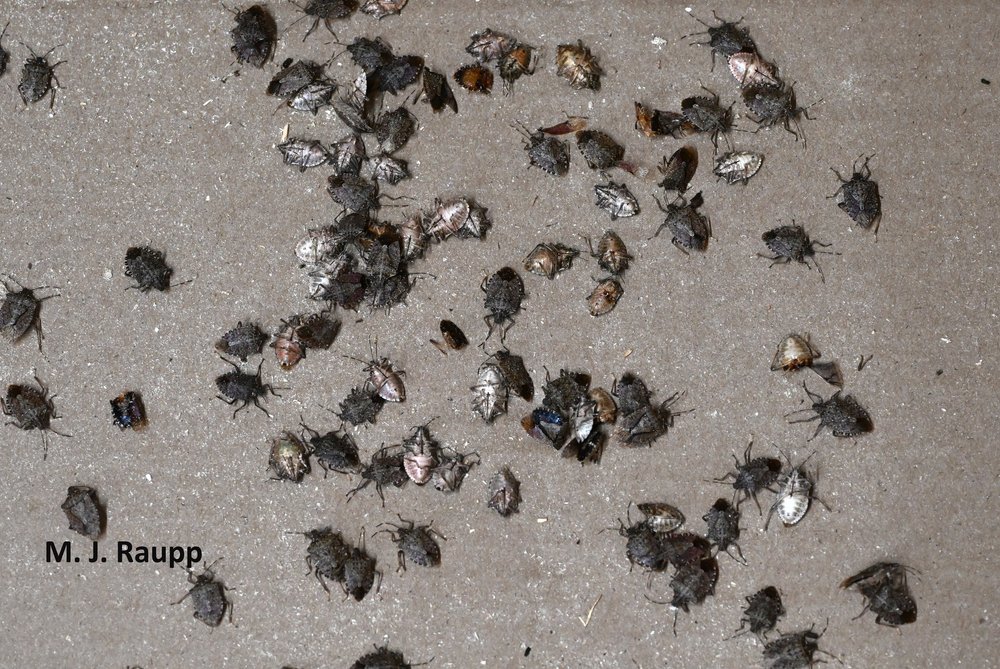
But not all choices of human-made structures are equal when it comes to surviving winter for BMSB. Choosing the right overwintering shelter is a matter of life and death for a stink bug. The business of shelter-choice by stink bugs reminds me of the famous line in the movie Indiana Jones and the Last Crusade. Hero Indy and villain Donovon must choose a potential Holy Grail cup from which to drink. The surviving Grail Knight warns Jones "Choose wisely, for while the true Grail will bring you life, the false Grail will take it from you.” Stink bugs face a similar choice. Based on the hordes of stink bugs running about, it appears that my home provided a thermal refuge from the winter of 2025 – 2026, classified as “severe” due to extended periods of nights and days below freezing. Well, what other choices were available to my neighborhood stink bugs? They had the option of overwintering in my unheated shed. And how did they fare? Maybe not as well. I visited several hundred stink bugs in my tool shed recently. Of hundreds I found littering the shed, less than 8% were still alive. In the words uttered by the Grail Knight, these stink bugs apparently “chose poorly”. These results are not surprising as several previous studies highlight the importance of different types of human-made shelters in providing suitable overwintering refuges for brown marmorated stink bugs.  

Unheated sheds are a bad choice to overwinter in when winters are severe. Hundreds of stink bugs perished in my outbuildings last winter.

As you deal with stink bugs this spring, here are some things to consider. Some folks have asked if “stink bugs can breed in my home?” To the best of our knowledge, the answer to this question is no. In the normal course of events, stink bugs move from winter refuges to plants outdoors where they feed for several weeks before they become competent to lay eggs. In your attic or an unused bedroom there is simply no food to provide the sustenance needed by stink bugs to produce eggs. Even if a stink bug could lay eggs indoors on a windowsill or wall, there would be nothing to sustain the young bugs, which require plant food for growth and development. Having made this claim, I might back-peddle just a little, as we have received reports of stink bugs feeding on house plants such as orchids and potted ponytail palms. Will stink bugs lay eggs on houseplants indoors? One homeowner discovered a batch of stink bug eggs on a houseplant in the spring a few years ago. So, the final answer to this jeopardy question is yes, they might breed in your home. The chances of stink bugs sustaining a population in your home probably lie somewhere between zero and nil, unless you have bountiful fruit bearing plants in your home and do everything to ignore stink bugs dashing about on those plants.

Another question that always comes up: What should I do about stink bugs that appear in my home this spring?  Sweeping, vacuuming, or simply picking them up and disposing of them is still our recommendation for control indoors. Because they will be active for a relatively long period of time, we are not recommending the application of insecticides to indoor living spaces to control stink bugs as they appear. Exposure of children and pets to pesticides could be worse than exposure to stink bugs. In fact, many pets and some children will be amused by a few stink bugs wandering about. My daughter’s cat loves them and, not surprisingly, my grandkids don’t fear the stink bug.  

To learn more about the brown marmorated stink bug, please visit the following website: http://www.stopbmsb.org/  

 To learn what to do when stink bugs get inside, and how to keep them out, watch the following video: https://youtu.be/0kG-2fetbZA

Acknowledgements

Thanks to stink bug hunter Dr. Shrewsbury for providing inspiration for this episode. Great references including “Cold tolerance, water balance, energetics, gas exchange, and diapause in overwintering brown marmorated stink bugs” by John J. Ciancio, Kurtis F. Turnbull, Tara D. Gariepy, and Brent J. Sinclair and “Cold Tolerance of Halyomorpha halys (Hemiptera: Pentatomidae) Across Geographic and Temporal Scales” by Theresa M. Cira, Robert C. Venette, John Aigner, Thomas Kuhar, Donald E. Mullins, Sandra E. Gabbert, and W. D. Hutchison provided insights into the cold tolerance of BMSB.