Monday, 28 September 2026

A season of evil returns as brown marmorated stink bugs, Halyomorpha halys, invade homes

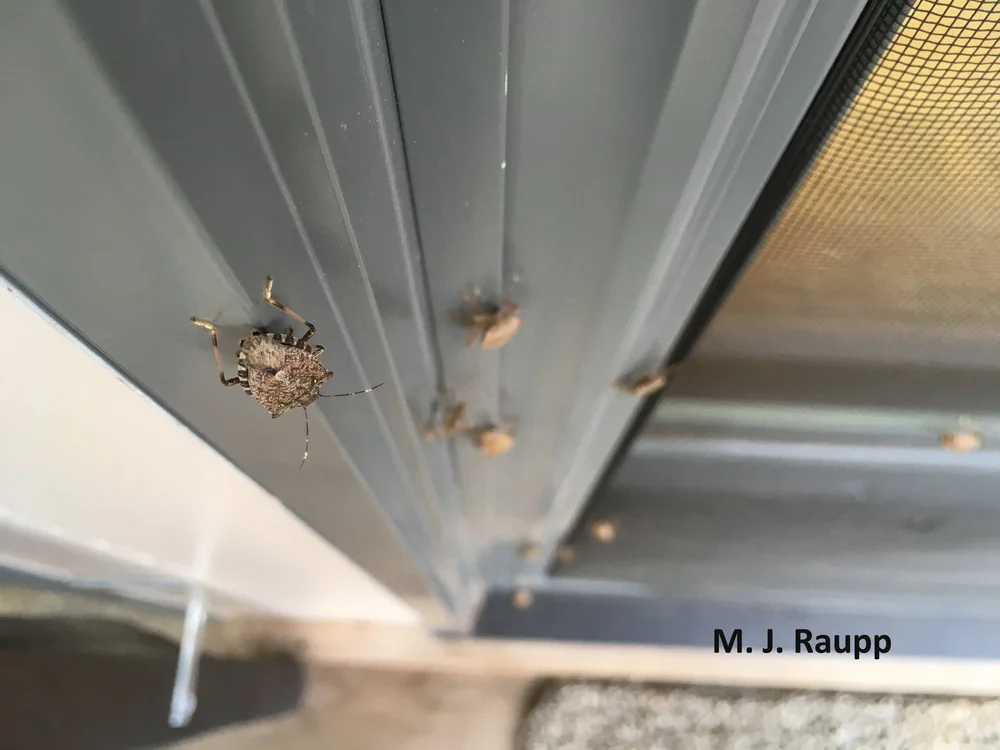
Stink bugs lining up on my doorframe just waiting for the chance to enter.

Early in spring, we visited brown marmorated stink bugs on their annual exodus from their winter refuge in a home. That was the stink bug tide going out. Now it’s time for the tide to come in.  Last week in what has become an annual ritual, brown marmorated stink bugs (BMSB) began collecting on my window screens, invading my home through any opening, and buzzing around the bedroom before lights out. The passing of the autumnal equinox and shortening of daylength mark the beginning of the stink bug’s quest for overwintering refuge and proclaims the start of the home invasion season, a stinky annual tradition throughout much of the country now.

With the arrival of autumn, so begins the home invasion with stink bugs. They stormed my home, climbing walls, finding gaps in screens and siding. They scaled my door frames, ran across my table, partied on my windowsills, and probed my walls. The final insult was to lay claim to my coffee cup before my first sip of dark roast.

First discovered near Allentown, PA, in the late 1990s, BMSB now occupies 47 states and four Canadian provinces in North America. Why are stink bugs on the move now? For the past several months, stink bugs have been fattening up on corn, soybeans, garden vegetables, and fruit. But soon this cornucopia of earthly delights will disappear for BMSB and other herbivorous insects. In temperate locations like Maryland, winter halts the growth of deciduous trees and shrubs and withers herbaceous plants. Food for plant and fruit-eating stink bugs all but disappears. With the arrival of cold weather, stink bug movement slows to a crawl and their development grinds to a halt. Prior to this inimical season, stink bugs seek refuge to chill-out where they will be protected from harsh winter weather and dangerous predators.
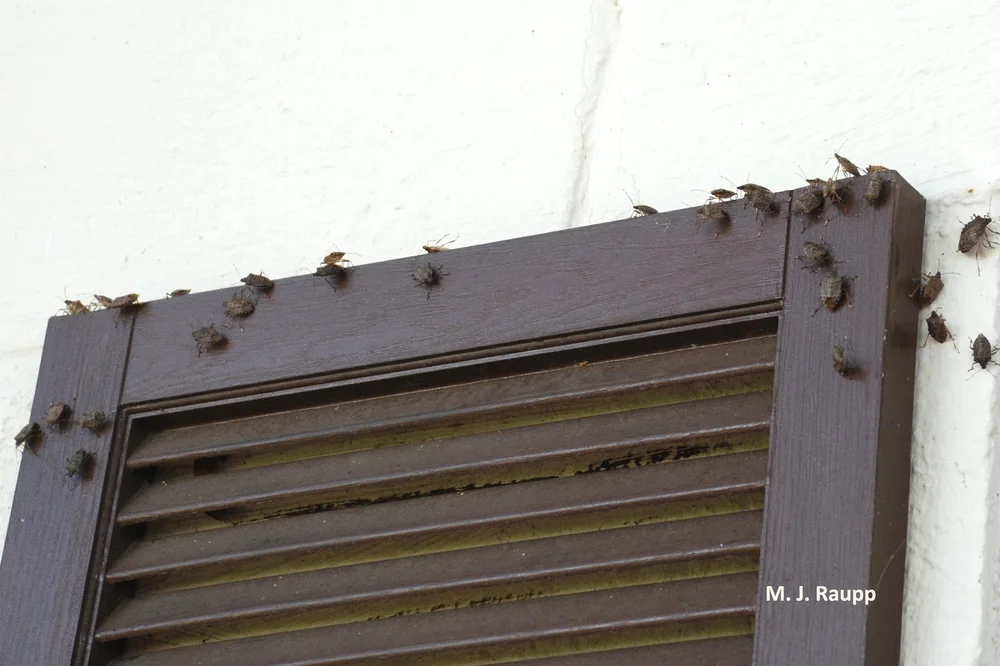
Stink bugs preparing to overwinter release aggregation pheromones. This assembly call directs stink bugs to potential hibernal refuge, including vents to the attic of homes.

Why do stink bugs enter homes and man-made structures? Some folks incorrectly believe home invasions provide warm winter refuge for stink bugs. Bear in mind that millions of years ago when these creatures evolved, there were no mansions or man-made structures to invade. Until recently, the natural winter redoubts of these stinkers were largely unknown. However, a clever study revealed large, freshly deceased but still standing trees are a prime winter hideout for stink bugs in natural settings. The loose bark of these trees affords a fine location for stink bugs to crawl underneath and escape the ravages of winter. Rocky ridge tops provide many dead trees and abundant places for stink bugs to chill-out. Here they can reduce their metabolism and await the return of spring that brings warmer temperatures and abundant food as plants flower, fruit, and grow.

For many viewers of Bug of the Week, stink bugs on rocky ridge tops seems like a remote problem. However, the nuisance potential of BMSB is almost without equal. To a stink bug, a home provides a wonderful assortment of overwintering opportunities beneath siding, behind shutters, and in attics. The pending invasion some homeowners face is no trivial matter. In 2011, a homeowner in western Maryland captured more than 26,000 BMSBs from January through June as they moved about his home seeking egress from their overwintering refuge. Yikes! 

Loose bark, rock crevasses, and homes provide overwintering refuge for the brown marmorated stink bug.

Why do populations of BMSB fluctuate so dramatically from year to year and place to place? Scientists at Virginia Tech and the USDA’s Appalachian Fruit Lab have evidence that visits from polar vortices in the winters of 2014 and 2015 put a beat-down on overwintering BMSB in our region. Mounting evidence from several universities and government laboratories in our region suggests that indigenous and introduced predators and parasites may be catching up with stink bugs and levying a toll on their populations (see Death of a stink bug, Part 1, Part 2, Part 3, and Part 4).  My money is on the possibility that all of these factors, and perhaps some still unknown, conspired to reduce stink bug numbers in our region over the past several years. However, as is often the case in the natural world, as prey populations decline, so too do numbers of predators, pathogens, and parasites attacking them.
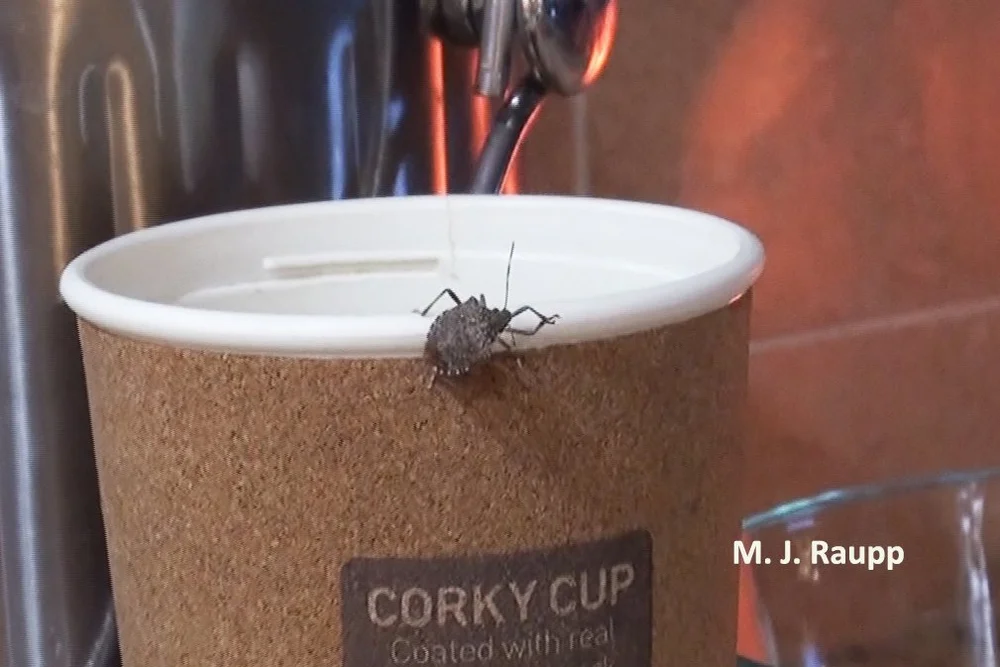
In the next few weeks, don’t be surprised to see a stink bug waiting for a cup of coffee in the morning.

Perhaps a relative dearth of stink bugs in preceding years and a resultant regional decline in Mother Nature’s hit squad has allowed stink bugs populations to rebound a bit this year in some locations, including around my home. Only Mother Nature and the stink bugs know for sure. Is this a crescendo leading to the return of stink bugs to major pest status here in the DMV? Only time will tell. One thing is certain, over the next several weeks stink bugs will be on the move. It’s time to seal cracks and crevices around the home, replace worn weather-stripping and door sweeps, and make sure that screens are in good repair. Steps to keep stink bugs out will also help to keep energy in during the winter season, paying dividends now by reducing the stink bug nuisance and later by saving energy costs.

Acknowledgements

Bug of the Week thanks Marie, Tom, Eloise, Abigail, and members of the BMSB Working Group for providing information and inspiration for this episode. Interesting studies including one by D. B. Inkley, “Characteristics of home invasion by the brown marmorated stink bug (Hemiptera:  Pentatomidae)” and “Frequency, efficiency, and physical characteristics of predation by generalist predators of brown marmorated stink bug (Hemiptera: Pentatomidae) eggs” by William R. Morrison III. Clarissa R. Mathews, and Tracy C. Leskey were also consulted. 

To learn more about BMSB biology, distribution and management, please visit the following web site: https://www.stopbmsb.org/   

To learn how to keep BMSB out of your home and what to do when they get in, please watch the following video: Brown Marmorated Stink Bug Control: Keeping Stink Bugs Out of Your House

Monday, 21 September 2026

Battle of the spotteds: Spotted orb weaver, Neoscona crucifera, vs spotted lanternfly, Lycorma delicatula

Spoiler alert: The match between the spotted lanternfly vs spotted orb weaver will go to the spider.

A few episodes ago we learned the fate of an unlucky spotted lanternfly that had a paralyzing encounter with a pair of scrappy house spiders. This week while putting away some tools, I noticed a very large and impressive spotted orb weaver feasting on a brown marmorated stink bug on the side of a tool shed. Marmorated stink bugs are one of those rascally invaders from Asia that was quite the stir when they first arrived in the DMV more than two decades ago.  Well, as I watched the orb weaver devour the stink bug, I couldn’t help but wonder if she might enjoy another tidbit from the Far East.

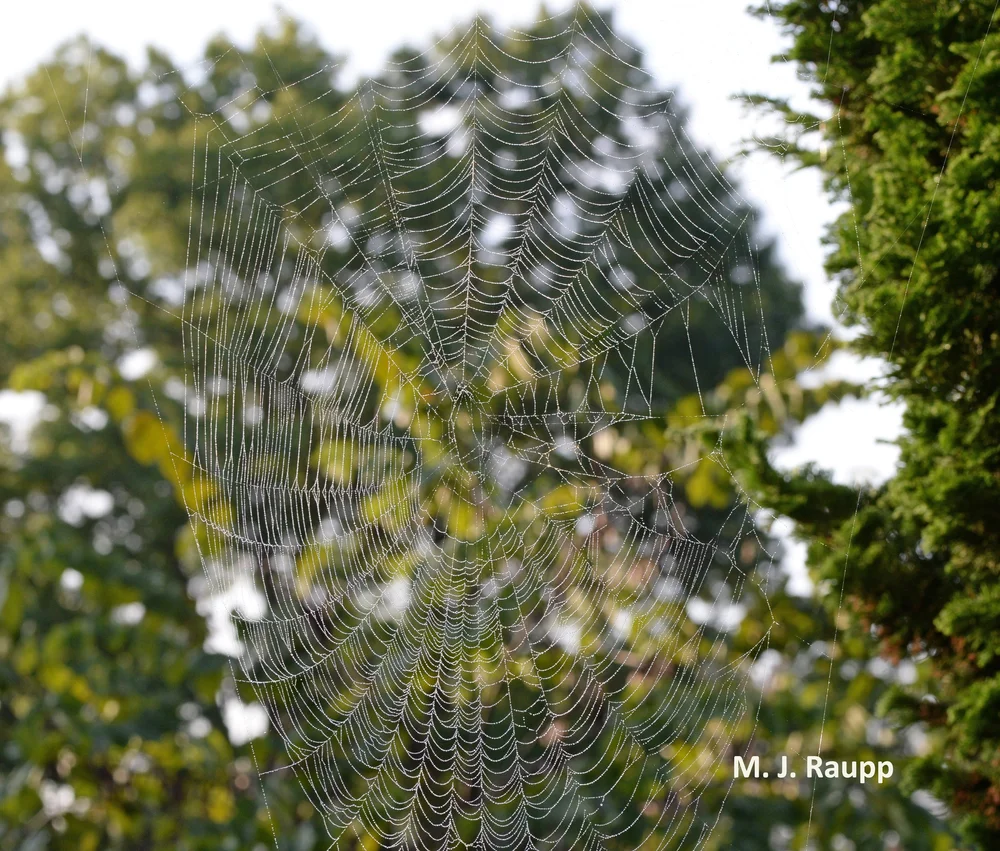
A fine morning mist reveals the beautiful web of a spotted orb weaver. Webs can be several feet at their widest dimension.

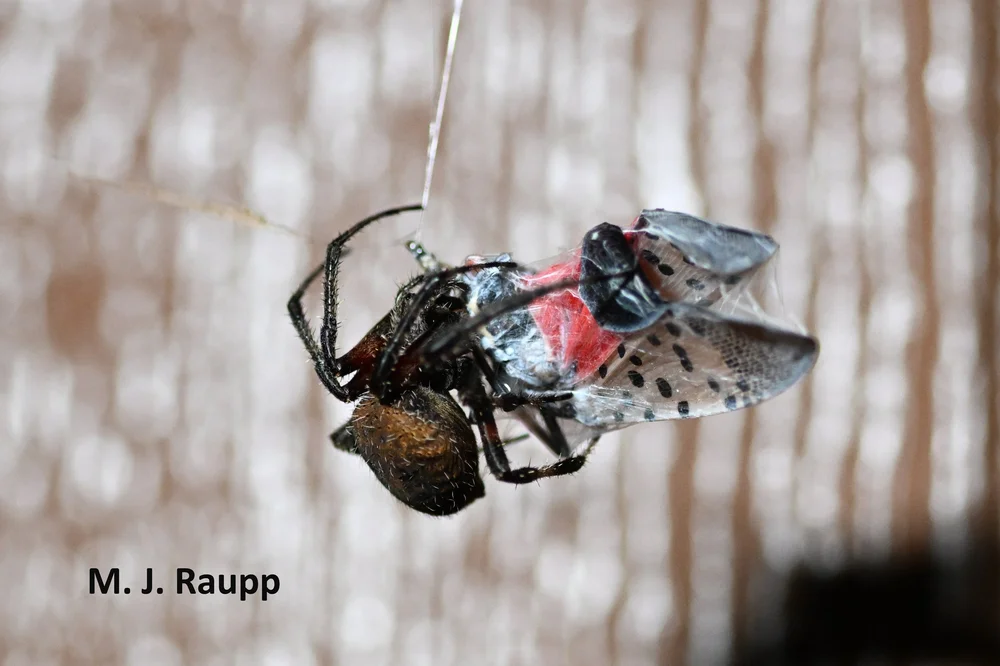
The following evening resting on the shed door not more than a meter away from the web was an adult spotted lanternfly. With just a little gentle prodding it launched itself into the orb weaver’s web. As you might have guessed, the match between the spotted lanternfly and the spotted orb weaver wasn’t much of a match at all. Within moments, the spider snared, wrapped, and paralyzed the lanternfly. Game over, but not exactly, as the spider fed on the lanternfly for several hours before abandoning its victim.

As twilight falls, a beautiful spotted orb weaver seems to float in air as she spins the delicate, nearly invisible strands of silk that form her web. Watch as she uses her hind legs to attach the sticky spiral threads to the radial lines. How cool is that?

Late summer is a time when many spiders reach maturity and maximum size, having devoured prey throughout the growing season. The web of the spotted orb weaver was no tiny affair like the webs of cellar spiders or common house spiders that we met in previous episodes. This web spanned more than three feet from one end to the other. In nature the spotted orb weaver is a denizen of woodlands, where it builds its web amongst the twigs and branches of trees and shrubs. Interesting studies of their web placement revealed that these spiders are creatures of the light. Webs are strung in relatively well lighted areas where the density of flying prey may be greater. This scenario surely fits with the location of my spider’s web, cleverly constructed in a flyway between two sheds.

On the side of my tool shed a lovely spotted orb weaver built her web. One evening I watched her devour an invader from Asia, the brown marmorated stink bug. I couldn’t help but wonder if she might enjoy another tidbit from the far east. The following evening, with a little prodding an adult spotted lanternfly hopped into the web. As you might have guessed, the match between the spotted lanternfly and the spotted orb weaver wasn’t much of a match. Within moments, the spider snared, wrapped, and paralyzed the lanternfly with venom. With her victim subdued, she embraced the lanternfly and began to feed. Game over, spider 1 - lanternfly 0.

During the daytime, the orb weaver hides in a small silken refuge beneath the roof of the shed. At dusk, I watched her spin a new web, and by nightfall she had snared a stink bug. Once a hapless victim was entangled, she secured it with sheets of silk from spinnerets on her rear end and delivered venomous bites with her fangs. Powerful fangs are used to pulverize the stink bug, and proteinaceous fluids and morsels are turned into spider eggs. In the current battle against spotted lanternflies, clever studies by scientists at Penn State have found spiders to be the invertebrate most often observed attacking lanternflies. With luck and abundant lanternflies, my spider may produce a marble sized egg sack with as many as 1000 eggs before chilly weather brings an end to her beneficial escapade. Nice work spiders.

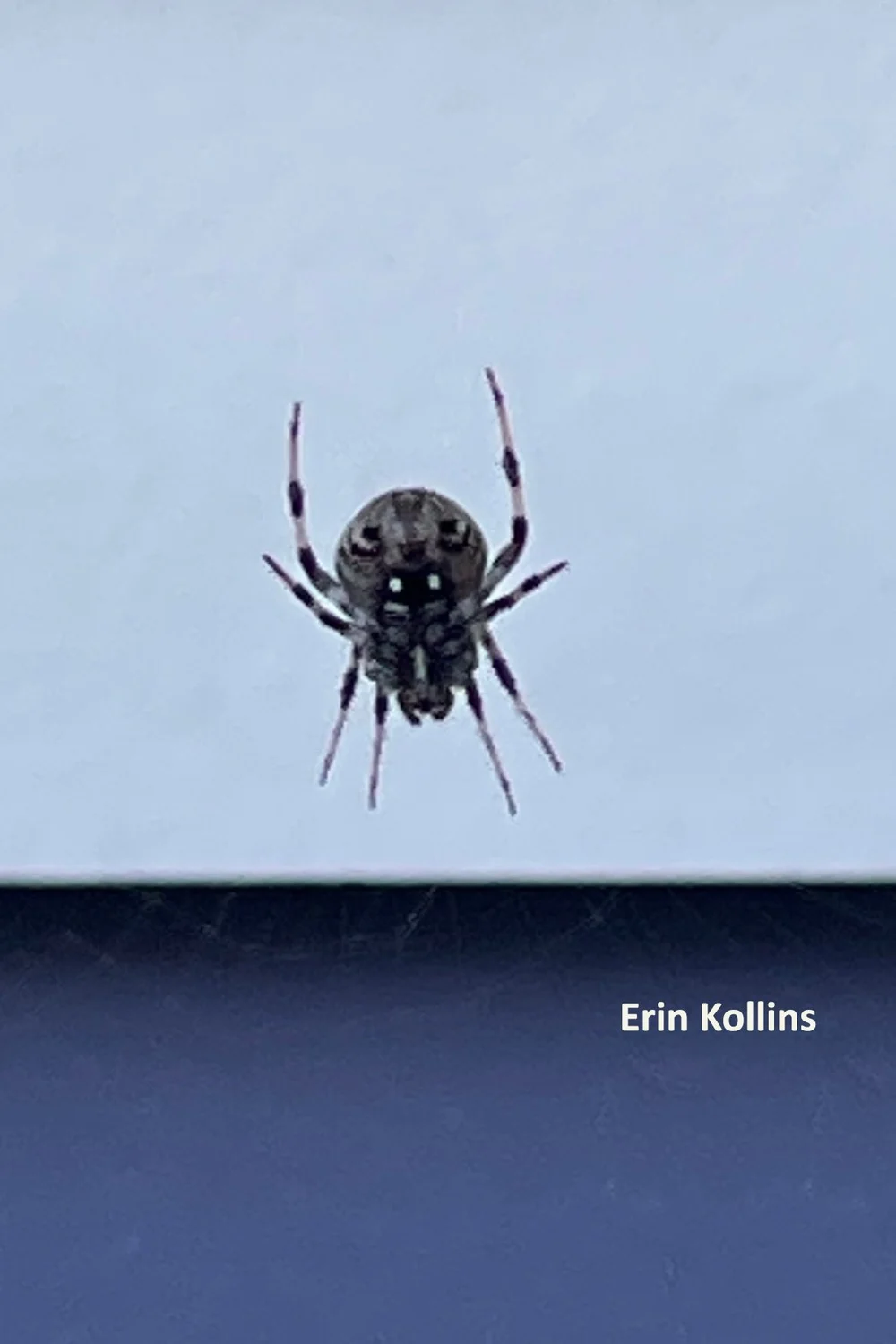
The underside of the spotted orb weaver may provide a clue as to how it got its name. Image credit: Erin Kollins

References

The wonderful website “Neoscona crucifera (Spotted Orbweaver)” at www.spiders.us, “Using community science to identify predators of spotted lanternfly, Lycorma delicatula (Hemiptera: Fulgoridae), in North America” by Anne E. Johnson, Alison Cornell, Sara Hermann, Fang Zhu and Kelli Hoover, and the article “Choosing Hunting Sites: Web Site Preferences of the Orb Weaver Spider, Neoscona crucifera, Relative to Light Cues” by M. R. Adams were used as references for this episode. We thank Erin Kollins for the image of the underside of the spotted orb weaver. The inspiration for this episode came from several Maryland Master Naturalists enamored with large spiders they had recently observed.


Monday, 14 September 2026

Invite a trio of digger wasps to control white grubs in your landscape: blue-winged digger wasp, Scolia dubia, noble digger wasp, Scolia nobilitata, and double-banded digger wasp, Scolia bicincta

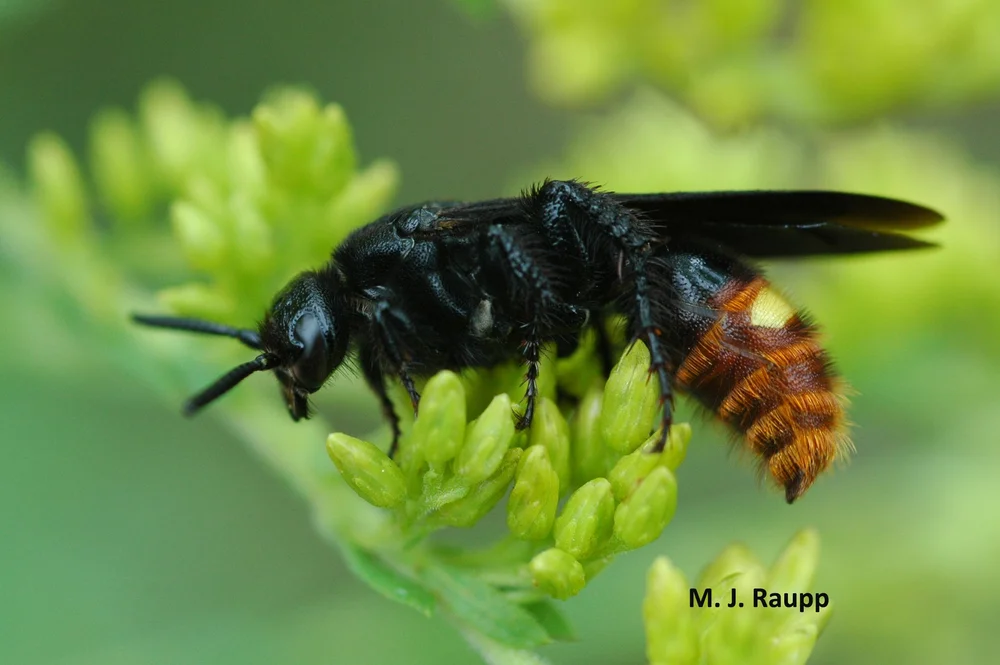
This hairy wasp with a yellow spot on each side of the abdomen digs through the soil to lay its lethal spawn on subterranean beetle grubs. White grubs, be very afraid when Scolia dubia comes to the garden.

This week let’s visit a trio of gorgeous and really cool wasps intent on annihilating   dastardly beetle pests in our lawns and gardens. The beetle pests these wasps attack include larval stages (a.k.a. white grubs) of green June beetles, Japanese beetles, Oriental beetles, Asiatic garden beetles, and other members of the scarab clan that dwell in soil and devour roots of our lawn grasses, annual, and perennial plants. As adults these beetles, known as scarabs, strip leaves and blossoms of hundreds of species of ornamental plants and wholesome vegetables. Adequate spring and summer rains conducive to grub survival have turned my flower beds into ideal breeding sites for these rascals. But in Mother Nature’s system of checks and balances, it is not unusual to see populations of predators and parasites rise shortly after populations of their prey increase.

Mints and asters bring digger wasps like Scolia dubia, Scolia nobilitata, and Scolia bicincta to your garden on sunny days in late summer and autumn. Scolia dubia is easy to know by the two yellow patches on the sides of its furry reddish abdomen. Scolia nobilitata has two pairs of orange or yellowish spots on its black abdomen and their cousin Scolia bicincta has two brilliant white bands wrapping around the dorsal surface of the abdomen. After tanking up on energy-rich nectar, they will search for white grubs in your lawn and gardens, dig into the soil, and deposit eggs on hapless grubs. Upon hatching, wasp larvae devour the grubs and thereby help to rid your landscape of these noxious pests. These wasps don’t harm humans or pets, so plant some mints and asters and enjoy the show. Video credit: Marie Rojas and Michael J. Raupp

Over the past week or so, several folks have commented on hordes of dark winged wasps cruising back and forth a foot or so over their turf. Most of these sightings are digger wasps, members of a family known as Scoliidae. The digger wasp moniker stems from the impressive ability of these fierce fliers to locate white grubs beneath the surface of the earth, tunnel through the dirt, deliver a paralyzing sting, and deposit an egg on the skin of the grub. The hapless white grub is incapable of removing the egg, which soon hatches and the parasitic larva of the digger wasp slowly consumes its living victim. Glad I’m not a white grub.  After completing its development during summer and autumn, the wasp larva spins a silken cocoon, pupates, and then passes the winter in the burrow created by the grub. Fresh, new wasps emerge as adults the following August and they are now busy in our landscapes gaining nutrition in the form of nectar and pollen as they visit flowers in our gardens and landscapes.

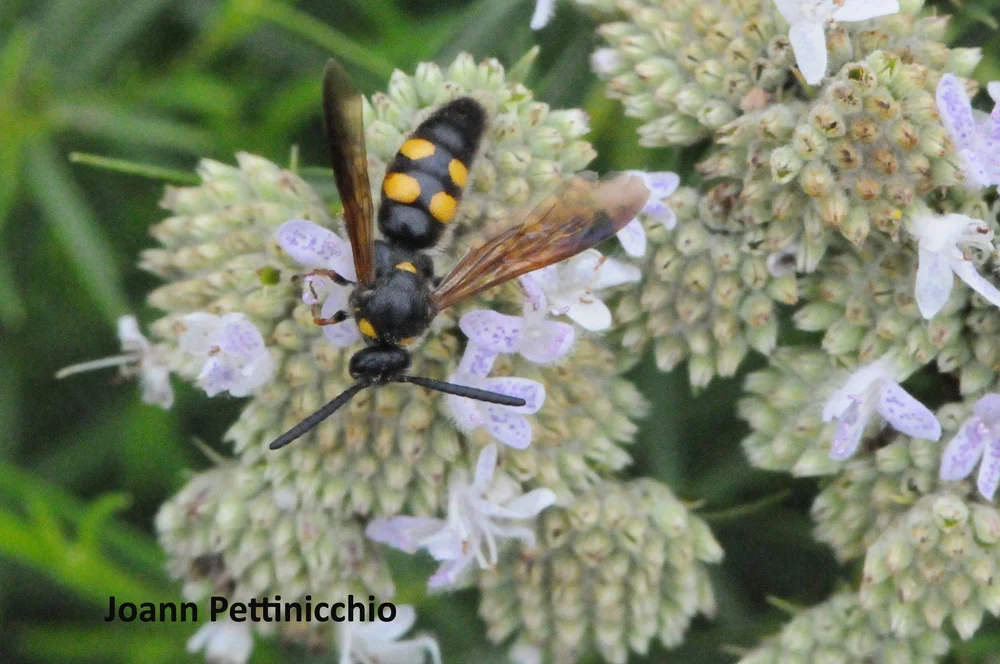
When not hunting white grubs, Scolia dubia is often found nectaring on flowers during August. Photo credit: Joann Pettinicchio

Several species of digger wasps can be found in the DMV, and three in the limelight this time of year are the blue-winged digger wasp, Scolia dubia, the noble digger wasp, Scolia nobilitata, and the double-banded digger wasp, Scolia bicincta. Scolia dubia sports striking iridescent blue-black wings. Its body is black excepting the end of its fuzzy abdomen, which is reddish brown. Scolia dubia is easily recognized by one pair of bright yellow spots on either side of its abdomen. Its cousin, Scolia nobilitata, has smoky brown wings with two pairs of yellow or off-white spots on its abdomen. Scolia bicincta has dark black wings and two brilliant white bands wrapping around the dorsal surface of the abdomen. These colorful beauties need energy to search for grubs and tunnel underground to find their victims. They are often seen carbo-loading in preparation for the hunt on nectar-rich members of the mint family (Lamiaceae) such as mountain mint and spotted horse mint, and members of the aster family (Asteraceae) such as goldenrod and wingstem, a.k.a. yellow ironweed.

Whether it’s small white grubs in the soil or zany green June beetle grubs that crawl on their back across the ground, these pests face an awesome grim reaper when Scolia digger wasps come to my garden. Video credit: Michael J. Raupp

Lawns and landscape beds rampant with white grubs often attract squadrons of digger wasps flying in tight figure-eight patterns just above the ground, presumably hunting for prey. While they might appear scary, please understand that these wasps are not aggressive towards humans and that they are highly beneficial by virtue of the beat-down they put on white grubs, as well as pollination of some of our favorite plants. You can befriend these beneficial wasps by providing nectar sources, such as mints and asters, in your landscape and thereby invite them to hang around and find some pestiferous white grubs to serve as food for their offspring. As part of Mother Nature’s system of checks and balances, plant some flowers, sit back and relax on a warm autumn day, let them do their work, and enjoy the show.

Acknowledgements

Bug of the Week thanks Marie Rojas for the awesome video of blue-winged digger wasps nectaring on mountain mint and Joann Pettinicchio for the pretty picture of the noble digger wasp. The wonderful books “Destructive Turfgrass Insects” by Dan Potter and “Bees, Wasps, and Ants” by Eric Grissell were used as references.


Monday, 7 September 2026

Spiders feasting on spotted lanternflies: Black and Yellow Garden Spider, Argiope aurantia, and Common house spider, Parasteatoda tepidariorum

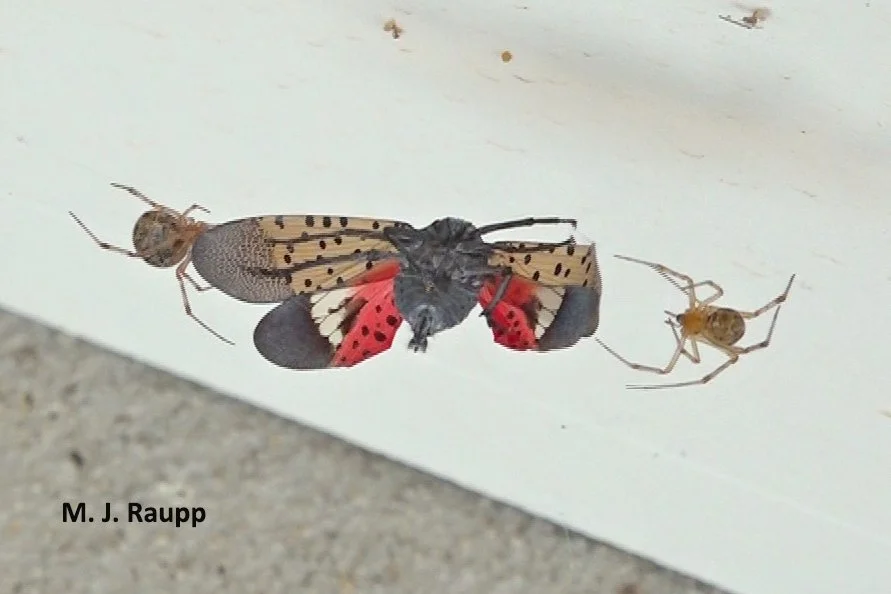
A pair of common house spiders team up to take down a spotted lanternfly.

Back in the initial years of the invasion of spotted lanternflies here in the DMV, local officials were uncertain if indigenous species of natural enemies, particularly predators and parasitoids, would be able to help quell the rising tide of lanternflies and their mischief. In Fairfax, Virginia, the county reported that “In its native land where it cohabits with its predators, parasites, and pathogens it is not a problem insect. However, as with many other insects arriving to the United States from other parts of the world and finding no established natural enemies here, it has become very invasive.” Often in the early stages of invasion by non-native insects, populations of the pests rise dramatically seemingly unchecked.

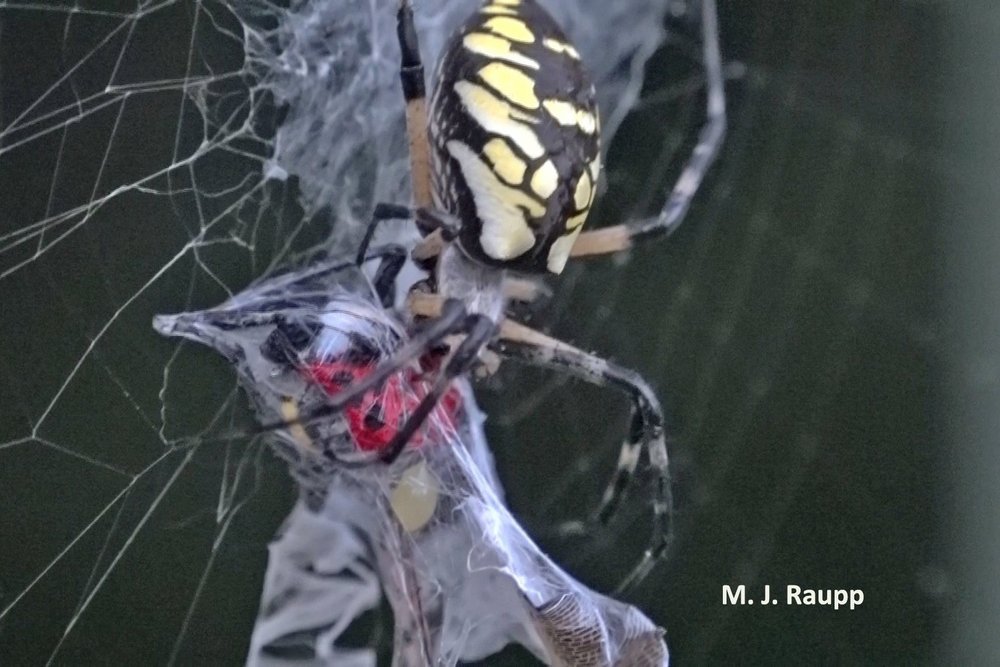
A beautiful black and yellow garden spider feasts on an adult spotted lanternfly.

As time moves along and communities of natural enemies adjust to the presence of a tasty new food item from afar, scientists can track the impact of our resident predators, parasitoids, and pathogens on these new invaders. Such was the case where a team from Penn State used citizen science data to identify some of the major players on Mother Nature’s hit squad attacking spotted lanternfly. Leading the charge from the world of invertebrates were spiders, with 206 reported observations. This week let’s catch up with a couple of arachnids that were part of this team.

In previous episodes we met the gorgeous black and yellow garden spider that resided outside my home in Columbia, Maryland. These large orb weavers have been serving a beat-down on invasive pests including brown marmorated stink bugs and spotted lanternflies.

An ill-fated spotted lanternfly struggles to free itself from sticky strands of the spider’s web. Web vibrations alert the spider to the victim’s presence. Lightning fast, the spider dashes from the center of the web and immobilizes the lanternfly with sheets of silk. With its prey swaddled and helpless, the spider delivers lethal bites to the lanternfly. She then retreats to the center of her web. As daylight wanes, the spider moves its meal to the center of the web. Using powerful fangs, she macerates the lanternfly and then slurps liquefied lanternfly into her digestive tract. By nightfall, the lanternfly is but a shriveled hulk. Bye, bye, lanternfly.

A few weeks ago, on a deck in Sharpsburg, Maryland, two delicate common house spiders teamed up to take down a spotted lanternfly. A coordinated entrapment in strands of silk and, presumably, rapid venomous bites soon immobilized the lanternfly. After a short suspense, one of the spiders settled in to macerate the lanternflies’ tissues and slurp them into its gullet. The common house spider was first described in Germany but is believed to be South American in origin. It is now found in many lands, likely transported by man as plants and goods moved around the world. Parasteatoda is known to eat small flies, other spiders, cockroaches, and as we saw in a previous episode, tree crickets. The common house spider belongs to a clan called the Theridiidae, spiders that include the black widow, considered by many to be the most dangerous spider in North America. While the bite of the common house spider is not considered dangerous to humans, it was more than sufficient to bring down a spotted lanternfly many times its size.

On the stoop of a back porch a hapless spotted lanternfly became entangled in the gossamer web of two common house spiders. These fierce small spiders teamed up to tackle the lanternfly. In a macabre duet almost too creepy to watch, the twins assail the lanternfly with silk applied by spindly legs and, presumably, tiny venomous bites that soon paralyzed their prey. After a short suspense one of the predators delivered a perfidious kiss to the immobilized lanternfly. Tiny fangs macerate her victim’s head while she slurps up the liquified tissues of her prey. A bad ending to an unwelcome invader. 

Common house spiders usually occur in collections of one or two around window frames or porches. However, sometimes prey become uber-abundant and when conditions allow, spiders may become partners in building enormous communal webs, vast killing fields for hapless arthropods. One such mega-web was described at a waste treatment plant in Maryland where vast numbers of prey items, small flies called chironomid midges, were present for extended periods of time. This mega-web occupied tens of thousands of cubic feet and likely contained more than one hundred million spiders, of which almost six million were common house spiders. A spider web like that could take care of a lot of spotted lanternflies.    

Acknowledgements

References used in this episode include the wonderful article “Using community science to identify predators of spotted lanternfly, Lycorma delicatula (Hemiptera: Fulgoridae), in North America” by Anne E. Johnson, Alison Cornell, Sara Hermann, Fang Zhu and Kelli Hoover, “An Immense Concentration of Orb-Weaving Spiders With Communal Webbing in a Man-Made Structural Habitat” by A. Green, J. Coddington, N. Breisch, D. DeRoche, and B. Pagac; and “The Common House Spider, Parasteatoda tepidariorum (C. L. Koch) (Arachnida: Araneae: Theridiidae)” by G. B. Edwards.