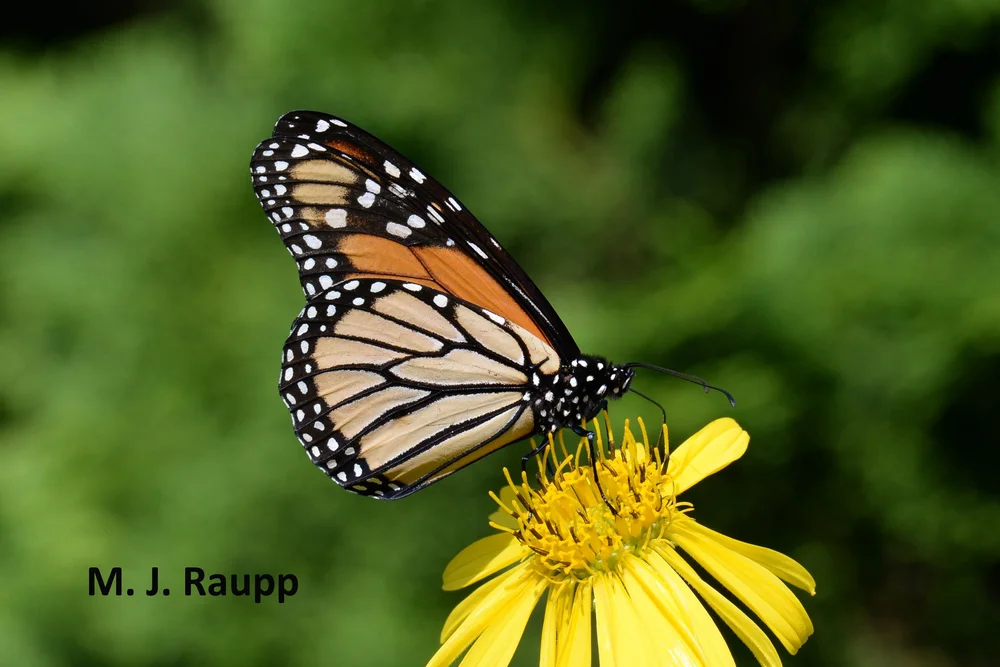
Blossoms of my cup plant, Silphium perfoliatum, are irresistible to many pollinators including Monarch butterflies.
Last week we visited a bevy of black butterflies, part of the hit parade of beauties that annually grace our gardens and meadows. Butterfly season in the DMV seems to have gotten off to a rather slow start and one species whose arrival I always fret about is the majestic monarch butterfly, journeying here from its southern redoubts. The vanguard of Monarch butterflies arrived in Columbia, MD, in mid-April this spring according to iNaturalist. But my Monarch concerns were not fully quelled until last week when a gorgeous Monarch visited my blossom-filled cup plant. Fortunately, butterfly weed in my garden also provides nectar for the Monarch and serves as a good place for her to deposit eggs. This native milkweed provides food for her caterpillars and, hopefully, caterpillars will appear in the garden in a week or two.
Cup plant is irresistible to many butterflies including beautiful Monarch butterflies. With the recent arrival of Monarchs and pockets of butterfly weed growing nearby, it won’t be long before Monarchs lay eggs and small caterpillars appear. Other recent arrivals of migrants to the garden from the south are Large Milkweed Bugs. Ready for action, they are busy making offspring that will soon decorate the seed pods of my milkweeds. So, plant a cup plant and some milkweeds. Enjoy the insects and have some fun.
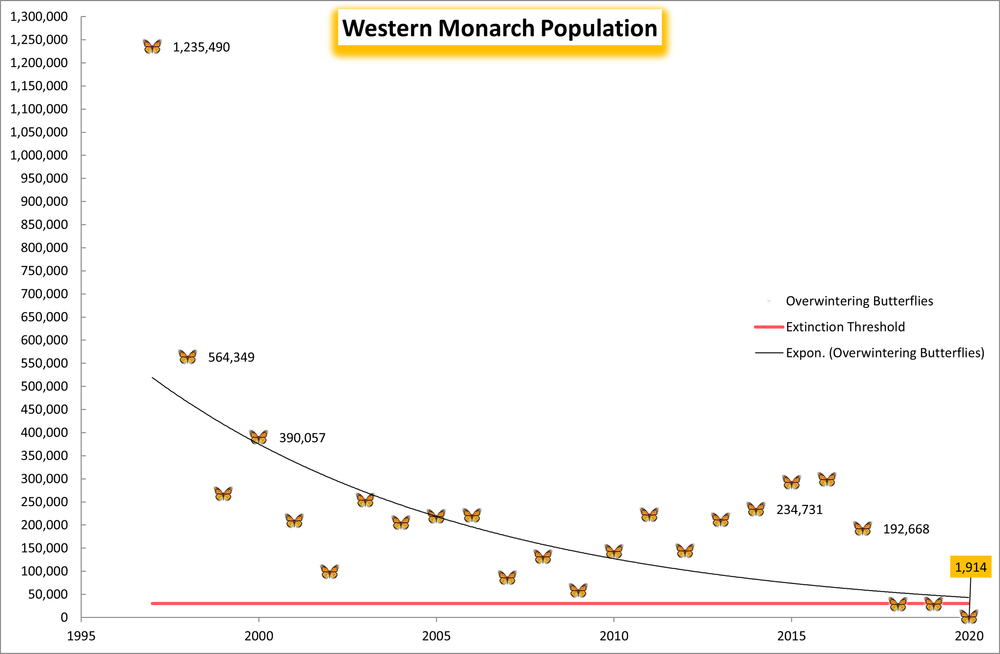
Once again, eastern migratory Monarchs have survived winter and are making their journey northward for another year. But how are these peripatetic marvels doing in general? Two years ago, we learned that populations of both eastern and western migratory Monarchs had declined dramatically from levels recorded in the 80’s and 90’s. Well, according to data reported by the Xerces Society, overwintering populations of eastern migratory monarchs in the mountains of Mexico expanded from 4.42 acres in 2025 to 7.24 acres in 2026. Some good news there but scientists noted that these population levels are still “well below historic norms.”
Some additional good news recently reported by the Xerces Society reveals that some Monarchs overwintering in northern Florida, rather than in Mexico, may migrate northward thereby bolstering migrations of their endangered Mexican-based kin. These smidgens of hope do not extend to all migratory North American Monarchs. Sadly, populations of western migratory Monarchs continue to flirt with collapse. The January 2025 overwintering counts of western Monarchs were the third lowest since records have been kept. Their populations hover around and often sink below a hypothetical extinction level.
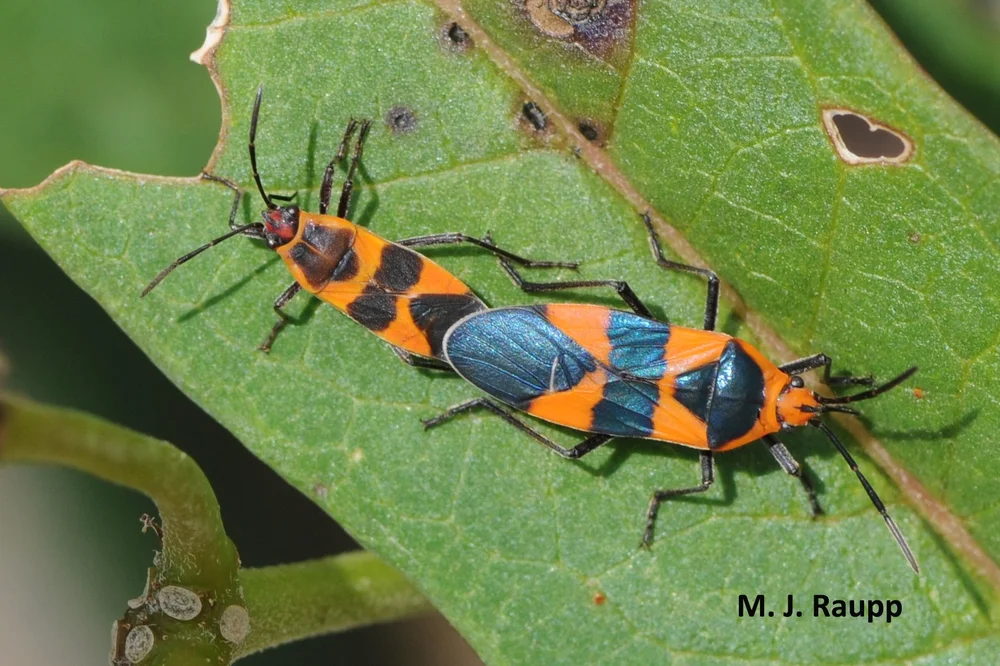
Migratory Large Milkweed Bugs arrived on my butterfly weed ready for action and got to the business of making offspring.
One migratory vagabond that seems to be prospering just fine is the Large Milkweed Bug. Some ento-enthusiasts might think that this bug hangs around the DMV all year, but truth be told, this orange and black harlequin arrives in our region from the south in late spring and early summer. Adults lay eggs on milkweed pods and immature stages called nymphs use sucking mouthparts to obtain vital nutrients from developing milkweed seeds. As milkweeds wane in autumn, Large Milkweed Bugs migrate to warmer zones. While reveling in the discovery of my monarch butterfly, I glanced down at my butterfly weed and discovered several Large Milkweed Bugs dashing about the milkweeds, engaged in the business of making offspring. It won’t be long before their tiny orange and black nymphs decorate the stems and pods of my milkweeds.
To help our struggling migratory Monarch butterflies, the Xerces Society recommends the following:
· Discover milkweed and nectar plants native to your region and plant a pollinator garden.
· Reduce your reliance on pesticides and make changes to how you manage pest issues in your community, nursery, home, farm, and other places in your community.
· Participate in the tri-national International Monarch Monitoring Blitz this summer. Report monarchs any time of year, in any country to iNaturalist or another monarch community science program.
· Find additional ways to help the eastern and western monarch populations, including supporting the protection of overwintering sites in California and restoring breeding habitat in key regions of the United States.
· Support the Xerces Society, a science-driven nonprofit working on solutions for monarchs and other butterflies.”
These practices are good not only for Monarch butterflies but also for other fascinating denizens of milkweed including Large Milkweed Bugs. Plant some milkweeds and enjoy!
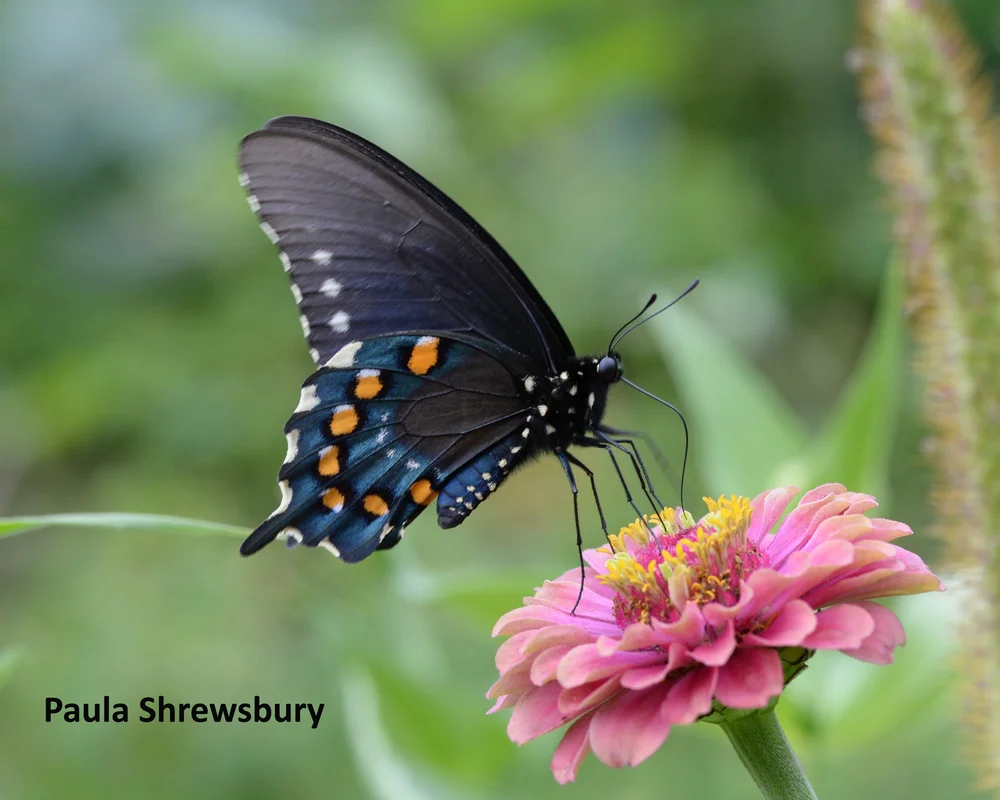
Color and pattern of the gorgeous pipevine swallowtail warn predators of a nasty surprise should they dare to attack. Image: Paula Shrewsbury, PhD
Here in the DMV, butterfly season is off and running at full force. A visit to a pollinator garden or meadow is rewarded with an array of several beautiful butterflies whose dominant wing coloration is based on the theme of a black background with series of patches and spots in shades of white, orange, and blue. Butterflies participating in this cabal include the dark form of the eastern tiger swallowtail, the pretty red-spotted purple, the eastern black swallowtail – eater of parsley and dill, and the clever spice bush swallowtail whose larvae mimic serpents. Why have these beauties converged on a rather common color scheme?
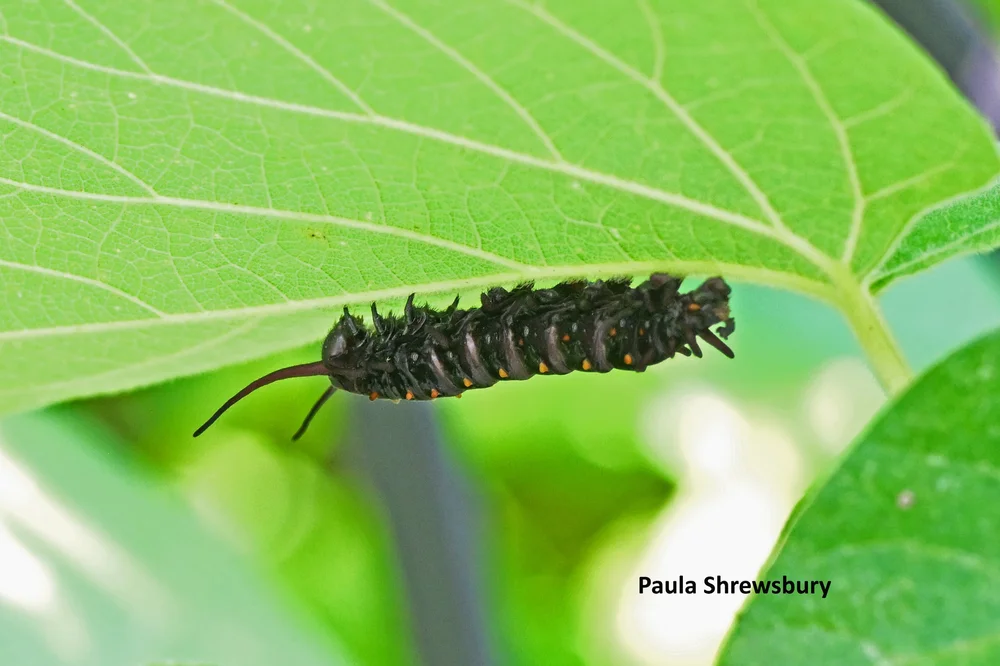
As caterpillars feed and grow, they accumulate noxious compounds and take on a startling visage, complete with fleshy dangling appendages and orange bumps advertising their distastefulness. Image: Paula Shrewsbury, PhD
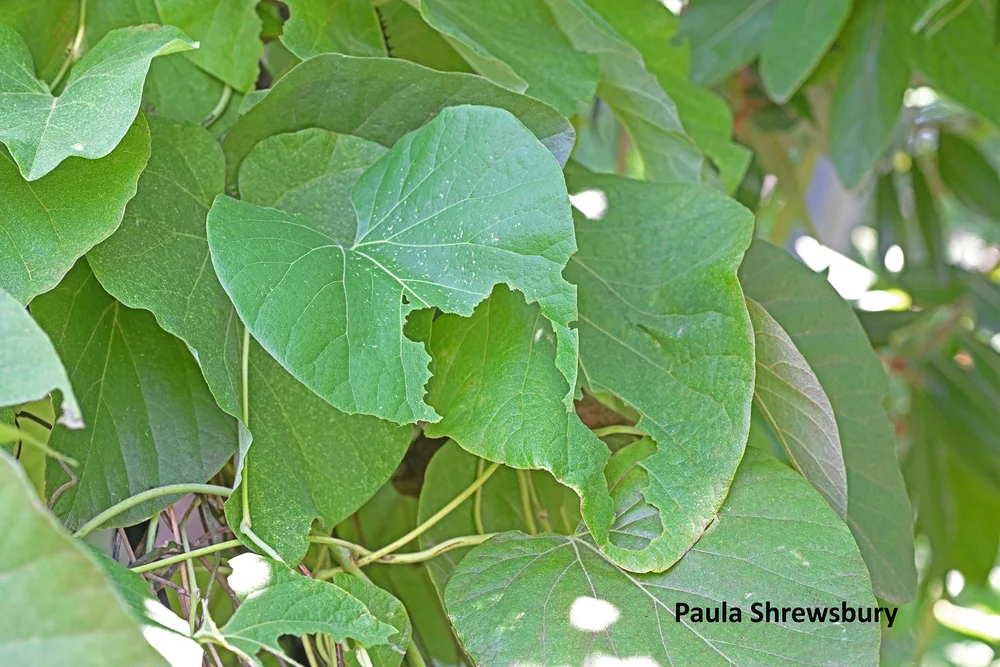
Caterpillars of the butterfly that we meet today, the pipevine swallowtail, dine on members of the birthwort family, Aristolochiaceae, plants that include vines commonly known as pipevines. Members of this family produce a class of compounds known as aristolochic acids which are known to be mutagenic, carcinogenic, and toxic to kidneys of mammals. As they consume pipevine leaves, these swallowtail caterpillars store aristolochic toxins in their tissues, and then retain them as they pupate into adult butterflies, which then pass them along to their eggs. Aristolochic acids sequestered by caterpillars may help protect them from attack by parasitic wasps. Adult butterflies are rendered distasteful to vertebrate predators such as birds by virtue of these noxious compounds. It is believed that birds attempting to eat butterflies whose larvae consumed pipevines have a nasty experience that teaches them not to mess with darkly colored butterflies.
Leaves of the pipevine contain noxious and toxic compounds that help protect pipevine caterpillars and swallowtails from their enemies. Image: Paula Shrewsbury, PhD
Other species of butterflies capitalize on the lesson taught by the pipevine swallowtail and have evolved color patterns to mimic their appearance, thereby gaining protection from visually astute predators. This type of mimicry in which warning colors of a distasteful species like pipevine swallowtails act as a model copied by other palatable butterflies is called Batesian mimicry. The great English naturalist Henry Bates first described this form of mimicry while studying butterflies in Brazilian rainforests. We met other species of Batesian mimics such as harmless flower flies that mimic stinging bees and wasps.
This gorgeous resting pipevine swallowtail will soon seek pipevines on which to deposit brightly colored orange eggs that hatch into tiny caterpillars. As these very hungry caterpillars feed and grow, they accumulate noxious compounds and take on a startling visage complete with fleshy dangling appendages and orange bumps advertising their distastefulness. Other darkly colored butterflies, including the dark female form of the eastern tiger swallowtail, the spice bush swallowtail, the eastern black swallowtail, and the pretty, red-spotted purple are believed to mimic the color pattern of the pipevine swallowtail to gain protection from hungry predators.
Adult butterflies are not the only creatures that mimic pipevine swallowtails. Recall that the caterpillars are also laced with aristolochid acids. Scientists believe that a cyanide producing millipede with deep red coloration mimics the color and pattern of the pipevine caterpillar, thereby gaining protection from predators. We have seen this mimicry before with several orange and black insects that eat milkweed including monarch caterpillars, milkweed bugs, and milkweed tussock moth caterpillars. This convergence on a similar, easily recognizable color pattern by two or more nasty-tasting insects is called Müllerian mimicry, named for the famous German naturalist Fritz Müller. As this spectacular butterfly season rolls along, try to grab a glimpse of one of these dark winged beauties and ponder the question – model or mimic?
Acknowledgements
Bug of the Week thanks observant Dr. Shrewsbury for spotting adults and larvae of the pipevine swallowtail and providing images featured in this episode. “Secret Weapons” by Thomas Eisner, Maria Eisner, and Melody Siegler, and “Featured Creature Common name: pipevine swallowtail, blue swallowtail scientific name: Battus philenor (Linnaeus 1771) (Insecta: Lepidoptera: Papilionidae: Papilioninae: Troidini)” and “Common name: Polydamas swallowtail, gold rim swallowtail, tailless swallowtail scientific name: Battus polydamas lucayus (Rothschild & Jordan) (Insecta: Lepidoptera: Papilionidae: Papilioninae: Troidini)” by Donald Hall provided valuable insights into the clever ways of this week’s star.
Recent press releases cautioned travelers to take precautions to avoid bringing bed bugs home from trips abroad, and earlier this spring bed bug “surges” were reported across several southern states. During a visit to a senior housing facility last month, several residents expressed concern about reports of bed bugs in their community. So, this week we return to an episode from a few years ago when stories swirled about concerning bed bugs in the DMV.
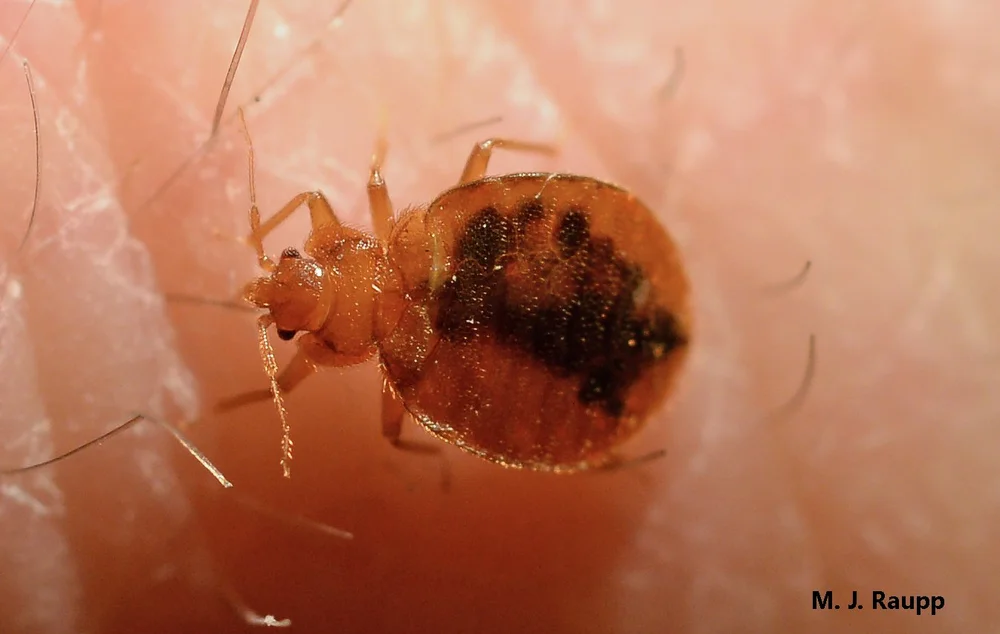
“Over the past decade we heard stories of bed bugs appearing in places without beds including office buildings, movie theaters, schools, and retail stores. How do bed bugs work and what is behind this recent upswing in bed bug detections, especially in our major cities? Like many obligate parasites, bed bugs lead an interesting, albeit codependent life. They must have a blood meal in all stages of development, except eggs, to survive. By inserting tiny sucking mouthparts and pumping in saliva laced with anticoagulants, bed bugs can take in several times their weight in blood in a feeding bout lasting from 3 – 10 minutes. They will bite any part of the body including the face, neck, shoulders, arms, and legs. When temperatures are warm, it takes less than a month to complete a generation and when cooler it may take 4 months to complete the life cycle. Like other true bugs, these have scent glands that give them a distinctive odor, and a sweet smell sometimes accompanies a heavy infestation.
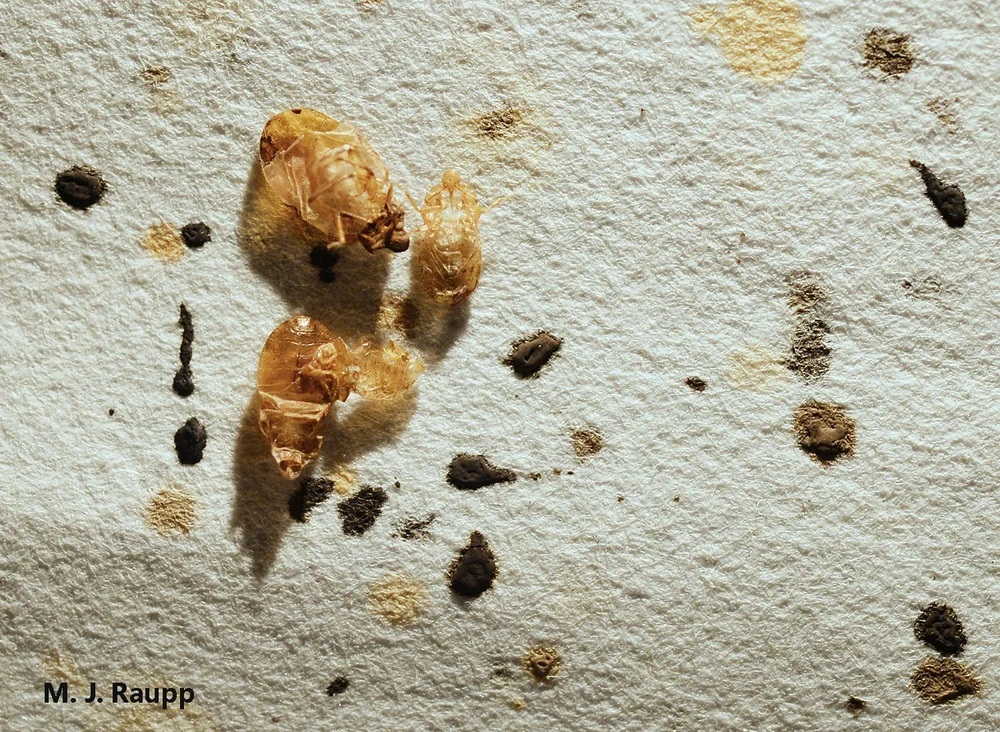
Shed skins and dark spots of excrement on a sheet or a mattress are clues of a bed bug infestation.
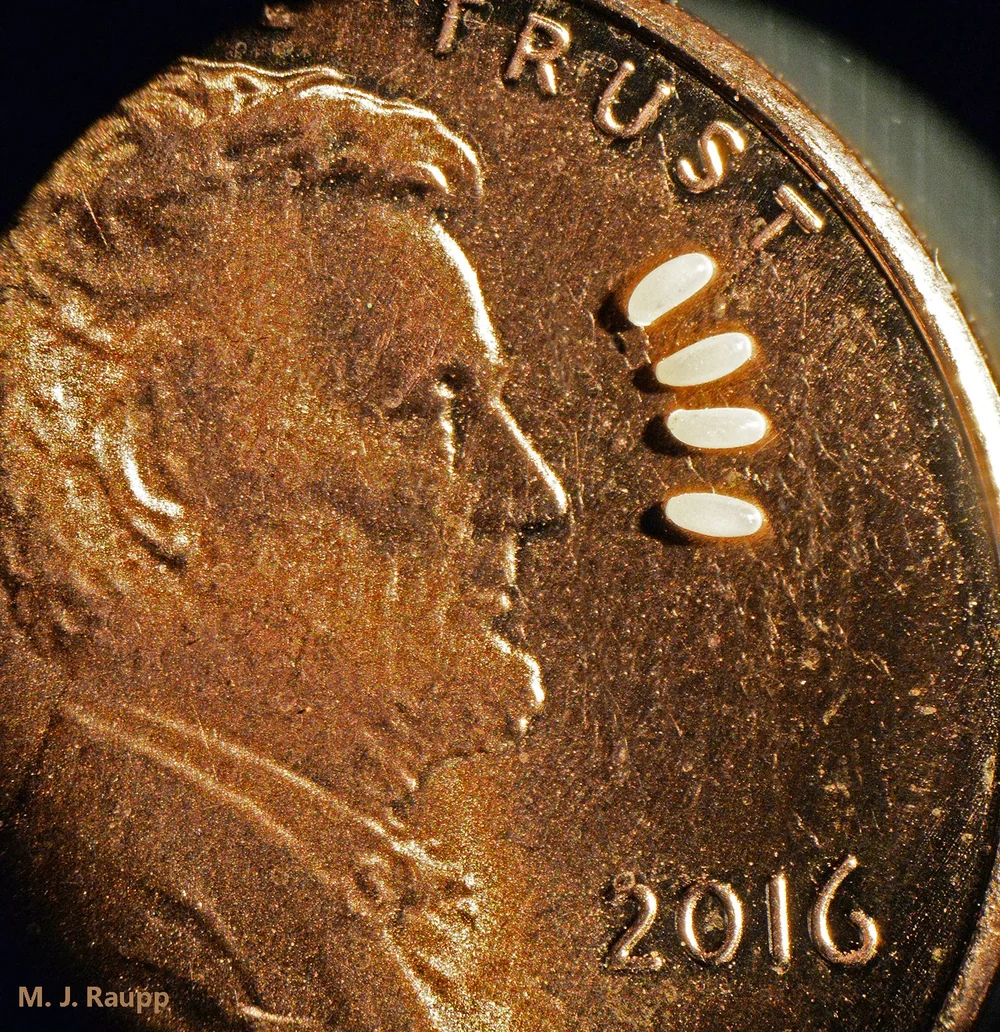
Bed bugs are tough. Nymphs can live several months without a meal and at certain temperatures adults are reported to survive more than a year without food. Females lay 200 to 500 eggs during their lifetime. The eggs are roughly the size of a period at the end of a sentence. The immature stages, the nymphs, are reddish brown when full of blood and tan when empty. Adults are about the size of a peppercorn and brown to chestnut colored when empty or full of blood, respectively. During the day, bed bugs usually hide in bedclothes, mattress seams, box springs, spaces in the bed frame, behind the headboard, baseboards, picture frames, chests of drawers, posters, loose wallpaper, and almost every nook and cranny in the bedroom. I have heard many tales of couches and living room furniture harboring these rascals, as well as seats in theaters. In offices, reports abound of infested work cubicles, where clutter and file cabinets provide small spaces in which bed bugs can hide. Bed bugs likely arrive in businesses and schools as hitchhikers from infested homes, traveling on clothing, book bags, backpacks, or briefcases.
Not much to say about this video. Enjoy the music and watch as a bed bug gains up to seven times its body weight as it tanks up on my blood at three times actual speed.
Several hypotheses explain the marked increase in reports of bedbugs in dwellings, schools, college dormitories, hotels, hospitals, and elder care facilities. Prior to the Second World War, bed bugs were commonplace in detached homes and multifamily dwellings in the US. The advent of insecticides such as DDT after the Second World War greatly reduced the incidence of bed bugs in this country and abroad. Indoor pests including cockroaches and ants were targets of liberal applications of potent residual insecticides. These practices also probably knocked down populations of bed bugs. A shift away from broadcast applications of DDT to targeted approaches using traps and baits for indoor pests may have opened the door for bed bugs to reappear as major pests. Moreover, one class of insecticides called synthetic pyrethroids became a mainstay for controlling indoor pests, including bed bugs. Studies revealed widespread resistance of bed bugs to some synthetic pyrethroids, rendering this class of insecticides far less effective in killing bed bugs than when these products first came into use. Another piece of the bed bug puzzle lies with an increase in international travel to regions of the world where bed bugs are common. International travel provides opportunity for these clever stowaways to enter this country. Bed bugs readily hide in concealed places such as luggage, and due to their small size and cryptic habits they travel right along with globetrotters. We have not yet found a wall tiny enough to keep bed bugs out of our nation. A third factor identified with the uptick in bed bug infestations is the exchange of secondhand furniture. Used sofas, bedding, chests of drawers, and other furniture provide great opportunity for bed bugs to move from one home to another.
President Lincoln sees just how small bed bug eggs really are.
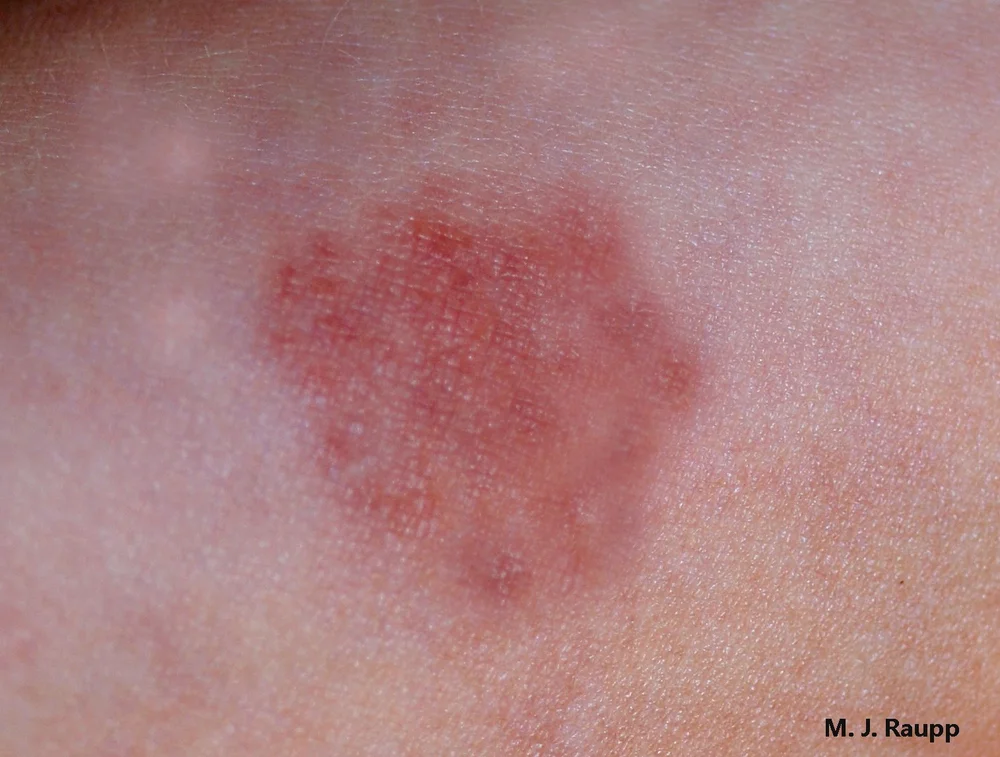
There is some good news in this story. First, DC has done a good job in licking the bed-bug-in-school problem and students should soon be back to their regular classrooms. The second piece of good news is that bed bugs are not known to be carriers of human disease. However, following a bed bug bite, the human body reacts to proteins injected into the skin by the bug as it feeds. The reaction to the bite is highly variable and ranges from nothing to large itchy red welts. My reaction appears within a day but for others, welts can appear weeks after an encounter. According to a study by Michael Potter and his colleagues at the University of Kentucky, for many people, the reaction to the bite is minimal. Factors such as gender and ethnicity do not seem to affect the strength of one’s reaction to a bite. Age, however, apparently does. The elderly are less likely to react to bed bug bites than younger folks. This is not good news because bed bug bites are often a harbinger of an incipient infestation. More importantly, these findings underscore the need for a high level of bed bug awareness and vigilance in facilities providing care and housing for seniors who may not know that they are being bitten.
This is a common skin rash where bed bugs fed on a sensitive individual.
How can you avoid bed bug infestations? When you travel be aware of your surroundings. If you stay in a hotel, inspect your bed. Look for the bugs or their telltale signs such as shed skins or dark excrement spots on the mattress, especially along the tacking. Use a small flashlight to look on the bed frame and behind the headboard. To reduce the risk of little stowaways entering your luggage and coming home with you, elevate your suitcase, place it on a luggage stand. Keep soiled and clean clothes in sealed plastic bags. Do not toss worn items on the floor. After returning home, vacuum out all luggage and toss your clothes into the dryer. By exposing clothing, bedding, backpacks, and other items to dry heat of 120°F or better for 20 to 30 minutes, all life stages of bed bugs will be killed. Portable heating boxes are available to heat items that might be damaged or are too large for dryer. Avoid creating an infestation in your home with used furnishings. Beware of secondhand furniture, especially bedroom items. Be sure to inspect thoroughly any used mattresses, box springs, bed frames, nightstands, and mirrors. College students returning to campus should resist the urge to go dumpster diving for dorm-room or apartment furnishings! This is a good way to move infested furniture into your room. Experts recommend the use of bed bug – proof encasements for mattresses and box springs. Bed bugs love to hide in these places and encasements force them into the open where they are more easily detected. Small entrapment devices can also be placed under the legs of the beds or sofas. Bed bugs climb in but cannot climb out. This makes detection easier even when populations are low.
Bed bugs, tiny vampires of the night, scatter when exposed to bright light or cling to each other in a roiling ball of bugs large and small.
Unusual bites may be your first sign of an infestation. If you suspect an infestation, confirm that the cause of the bites are human bed bugs and not another arthropod or closely related bug associated with bats or birds that have entered your home. To do this you will need to capture one of these rascals and have it identified by an expert. Bat bugs and bird bugs are common and often mistaken for bed bugs. If bird or bat bugs invade, then the solution is to eliminate the nest (birds) and exclude birds and bats from the house with screening and repair of structures. If you confirm a bed bug infestation, you may not want to go it alone. A professional pest control operator will have tools, techniques, and an integrated pest management (IPM) plan to detect and deal with the problem. Some commercial firms employ bed bug sniffing dogs to detect infestations. Unlike their handlers, these canines work for kibble. They are extraordinarily adept in finding bed bugs. Once an infestation is confirmed, the solution will involve more than one visit. Professionals may use a variety of management approaches involving treatments of heat or cold, the application of EPA registered insecticides, and a variety of other methods to exclude and thwart these bloodsuckers. Some things that you can do to help these professionals is to reduce clutter in the bedroom and around the home, vacuum floors and baseboards thoroughly and repeatedly, wash all bedclothes in hot water, and discard or encase infested mattress and box springs. Ridding a school, home, apartment, office, business, theater, hotel, health care facility, or any structure infested with bed bugs involves a serious ongoing commitment of time and resources by all parties involved – administrators, parents, renters, occupants, owners, property managers and pest management professionals. As bed bugs become more widespread and commonplace, early detection, rational discussion, and carefully designed and executed management programs will help us deal with these disagreeable characters.”
Acknowledgements
Special thanks to my colleagues for providing bed bugs videotaped and photographed for this episode. Stimulating discussions with Reg Coler, Larry Pinto, and Rich Cooper provided much of the insight for this story. The fascinating articles “[Bed Bugs] The Sensitivity Spectrum: Human Reactions to Bed Bug Bites” by Michael F. Potter, Kenneth F. Haynes, Kevin Connelly, Michael Deutsch, Erich Hardebeck, Don Partin, and Ron Harrison, and “Insecticide Resistance in the Bed Bug: A Factor in the Pest’s Sudden Resurgence?” by Alvaro Romero, Michael Potter, Daniel Potter, and Kenneth Haynes were used as references for this episode.
For more information on bed bugs, please visit the following websites:
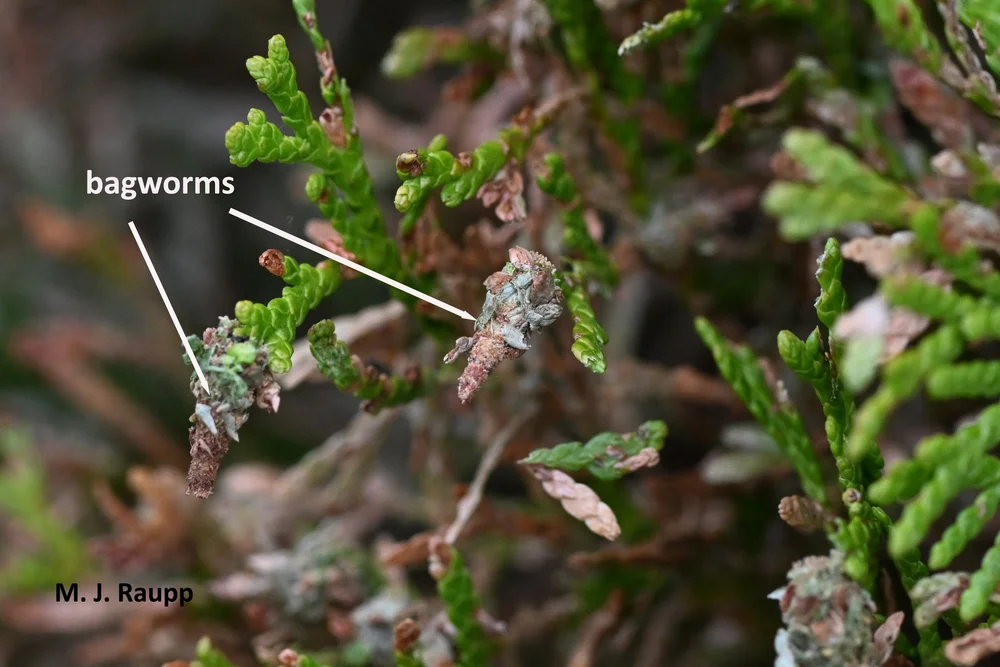
It’s easy to see why small bagworms may be overlooked early in the season.
Inertia is a property whereby objects in motion tend to stay in motion and objects at rest tend to stay at rest. One of the finest examples of inertia is the inexorable annual disappearance of evergreens down the gullets of bagworms. Bagworms are objects in motion. Sometimes, as I witnessed recently, property owners are too often objects at rest. Here’s why. Last week I stopped by my favorite coffee shop and as I sipped, I noticed a peculiar aberration in a lovely planting of arborvitaes lining the parking lot. Smack in the middle of the row of emerald beauties was one decidedly ugly brown rogue. Victim of too much mulch, too little water, or girdling plastic around the root ball, perhaps? Nah, a closer examination revealed hundreds of tiny bagworm caterpillars whose busy jaws were shredding foliage, transforming the evergreen to ever brown.
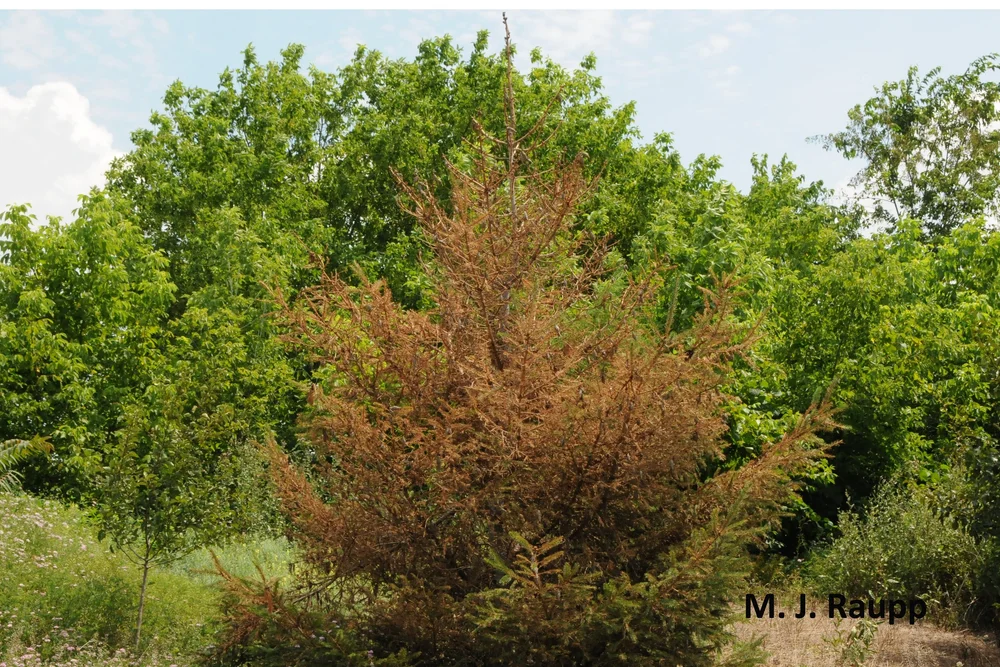
Hundreds of small bagworm caterpillars hatched in spring and now have shredded foliage on this pretty arborvitae.
Populations of bagworms seem to be on the rise again in the DMV. Whether it’s favorable weather, a dearth of natural enemies, climate change, or just bad luck, bagworms have returned in force to many places in our region. Bagworms have been reported to feed on more than 100 species of plants in our area. They are most damaging to evergreens such as juniper, spruce, arborvitae, pine, and Leyland cypress; however, they will consume a wide variety of deciduous trees and shrubs with equal gusto. Complete defoliation of an evergreen such as pine, arborvitae, or spruce can kill the tree in a single season. Deciduous trees such as sycamore or maple are much more tolerant of this abuse, as they may be able to produce new leaves if defoliation has not occurred too late in the season. If you have bagworms on your plants, especially evergreens, you may be in deep trouble as you read this story. But if your conifers are not yet knocking on heaven’s door, this is a good time to save them for years to come.
Oh no, what’s up with this brown arborvitae? Hundreds of tiny bagworm caterpillars, that’s what. Some are dining on foliage, others are adding silk to their bag from silk glands on their mouth, others are relocating their shelter, and some are just hiding from the camera. In another month or so, tiny caterpillars will be more than an inch long, performing aerial acrobatics as they move about. Left unchecked, this is what bagworms will do to an evergreen tree, sorrow and death may await these evergreens.
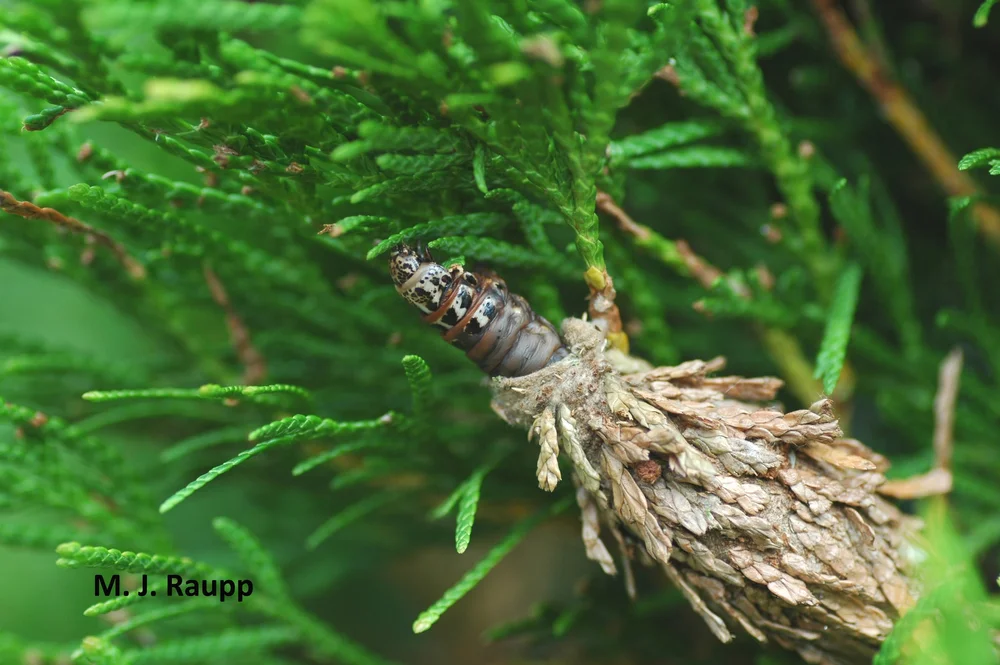
The bagworm is named for its curious habit of carrying about its refuge, a bag woven of silk and plant parts. Back in May, eggs of bagworms completed their development inside overwintered bags dangling on trees. Tiny caterpillars hatched and emerged from the bottom of the bag. Some stayed put on their natal plant while others ballooned on silken threads to other plants nearby. Caterpillars construct and enlarge their bags as they grow. People sometimes confuse the bagworm's bag with a plant part such as a pinecone. This makes detection a problem. However, a closer look at the bag, especially on a warm summer’s day, often reveals the head and legs of the caterpillar as it moves about eating leaves or needles. By late summer, larvae complete their development, securely attach their bags to twigs with silken threads, and pupate within the bags.
By late summer, fully developed bagworms like this one can be easily removed from plants to reduce problems next year.
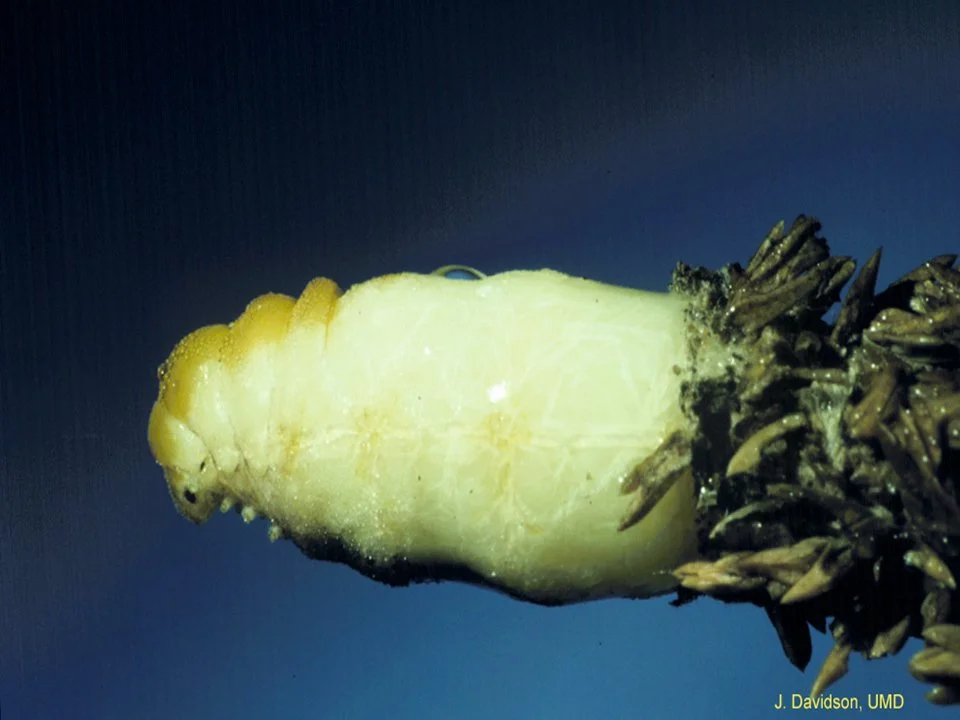
After a few weeks, the male bagworm, a black moth with clear wings, emerges from his bag and flies to find a mate. The female, a maggot-like wingless sack of eggs, releases a pheromone, a sex attractant, to lure the male to her bag. After attracting her mate, the female bagworm does not emerge to greet him. Instead, she remains in her bag, hidden from her mate during the conjugal visit. After mating, she lays from several hundred to more than 1,000 eggs in the bag, and then, like a tragic Greek heroine, she dies, leaving her eggs behind to hatch next spring.
Grotesque adult female bagworms are wingless. No wings translate to more eggs and females can lay hundreds. Image: John Davidson, PhD
If bagworms are no longer actively feeding or moving, the damage is done and applying insect sprays is useless. So, don’t do that. However, if large bagworms are still active, it is not too late to nip next year’s incipient bagworm explosion in the bud. Removing bags by hand can be very effective in halting an outbreak, so put on a pair of gloves, grab a garbage bag, and start pickin’. As you remove the bagworms, be sure to collect them in a container or bag, seal it tightly, and dispose of them. Do not simply toss bagworms on the ground or in the driveway. Displaced bagworms are relentless and they will return, crawl up your tree, and resume their feast. If offending bagworms have completed development in late summer or early autumn, you can dramatically reduce the population next year by removing the egg-laden bags now.
Unchecked, bagworms can completely defoliate evergreens, which may result in tree death.
Returning to the present, what can be done now to reduce the carnage? Large numbers of tiny bagworms may be too numerous to be picked by hand. If the caterpillars are small, you may be able to control them with a thorough application of an insecticide such as biologically based, Bacillus thuringiensis (Bt). Some formulations of Bt are listed by the Organic Material Research Institute (OMRI) as safe to use in the production of organic foods you purchase in the market. Bt works well on small caterpillars. If caterpillars are larger, an insecticide containing the OMRI listed, reduced risk active ingredient called spinosad works well to control bagworms.
Remember, as we approach the middle through the end of August in the DMV, bagworms will have completed their development and sprays on foliage will not kill pupae, adults, or eggs. Physical removal is your best alternative from late summer until May of next year. Sometimes natural enemies including birds, wasps, and voracious predatory bugs kill enough bagworms to quell an outbreak, but I would not count on it. Take stock of your bagworm situation, make a plan, and snap to it!
Acknowledgements
Information for this Bug of the Week came from “Managing Insects and Mites on Woody Landscape Plants: An IPM Approach” by J. A. Davidson and M. J. Raupp. For more information on bagworms check out the following website: https://extension.umd.edu/resource/bagworms-trees-and-shrubs/
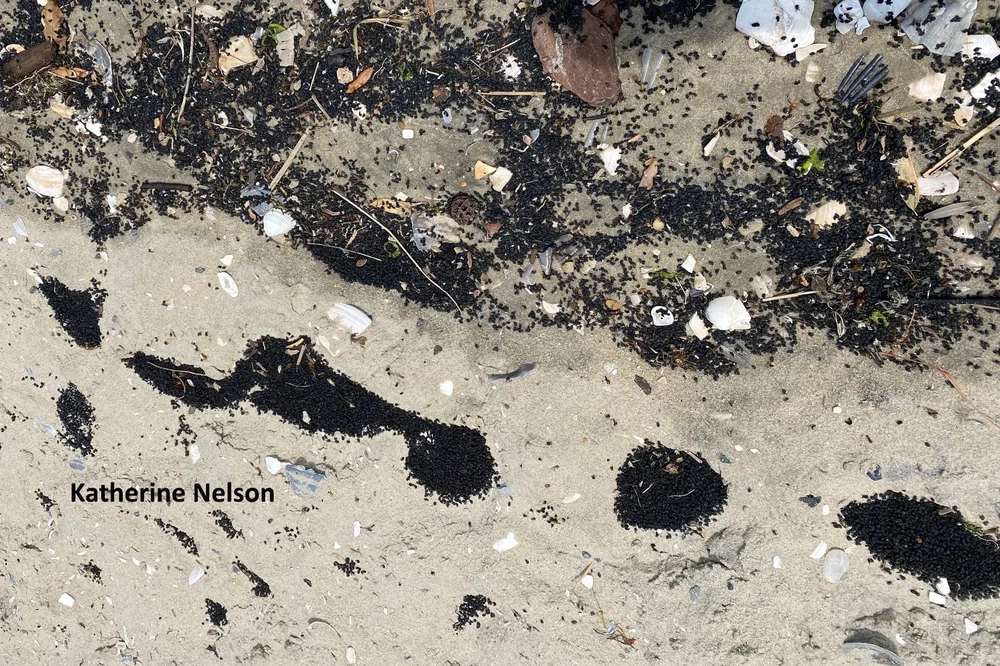
Masses of Yellow Poplar Weevil adults washed onto the shore of the Chesapeake Bay near Calvert Cliffs in Maryland. The black piles you see on the sand are thousands of weevil adults. Image: Katherine Nelson
Every now and then, for reasons known or unknown, some of our native insects go wild and reach astounding numbers, creating some concerns and damage. Earlier this year we met an outbreak of native caterpillars defoliating hundreds of acres of native hardwood trees in Western Maryland. In June of 2021, you may recall a report of thousands of periodical cicadas that appeared on the beaches of the Chesapeake Bay. Well, earlier this month an avid beach comber reported “billions” of robust tiny beetles lining the western shore of the Chesapeake for more than a mile near Calvert Cliffs, MD. Some were dead but many were alive, clinging to beach wrack and each other along the shoreline. These waterlogged insects were Yellow Poplar Weevils (YPW), a native insect that reached outbreak levels in 2025 in nurseries and landscapes here in the DMV. To learn a bit more about this strange event, we spoke to Professor Paula Shrewsbury of the University of Maryland, an expert in the management of pests of ornamental plants. Her comments are excerpts from weekly reports prepared for the Green Industries of the Mid-Atlantic region in 2025 and 2026.
“These types of “wash ups” are often related to winds and water currents, and the weevil’s (YPW) ability to float. Environmental conditions came together this week that resulted in so many weevils on the shoreline. In looking into this, there have been other reports of similar wash up phenomena of YPW in MD and VA over the years.”
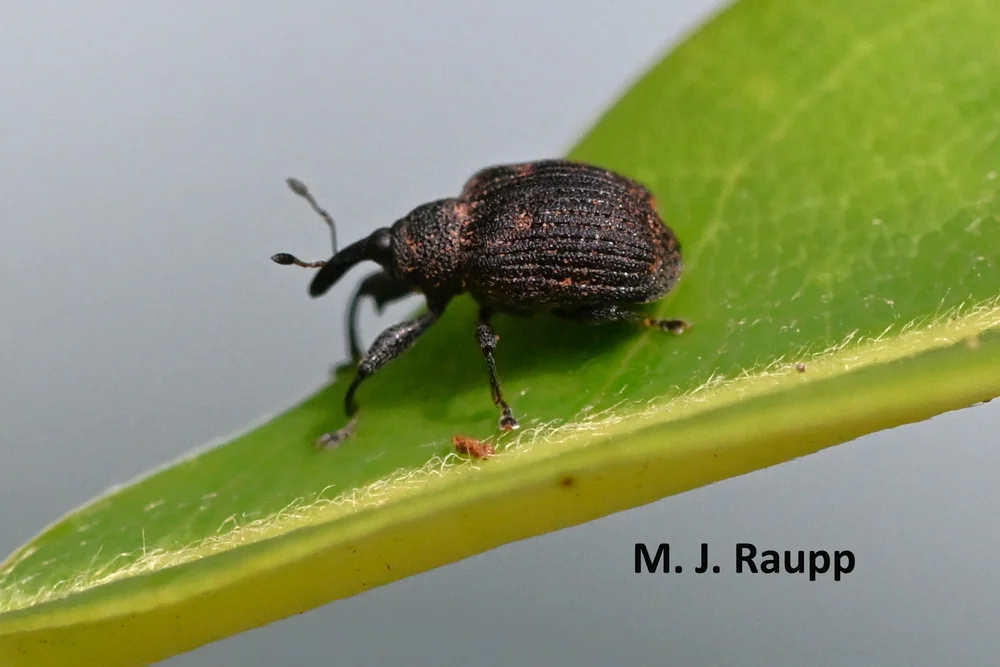
Piles of small black beetles are composed of thousands of Yellow Poplar Weevils that washed up on the shores of Chesapeake Bay in June. Tiny jaws on the snout of the beetle damage leaves on several kinds of ornamental plants. Watch as one of these tiny terrors moves along stems and leaves of a yellow poplar, a.k.a. tulip tree, and a closeup of the small beetle on a magnolia leaf. Recently, it has been raising havoc in commercial nurseries and landscapes in the DMV. Images by Katherine Nelson, Michael Raupp, and Paula Shrewsbury, video by Marie Rojas and Michael Raupp.
“Monday, June 9th, [2025] I was contacted by two nurseries in Frederick County, MD describing extremely high numbers of native yellow poplar weevil (YPW) adults, Odontopus calceatus (Coleoptera: Curculionidae), on magnolias and they were causing significant damage to the newer foliage. This is a new pest to me and as I searched for information, I found reports of YPW in recent days from VA, DC, and OH. This weevil is known to sporadically outbreak. In an article from Penn State Extension on YPW published in 2015, they reported extremely high densities of YPW in PA and the mid-Atlantic and stated that the level of outbreak then had not been seen since 1968.
Host plants of YPW include magnolias, sassafras, tulip tree (yellow poplar) and sweet bay. YPW’s life cycle consists of one generation per year and YPW activity is reported to occur from mid-late May through mid-July. YPW overwinter as adult weevils in the leaf litter under their host plants. In the spring / early summer as the weather warms, adult weevils emerge and feed on the buds and newer foliage of their hosts with their chewing mouthparts, mate, and lay eggs in the mid-vein on the lower leaf surface. Newly hatched larvae chew into the leaf tissue and feed as leaf miners. Multiple leaf miners can be found in a single leaf. Larvae pupate within the leaf mine.
At the tip of the elongated snout, tiny mandibles of the Yellow Poplar Weevil chew holes in leaves and damage many types of plants.
Adults emerge and use their chewing mouthparts on the end of their long “snout” to feed on leaves (usually newer, tender leaf tissue), stems, and flowers resulting in crescent-shaped (more or less) brown etching in the tissue. Feeding results in leaf curling and distortion, and premature leaf drop. YPW are reported to cause the most damage during this time. Around mid-July or so YPW adults enter a period of aestivation (summer inactivity) and enter the leaf litter, where they overwinter. Areas that are under drought conditions seem to suffer from YPW more.
Feeding by Yellow Popular Weevil results in ugly lesions on plant leaves. Image: Paula Shrewsbury, PhD
What else do we know? As of now, I have only seen and had reports of adult weevils being active and causing damage, and only on Magnolia in two nurseries. There are high populations of adults, and they are causing lots of damage, and the damage happens quickly. Monitor hosts of YPW now! Magnolia species / cultivars appear to vary in the amount of YPW adult activity and damage they are receiving. It appears that varieties that still have tender newer foliage are getting hit worse than those with foliage more hardened off. Weevil adults are being seen on non-plant structures (ex. plant poles / signs) and other plants (ex. dogwoods near the magnolias – but I did not see damage on the dogwoods as of Monday).”
Weevils ravaged plants in nurseries and landscapes this year. Image: Paula Shrewsbury, PhD
Scientists report that following years of outbreaks, YPW populations decline dramatically. Upticks of predators and several species of parasitic wasps and late spring frosts are implicated in these population collapses.
Of the many comments that have appeared in response to the appearance of YPW, people have wondered if YPW is “the lesser of two weevils” and noted that these weevils are now “all washed up.”
Acknowledgements
Sincere thanks to Dr. Shrewsbury for allowing us to reprint information from her reports and for sharing images of the YPW. Thanks also to Marie Rojas for contributing her images and videos of the weevil. Thanks to Katherine Nelson for providing the inspiration for this episode and sharing wonderful images of waterlogged weevils she spotted on the shores of the Chesapeake.
For more information about the Yellow Poplar Weevil life cycle, ecology, damage, and management, please click the following links:
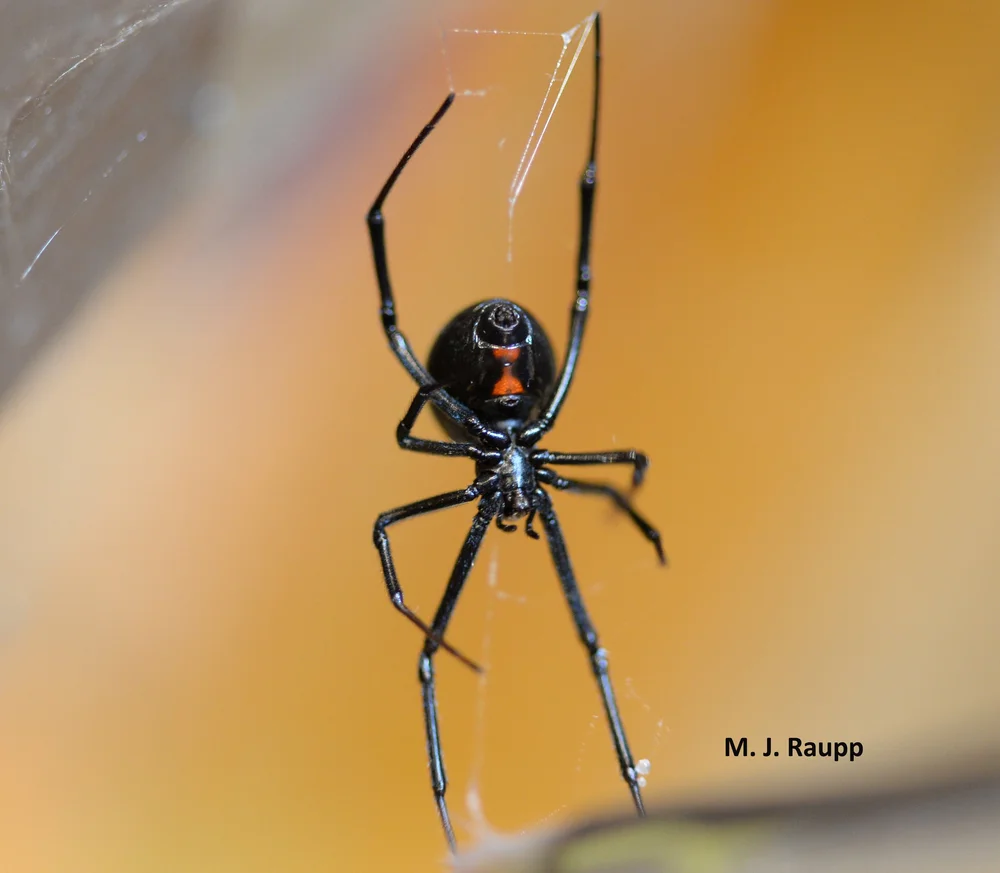
Another common name for a black widow spider is an hourglass spider. Guess why!
Last week while tidying up a basement walkout, a colleague discovered a gorgeous and very pregnant black widow spider attempting to escape her broom. Fortunately, my colleague did not freak out and punish the spider. After glamming for the camera for a while, the widow casually strolled into a capture jar held by the dauntless homeowner. This beauty, named Lola, enjoyed a photo shoot and will soon be joining her cousins as a full-fledged member of the Insect Petting Zoo at the University of Maryland. Another name for these creepily beautiful arachnids is ‘hourglass spiders’ due to the bright red hourglass-shaped mark on the underside of the abdomen of some species.
What a surprise! A gorgeous female black widow spider making a basement walkout her home. After glamming for the camera for a few moments, she readily investigated a capture jar held in the steady hands of stout-hearted Dr. Shrewsbury. This beautiful spider, now christened Lola, will join more than a hundred of her arthropod kin in the insect petting zoo at the University of Maryland, College Park.
The black widow is arguably one of the most interesting characters in Marvel Comics pantheon of heroes and one of the most dangerous groups of spiders in the United States. The widow’s venom contains a very potent neurotoxin, alpha-latrotoxin. A measure of the toxicity of alpha-latrotoxin, an LD50 of 20 – 40 micrograms per kilogram of body weight, puts it right up with some very deadly snakes. Fortunately, widows do not always inject venom when they bite and even if they do, the quantity is exceedingly tiny. There are five species of widows in the United States, three native species and two non-native species, and they are found in every state except Alaska, but mostly in southern and western states. Widows spin loose webs in protected places such as under logs, stones, or boards, and in angles of windows and shutters. They are commonly found in dumps and in rural areas such as farms and plant nurseries where they frequent barns, sheds, outhouses, and equipment storage areas.
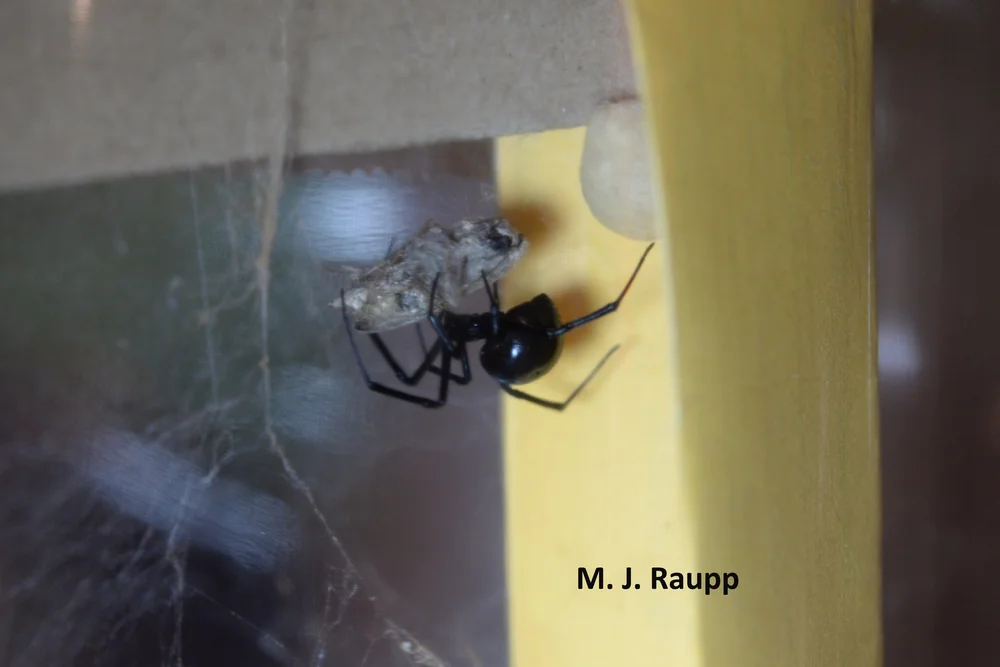
Having paralyzed a hapless moth with venom and wrapped her victim in silk, the black widow will feed at her leisure.
Like most spiders, the fangs of the black widow are used to capture prey and the venom injected through the fangs helps subdue the victim. Also like most spiders, black widows are not aggressive and bite humans only when harassed or accidentally pinched or grabbed. The bite of the widow is usually painless or felt as a pinprick. The more serious symptoms of the bite first appear within 30 minutes to two hours after the bite. These include back pain and muscle cramps that can be severe, rigid muscles in the abdomen, nausea, vomiting, sweating, restlessness and, in some cases, elevated blood pressure. These symptoms are most severe after 3 hours but may persist for many days.
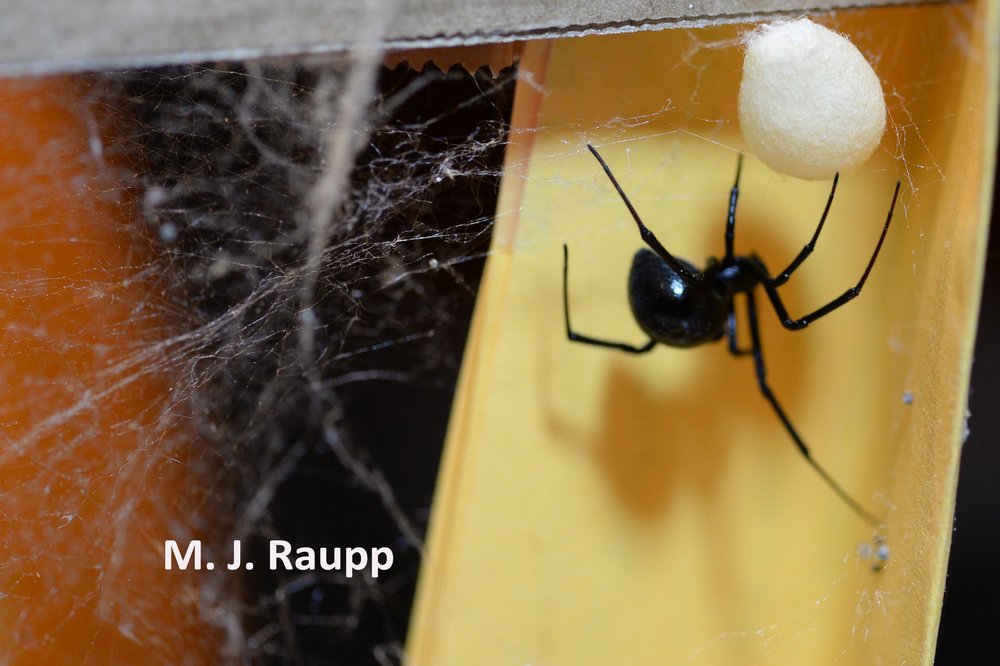
A previous member of the Insect Petting Zoo at the University of Maryland, a gorgeous black widow named Scarlett, glides back to protect her unhatched brood in the egg case after carefully inspecting her gossamer web.
Black widows do not discriminate among their human victims, and envenomation can occur in people of any age. In the U.S., between 2,000 and 2,500 bites are reported each year with the greatest number of bites in children. Lethal bites are exceedingly rare and only three deaths have been reported worldwide in medical literature. Complications associated with black widow bites are greatest for the very young, the very old, and people with cardiovascular disease. The death rate from documented bites occurs in far less than 1% of reported cases. Rapid treatment with antivenin and other medications can greatly reduce the severity and duration of symptoms associated with a black widow bite. Unlike other spider bites, such as those from the brown recluse, there is no terrifying necrotic skin lesion at the site of the bite.
Hundreds of spiderlings hatch from a single egg sac of the black widow and each female can lay several egg sacs annually.
To avoid bites of black widows and other spiders, wear gloves and long-sleeved shirts when you work in areas that might house spiders. Try to reduce clutter such as brush piles, vegetation, trash, and rubbish where spiders might hide outdoors. Do the same for furniture, sports equipment, and clothes indoors. Carefully inspect these items before moving them and store them in containers or sealed bags whenever possible. If you are bitten by a spider, try to collect the spider whether alive and intact or dead and pulverized. This will help a trained arachnologist identify the offending arthropod and help direct the course of therapy. If you or your child is bitten by a black widow spider, seek medical attention immediately. Finally, despite its name, the black widow does not always eat her mate. In fact, in some species of widows the male brings food to his mate. What a guy!
References
Special thanks to courageous Dr. Shrewsbury who discovered and captured Lola, the gorgeous black widow spider featured in this episode. The great spider books ‘Biology of Spiders’ by Rainer Foelix, “Black widow spider” by Steve Jacobs, and the fact filled article “The Treatment of Black Widow Spider Envenomation with Antivenin Latrodectus mactans: A Case Series” by Steven R. Offerman, G. Patrick Daubert, and Richard F. Clark served as references for this episode.