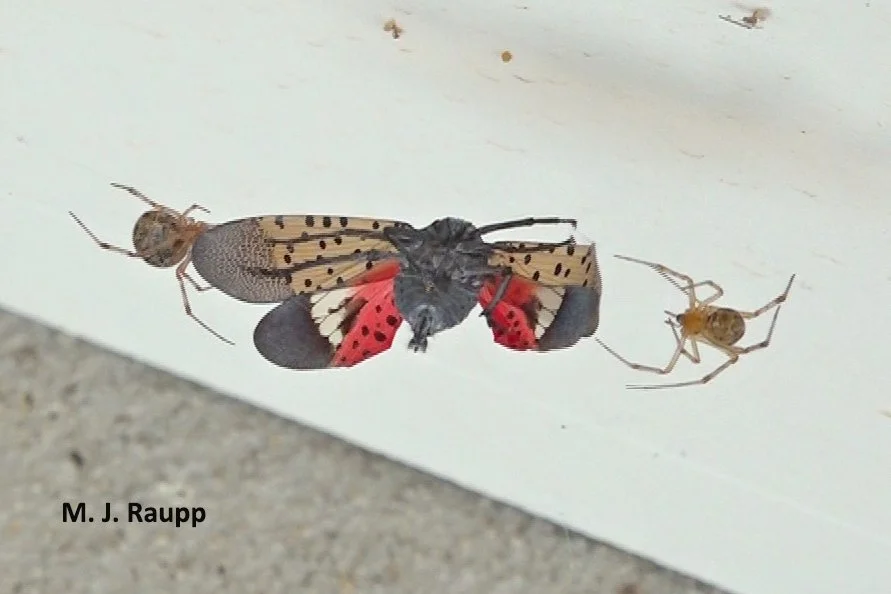
A pair of common house spiders team up to take down a spotted lanternfly.
Back in the initial years of the invasion of spotted lanternflies here in the DMV, local officials were uncertain if indigenous species of natural enemies, particularly predators and parasitoids, would be able to help quell the rising tide of lanternflies and their mischief. In Fairfax, Virginia, the county reported that “In its native land where it cohabits with its predators, parasites, and pathogens it is not a problem insect. However, as with many other insects arriving to the United States from other parts of the world and finding no established natural enemies here, it has become very invasive.” Often in the early stages of invasion by non-native insects, populations of the pests rise dramatically seemingly unchecked.
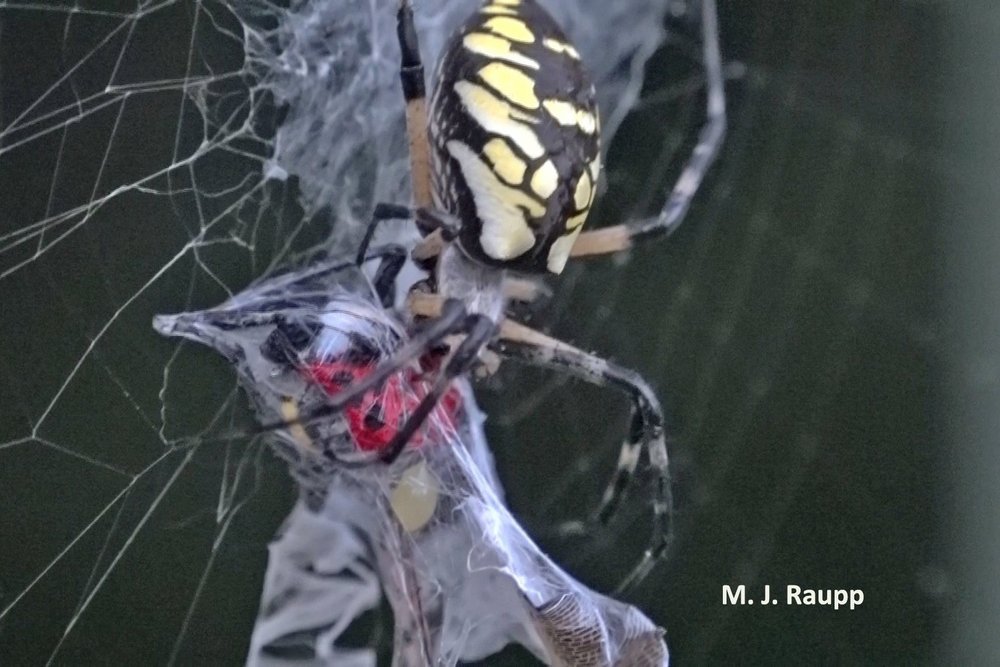
A beautiful black and yellow garden spider feasts on an adult spotted lanternfly.
As time moves along and communities of natural enemies adjust to the presence of a tasty new food item from afar, scientists can track the impact of our resident predators, parasitoids, and pathogens on these new invaders. Such was the case where a team from Penn State used citizen science data to identify some of the major players on Mother Nature’s hit squad attacking spotted lanternfly. Leading the charge from the world of invertebrates were spiders, with 206 reported observations. This week let’s catch up with a couple of arachnids that were part of this team.
In previous episodes we met the gorgeous black and yellow garden spider that resided outside my home in Columbia, Maryland. These large orb weavers have been serving a beat-down on invasive pests including brown marmorated stink bugs and spotted lanternflies.
An ill-fated spotted lanternfly struggles to free itself from sticky strands of the spider’s web. Web vibrations alert the spider to the victim’s presence. Lightning fast, the spider dashes from the center of the web and immobilizes the lanternfly with sheets of silk. With its prey swaddled and helpless, the spider delivers lethal bites to the lanternfly. She then retreats to the center of her web. As daylight wanes, the spider moves its meal to the center of the web. Using powerful fangs, she macerates the lanternfly and then slurps liquefied lanternfly into her digestive tract. By nightfall, the lanternfly is but a shriveled hulk. Bye, bye, lanternfly.
A few weeks ago, on a deck in Sharpsburg, Maryland, two delicate common house spiders teamed up to take down a spotted lanternfly. A coordinated entrapment in strands of silk and, presumably, rapid venomous bites soon immobilized the lanternfly. After a short suspense, one of the spiders settled in to macerate the lanternflies’ tissues and slurp them into its gullet. The common house spider was first described in Germany but is believed to be South American in origin. It is now found in many lands, likely transported by man as plants and goods moved around the world. Parasteatoda is known to eat small flies, other spiders, cockroaches, and as we saw in a previous episode, tree crickets. The common house spider belongs to a clan called the Theridiidae, spiders that include the black widow, considered by many to be the most dangerous spider in North America. While the bite of the common house spider is not considered dangerous to humans, it was more than sufficient to bring down a spotted lanternfly many times its size.
On the stoop of a back porch a hapless spotted lanternfly became entangled in the gossamer web of two common house spiders. These fierce small spiders teamed up to tackle the lanternfly. In a macabre duet almost too creepy to watch, the twins assail the lanternfly with silk applied by spindly legs and, presumably, tiny venomous bites that soon paralyzed their prey. After a short suspense one of the predators delivered a perfidious kiss to the immobilized lanternfly. Tiny fangs macerate her victim’s head while she slurps up the liquified tissues of her prey. A bad ending to an unwelcome invader.
Common house spiders usually occur in collections of one or two around window frames or porches. However, sometimes prey become uber-abundant and when conditions allow, spiders may become partners in building enormous communal webs, vast killing fields for hapless arthropods. One such mega-web was described at a waste treatment plant in Maryland where vast numbers of prey items, small flies called chironomid midges, were present for extended periods of time. This mega-web occupied tens of thousands of cubic feet and likely contained more than one hundred million spiders, of which almost six million were common house spiders. A spider web like that could take care of a lot of spotted lanternflies.
Acknowledgements
References used in this episode include the wonderful article “Using community science to identify predators of spotted lanternfly, Lycorma delicatula (Hemiptera: Fulgoridae), in North America” by Anne E. Johnson, Alison Cornell, Sara Hermann, Fang Zhu and Kelli Hoover, “An Immense Concentration of Orb-Weaving Spiders With Communal Webbing in a Man-Made Structural Habitat” by A. Green, J. Coddington, N. Breisch, D. DeRoche, and B. Pagac; and “The Common House Spider, Parasteatoda tepidariorum (C. L. Koch) (Arachnida: Araneae: Theridiidae)” by G. B. Edwards.

No comments:
Post a Comment