Tuesday, 15 May 2040

You have actually invested a huge chunk of your life's cost savings in a gorgeous house. Then you saved and conserved and did it up so it matches your tastes and made it as close to your dream home as your finances would permit.

Perfect.
Happiness.
Gladly ever after?
Not Quite.

If you have actually come this far, you also realize that after you have actually done up your home, you face a huge duty to MAINTAIN it. This involves fixing what's broken and guaranteeing that preventive measures are required to see that things do not break which they continue to work efficiently.

I'm sure you have upkeep contracts to cover your refrigerator, television, water cleanser, A/c unit and so on ...

What about your home - The furniture in it?

An insurance plan will guarantee that you can claim some amount in the event of a disaster, however does that ensure you a house free from insects?

Have you ever experienced the humiliation of having a cockroach run into plain view in front of your visitors? Do you wish to experience it?

Have you ever suffered mice in your home gnawing your fruit and grain, contaminating whatever they touch?

What about Bed bugs disturbing your sleep or termites eating away at the most significant investment of your life, gradually turning it to dust?

If somebody required their method into your house, poisoned your food, injured your children and animals, and destroyed your furnishings beyond repair, would you simply sit by and believe that you should find a solution for it, however put it off for later on?

Never.

You would pick up whatever you had in your hand and do everything possible to conserve your home and residential or commercial property from this plunder.

Bugs do the very same thing in your house. They force their method. They contaminate your food. They bite your children and bugs and extremely typically send harmful illness. They gradually consume your furniture and turn all the wood in your house to dust.

How come you hesitate when it comes to hiring a pest control company?

Now you might believe that you could manage the pest control of your house by yourself. You might well have the ability to, but you do not have the know-how to match that of people who handle pest invasions on a daily basis.

- You will have to go through a procedure of trial and error in selecting the right pesticides to target particular bugs.
- Then you have to guarantee that the pesticides are kept in a manner where they do not lose effectiveness and do not fall into your children's hands.
- Next you need to determine where to spray, use or put your pesticide so it will be most effective.
- Now you must balance the best dosage to take full advantage of efficiency while minimizing toxicity to your household.
- You need to guarantee that you preserve a repaired schedule so you lead that specific pest's reproducing cycle and do not run the risk of re-infestation.

You need to discover and do all this while likewise keeping your house (there are other areas that require attention) and your job.

That's a tall order for anyone, however it's not impossible.

However, if you are like me and like to keep your mind and time totally free for other pursuits rather than being tied up with simply the house, you'll discover it much easier to work with a pest control company and enter into a contract with them to keep your home pest free.

Pest Control Companies typically service lots of clients and have a varied client profile (dining establishments, offices, residences). They therefore have a lot more competence in dealing with pests.

They understand how to determine types and figure out the pesticides that would be most efficient in treating those particular types of pests.

They know typical places in your home for particular pest habitations (mice nests, termite colonies, cockroach homes and so on). So they know where to utilize their pesticides to maximize their result.

They know what chemicals to use, just how much to use and how and where to save them.

They understand at what frequency treatments are required to remove opportunities of re-infestation.

I would select a pest control company for my home any day. I do not have the time or knowledge required to keep my home pest complimentary. I 'd rather use the time on my hands to do more fascinating things.

So how do you find the best fit? How do you identify a pest control company that will provide you full value for your cash?

When looking for a pest control company to treat your house, lookout for the following functions in your agreement:

- What pests does the treatment cover?

There is typically one plan that covers ants and roaches, a completely various treatment for termites and another one for mice/ rodents another one for insects ... you understand. Make sure that treatment you are registering for covers your problem.

- The variety of treatments provided in the contract period.

It's typically 4 treatments in one year for typical household pests like ants and cockroaches. Treatments for rodents, termites, bed bugs might differ.

- Does the company deal totally free treatments in between 2 set up treatments in case there is a recurrence of the issue?

Many companies use a center where you can have your home dealt with totally free if your problem recurs before the next scheduled treatment is due.

- Are the chemicals used safe for children and family pets?

Some companies require that children and pets ought to not be allowed into the cured location for a stated time after the treatment. Some companies claim their treatments do not need this kind of evacuation.

- What do they need you to do to optimize the effect of the chemicals?

It is essential you ask this concern. Some companies require that you do not swab your home for 24 or 2 days after it has been sprayed so the pesticides have time to work before they are wiped. You might even need to prevent washing specific areas especially if a gel has been applied. Ask your service provider these concerns so you get the most out of the treatment.

- What do their customers state?

Ask for recommendations and Consult a couple of customers whose home they have serviced to make sure that the treatment is effective which the treatment schedule is stuck to.

- What guarantee do they offer?

Particularly for termite treatment, ask what duration they guarantee that you will not have a re-infestation. No re-infestation warranties after termite treatment can range from 1 to 3 years. Nevertheless, the majority of experts will risk a warranty just after they have actually inspected your property and taken all factors like surrounding location, amount of wood, humidity etc. into factor to consider.

- Rate

Though this is a big aspect to consider, it isn't the only one. For example, a company that charges you 2000 but does not use any guarantees is not as good as a company that charges you 2250 and gives you a 1 Year guarantee. If you have little kids or pets, their safety is paramount. You will insist on a treatment that is not harmful to their health, no matter what the expense.

Depending on your circumstance at any given time, the value of these elements will vary. If you have just adults in your house and no family pets, the reality that a specific treatment is kid and family pet friendly might not impact your decision much. If you have an existing problem, the provider's expertise in that particular area will be extremely important to you.

When you ask the concerns listed in this short article, you receive a lot of essential details. Armed with this info, you are in a far better position to make sure that your pest control company gives you the most worth for your money - sufficiently ridding you of your problem and avoiding it from occurring again.

Then you can sit back and unwind. Delight in the pleasures of your pest-free, tidy house. For help on finding a local pest control company contact InsectPestControl New York.

Monday, 24 August 2026

Horntails and Lanternflies hammer invasive Tree of Heaven (Ailanthus altisima): Spotted lanternflies, Lycorma delicatula, and the Pigeon tremex, Tremex columba

Spotted lanternflies and horntail wood wasps conspire to remove invasive Tree of Heaven from landscapes in the DMV and elsewhere.

Tree of Heaven (TOH) was imported to North America by an avid gardener in Philadelphia, PA in 1784, a time when importing exotic plants from around the world to grace gardens and landscapes was the thing to do. Human-assisted spread of TOH continued into the 1850s, when TOH were transported to Western states. While originally planted for its uncanny ability to thrive in highly disturbed locations and poor soils, its ability to displace native vegetation and to serve as a factory for invasive pests, including spotted lanternflies, has earned it a place on the “trees I don’t want in my landscape” list.

This Tree of Heaven succumbed to the combined attack of lanternflies, wood-boring insects, pathogens, and, perhaps, other non-living stressors of the environment.

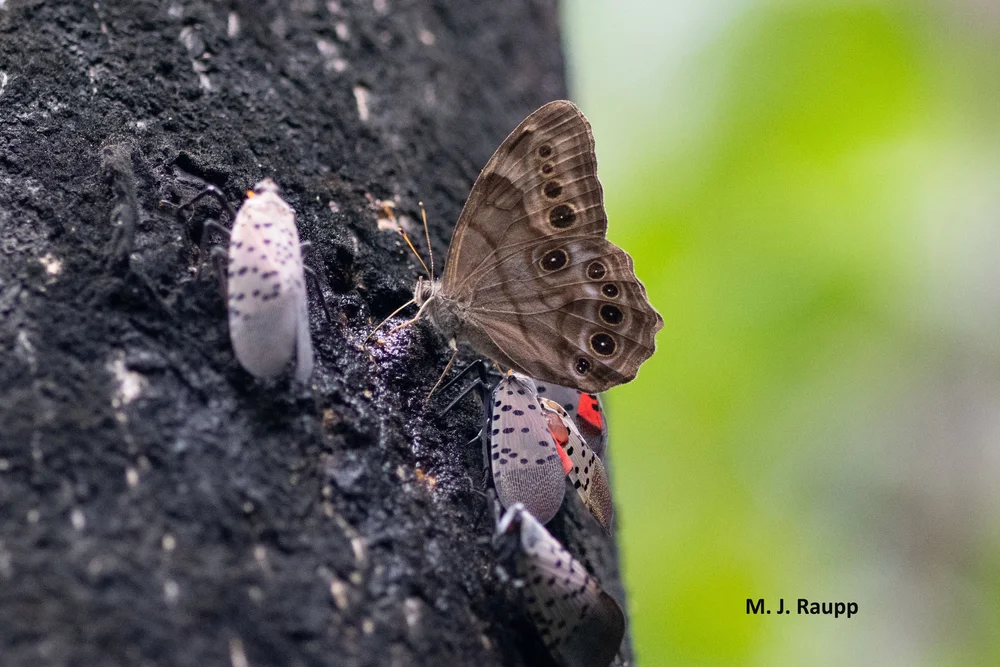
In a previous episode, we met the ailanthus webworm, a native moth whose caterpillars feed on the foliage of TOH and contribute to its demise. We also learned that chronic, high-density infestations by lanternflies rob TOH of vital nutrients, and this combined with other factors may lead to the death of TOH. Last week while visiting a Forest Retention Area heavily infested with TOH and spotted lanternflies, I stumbled across a TOH tumbling down the death spiral with hordes of lanternflies sucking its vital sap and a thinning canopy dropping dead branches. Newly arrived at the bole of the tree was a spectacularly large, colorful wasp called the pigeon tremex. She was thoroughly engaged in depositing her eggs into the dying TOH. The pigeon tremex, a.k.a. pigeon horntail, is part of the wood wasp clan known as Siricidae. Adults of this species have a hornlike appendage at the tip of their abdomen giving rise to the moniker “horntail”. The female wasp seeks dying or freshly dead trees as a nursery for her young. The female uses an exquisitely long egg-laying tube called an ovipositor to drill into the bole of the tree and deposit her eggs.

It’s easy to see why the pigeon tremex is called a horntail. The female’s powerful ovipositor drills deep into a tree to lay eggs. After hatching, her wood-boring larvae hasten the demise of the tree.

Along with the eggs, wood wasps introduce fungi into the wound. These fungi help digest recalcitrant woody tissues that serve as the food for developing wasp larvae. Larvae devour the woody tissues and are easily recognized by a characteristic spiny appendage on their rear end. Feeding by wasp larvae reduces the structural integrity of the tree, further hastening its collapse.  Reports abound that the pigeon tremex often dies with her ovipositor still inserted into the bark of the tree. However, an inspection of the tree the following day provided no evidence that this wasp perished following the act of laying her eggs. Perhaps, she lived to lay another day or disappeared down the gullet of a hungry bird. Who knows?

Chronically high densities of spotted lanternflies like these weaken invasive Tree of Heaven (TOH) and may usher them along a spiral of decline leading to death. Dying and dead deciduous trees including TOH attract a spectacularly large, colorful wasp called the pigeon tremex. Adults of this species have a hornlike appendage at the tip of their abdomen giving rise to the name “horntail”. Watch as the female uses a long egg-laying tube called an ovipositor to drill into the bole of the tree, where she deposits eggs. When eggs hatch, with assistance from fungi introduced by the wasp, her larvae devour the woody tissues of the tree, reducing its structural integrity and hastening its collapse. Wood wasp larvae are important recyclers of dead and dying trees.

Sadly, not all is well for the helpful larvae of the pigeon tremex. They are hunted by a colorful parasitic wasp called the long-tailed giant ichneumonid wasp, Megarhyssa macrurus. This clever parasitoid lands on the surface of a tree wherein larvae of the pigeon tremex develop. Using a combination of cues, she tracks down the precise location of the tremex larva, drills though the wood, stings and paralyses the tremex larvae, and deposits an egg which will hatch into a hungry larva that devours the offspring of the wood wasp. In a bug eats bug world the twists of fate blur the distinction between which bugs are helpful and those that are not.

Beautiful female long-tailed Megarhyssa wasps use their supper long ovipositors to deposit eggs deep inside a tree where larvae of the pigeon tremex feed. Larvae of the tremex will become food for developing Megarhyssa larvae.

Acknowledgements

These fascinating articles were used to prepare this weeks episode:  “Tree-of-Heaven” by David R. Jackson, Art Gover, and Sarah Wurzbacher, “Spotted Lanternfly Frequently Asked Questions” by Heather Leach, “Pigeon Tremex” by James Baker, “Symbiotic relationship between Cerrena unicolor and the horntail Tremex fuscicornis recorded in the Czech Republic” by SYLVIE PAŽOUTOVÁ and PETR ŠRŮTKA, and “Megarhyssa spp., The Giant Ichneumons (Hymenoptera: Ichneumonidae)” by Ilgoo Kang, and Christopher Carlton.


Monday, 17 August 2026

Serving a watery eviction notice to common paper wasps, Polistes exclamans

Beneath a picnic table, fierce paper wasps are on guard and ready to defend their nest.

Subscribers to Bug of the Week have noted the somewhat perplexing juxtaposition in the viewpoint of this blog. Sometimes we advise extreme prejudice against bugs like mosquitos and bed bugs, and sometimes we advocate benevolent treatment for insects like Monarch butterflies and solitary bees. This week we do a little of both with paper wasps, Polistes spp. Many of us have had the enlightening experience of coming just a bit too close to a paper wasp nest and being rewarded with a memorable sting. This happened to me recently as I tried to move two pieces of patio furniture and was surprised by the sting of a paper wasp intent on protecting her nest, which was nestled beneath the arm of a chair.

“Come one step closer to these eggs and I will teach you a lesson!”

While nests are typically located beneath overhangs of houses, sheds, or entryways of homes, virtually any horizontal surface shielded from rain can be a nesting site. In temperate regions like the DMV, in early spring nests are initiated by a female wasp called a foundress. The foundress survived the wicked winter in a sheltered spot, perhaps beneath the bark of a tree or behind a loose piece of siding on a home. The foundress uses her powerful jaws to gather wood fiber from trees and shrubs. She chews the fiber into pulp and molds the pulp into papery cells. The ever-enlarging nest is shaped like a parasol and suspended by a narrow stalk called a pedicel. After the first few hexagonal cells are constructed, the foundress deposits an egg within each chamber.

While rearranging some patio furniture, a paper wasp delivered an unexpected sting when I moved a chair. Beneath the arm of the chair, two fierce females were ready to defend their small nest. Nearby, under a picnic table, a larger nest was guarded by several wasps. In another video, watch how I evict these paper wasps from my furniture and house without the use of insecticides.

Eggs soon hatch into legless larvae. Her youngsters have healthy appetites, and the queen gets busy hunting food for her babes. Not all potential foundresses are successful in establishing a colony. Some may join an established nest where they assist the resident foundress in caring for the brood. The colony grows as summer progresses and more than a hundred workers may be produced in some species of paper wasps. Caterpillars are one of the favorite menu items for larvae of paper wasps, and in this way paper wasps are our allies in the fight against leaf-munching garden pests. By capturing droves of caterpillars, paper wasps reduce damage to our valuable crops and landscape plants. In addition to eating pests, paper wasps provide a second ecosystem service by pollinating plants. I often see them visiting mountain mints in my garden and goldenrods in the meadow.

Enough of the goodness of paper wasps. Let’s talk about what you can do at this time of year if you discover paper wasp nests in your patio furniture or under the roof of your porch. There are several commercial wasp sprays that will kill resident paper wasps and their youngsters developing in the papery nest. If you are allergic to stings of bees or wasps, or if you are simply fearful of wasps and their stings, wasp sprays may be a good option. You could, of course, employ an exterminator to get the job done. Due to their service roles as pollinators and biological control agents, I chose not to employ the insecticide route. Instead, I simply deliver a watery eviction notice to the wasps and encourage them to build their nests elsewhere.

Due to their service roles as pollinators and biological control agents, I chose not to employ the insecticide route. Instead, I simply deliver a watery eviction notice to the wasps and encourage them to build their nests elsewhere. I use a high-powered stream of water from a garden hose to displace the wasps. While they are floundering in disarray or have vacated the premises, I simply remove the nest and toss it on the lawn where fierce, hungry predators will dine on the eggs and developing larvae. Often a single watery eviction will suffice, but sometimes wasps will return and try again to build a nest. After another episode or two of a watery eviction, wasps seek other places to build their nests.

In a previous episode, I recommended simply knocking the nest down with a broom very early in season when but a single wasp or two was present. But by late summer, several aggressive females are present and ready to defend the nest. Instead of a broom, I use a high-powered stream of water from a garden hose to displace the wasps. While they are floundering in disarray or have vacated the premises, I simply remove the nest and toss it on the lawn where fierce, hungry predators will dine on the eggs and developing larvae. Often a single watery eviction will suffice, but sometimes wasps will return and try again to build a nest. After another episode or two of a watery eviction, wasps seek other places to build their nests. This mode of displacement allows the foundress and other wasps to continue their service as pollinators and assassins of pests and live to start another nest or perhaps join a different colony. So, maybe have a look beneath overhangs, in the carport, or at the entryway to your home and eliminate a potential problem now. If you discover a nest out by the barn or in another less worrisome place, maybe watch at a distance the antics of these interesting beneficial insects.

Acknowledgements

Two marvelous references, “The Insect Societies” by E.O. Wilson and “Biological studies of Polistes in North Carolina (Hymenoptera: Vespidae)” by R.L. Rabb, were used in the preparation of this episode. We thank Anne and Jim for providing inspiration for this episode.


Monday, 10 August 2026

Plants as camouflage, who thought of it first? Meet the camouflaged looper, Synchlora aerata

Part of the flower? Not really. A camouflaged looper caterpillar pretends to be florets of a goldenrod blossom.

Movie aficionados may have seen Mark Wahlberg in “Shooter”, a warrior who dons a “ghillie suit.” The ghillie suit incorporates leaves and branches into a camouflaged garment to hide a person from an enemy. Next time you see something like this, just remember that several million years ago a caterpillar thought of it first.  Here’s the backstory. One morning last week as I enjoyed the pollinators in my front flower bed while sipping my morning joe, I noticed a cluster of withered flower petals swaying on a spent flowerhead of a wild bergamot. While this would have meant nothing on a breezy day, it was a puzzle on that still morning.

A ghillie suit of withered burgamot flower petals hides a camouflaged looper within.

A closer inspection revealed that beneath the vegetation, a surprisingly handsome caterpillar wearing a ghillie suit was responsible for animating the withered blossoms. This little trickster was the camouflaged looper, Synchlora aerata. Bedecked with bits of foliage and flower petals, it is sometimes detected when performing a herky-jerky waltz as it moves from one meal to the next. If you have the good fortune to find one, take a moment to sit and watch a stellar performance as the looper sways back and forth, adding to the illusion of a plant part being blown by the wind.

Last week while sipping my morning coffee, I noticed some withered vegetation swaying on a spent flowerhead of wild bergamot on a windless day. When transferred to the siding of the house, this faded foliage revealed itself as camouflaged looper caterpillar. Its superpower lies in its ability to disguise itself using leaves and petals of the flowers on which it feeds. When dining on fading bergamot, browns and grays seem the smart camouflage choice. But when crimson mums are on the menu, it’s better to go with the crimson petals. And when you depart for the next meal add a little “I’m just a petal swaying in the breeze” to your routine just to fool the hungry eyes of predators. Adults of these tricksters are the lovely geometrid moth called the wavy-lined emerald. As autumn approaches, have fun searching for these cool caterpillars in the flower garden or meadow.

Loopers are members of a large family of moths known as geometrids. The name geometrid stems from Greek roots meaning ‘earth measure’. Another common name for some geometrid caterpillars is inchworms. As they cruise about the blossoms, loopers and inchworms do appear to measure the earth inch by inch. In addition to my chrysanthemums, camouflaged loopers eat many types of flowers including ageratum, aster, black-eyed Susan, boneset, coreopsis, daisy, goldenrod, Joe Pye weed, ragweed, raspberry, rose, sage, St. John’s wort, and yarrow. The adult stage of the camouflaged looper is a moth known as the wavy-lined emerald and it is every bit as beautiful as the larva.

The camouflaged looper turns into a pretty, wavy-lined emerald moth.

A few years back, while working pulling weeds in a bed of chrysanthemums, I noticed a liberal sprinkling of caterpillar frass decorating blossoms of several plants. Frass, the euphemistic term for the pellet-like, powdery, or sawdust-like excrement of herbivorous insects, often provides a clue, alerting one to the presence of an insect on or in a plant. A thorough inspection of my mums failed to disclose the culprit, but as I watched the plant over a leisurely cup of coffee, I noticed a small cluster of flowery debris swaying on a blossom. A closer inspection revealed a cleverly disguised camouflaged looper cloaked in purple petals busily dining on the flower head. In years past, several eagle-eyed naturalists reported similar sightings on mints and Joe Pye weeds in gardens and meadows as summer turns into autumn. So next time you see some unexpected frass on your flower blossoms or a small cluster of vegetation swaying in the wind, take a few moments to observe your flowers with an eye out for these masters of disguise.

A blossom full of frass is a pretty good clue that a caterpillar may be lurking nearby. This frass was produced by a camouflaged looper feeding nearby.

Acknowledgements

Many thanks to our observant naturalists who discovered camouflaged loopers in their landscape, especially Mara McCall and Glen Schulze, for providing the inspiration for this episode. The wonderful reference “Caterpillars of Eastern North America” by David Wagner was used as a reference for this Bug of the Week.


Monday, 3 August 2026

Don’t let mosquitoes bite: Northern House mosquito, Culex pipiens, and Asian Tiger mosquito, Aedes albopictus

Hungry Northern House mosquitoes, vectors of West Nile virus, are thriving and on the hunt for blood.

As we enter the month of August, it’s high time to protect yourself from mosquito borne illnesses like West Nile Virus. In mid-July a local news agency reported the detection of West Nile Virus in mosquitoes in two counties of central Maryland. Although no human cases were detected at that time, as of the third week of July, the Centers for Disease Control (CDC) reported more than 90 cases of human disease in 20 states with Arizona and Texas leading the way. As record heat continues in our land, generation times shrink for mosquitoes. More mosquitoes are produced in shorter periods of time. Also linked to global warming is the fact that like many insects, mosquitoes become active earlier in the year and their activity continues later in the year. Scientists found that between 1979 and 2022 in cities throughout the United States higher temperatures have greatly increased the number of days each year that are warm enough for mosquitoes to bite. In San Francisco, California, the number of “biting days” has increased by 43 days since 1979. As the tropical storm season ramps up, drenching storm systems create abundant breeding sites for aquatic mosquito larvae. Together, heat and rainfall provide the perfect storm for elevating populations of mosquitoes in many parts of our nation. Let’s learn a little more about mosquitoes, the risks they pose, and how to avoid their bites and the illnesses they carry. The following is revised from a previous episode of Bug of the Week.

Not much to say about this video. Watch as a female Culex pipiens form molestus extracts all the blood she needs to produce the next batch of eggs and then scurries away to the shadow of a knuckle to hide. Filmed at twice life speed.

“Mosquitoes are more than just a nuisance and several species carry important diseases such as West Nile Virus. According to the CDC, following its discovery in the United States in 1999, more than 63,000 cases of West Nile Virus have been reported and more than 3,300 deaths associated with West Nile Virus have occurred. While most of us shrug off West Nile virus with little or no symptoms, it can be severe and lethal to seniors and certain others. Researchers have suggested that some seniors and people with compromised immune systems may lack sufficient immune responses to thwart the West Nile Virus.

Historically, August is the most common month to contract West Nile Virus. Image courtesy of Centers for Disease Control

Many species of mosquitoes prefer to feed at dusk, and you can avoid being bitten by staying indoors in the evening. Unlike many of our native mosquitoes, the exotic Asian Tiger is a daytime biter, adding hours of itching, scratching, and swatting to days in the garden. Protect yourself from aggressive biters by wearing lightweight, long-sleeved shirts and pants when working outdoors. Certain brands of clothing are pretreated with mosquito repellents such as permethrin. I wore these clothes in tropical rainforests where mosquitoes were ferocious and they really did help. Many topical insect repellents can be applied to exposed skin before you go outdoors. Some will provide many hours of protection, while others provide virtually none. Some repellents should not be applied to children, and you should always help kids apply repellents. Do not apply repellents containing DEET under clothing. To learn more about mosquito repellents, click here to see repellents recommended by the Centers for Disease Control. For safety, be sure to read and follow the directions on the label of the repellent before you apply it to people or clothing.

Asian tiger mosquitos are active during daylight hours. They vector important human diseases including dengue, chikungunya, and Zika.

If you dine outdoors, place a fan on your patio. The light breeze created by the fan will greatly reduce the number of mosquitoes flying and biting. Many traps are also available to capture and kill mosquitoes. Some rely on a light source to attract blood seekers. However, many types of moths, flies, and beetles are attracted to light. Mosquitoes, unfortunately, do not use light to find their meals and are not readily attracted to light traps. One study demonstrated that less than 1% of the insects attracted to light traps were biting flies such as mosquitoes. This study estimated that light traps kill billions of harmless and beneficial insects each year. Blood seeking mosquitoes are actually attracted to odors emanating from the host. As we move about the earth, we release many odors, including carbon dioxide and lactic acid, that are used by hungry mosquitoes to find us. Some mosquito traps release carbon dioxide and will catch many mosquitoes. Female mosquitoes ready to lay eggs are attracted to odors emanating from water sources. A clever trap called a Gravid Aedes Trap (GAT) has been used in community-wide programs in the DMV to reduce local populations of Asian Tiger mosquitoes. Females fly into these traps to lay eggs but never escape. Sounds like Hotel California for these tiny vampires.

 A garbage pail lid full of water becomes the perfect nursery for a crop of Culex mosquitoes. Two egg rafts contain scores of eggs ready to hatch. Nearby, fleets of mosquito larvae called wrigglers filter tiny particles of food from the water. In just a few short weeks, this lid will be bustling with fully developed wrigglers suspended beneath the water by breathing siphons. Amidst the milieu, zany mosquito pupae called tumblers bumble about. With continued hot weather and ample rainfall, adults will emerge, and yes, there will be blood.

To reduce the chances of mosquitoes breeding around your home, eliminate standing water by cleaning your gutters, dumping your bird bath twice a week, inverting your wheelbarrow, and getting rid of water filled containers. If you have an aquatic water garden or standing water on your property that breed mosquitoes, you can use a product containing the naturally occurring soil microbe known as Bacillus thuringiensis israelensis a.k.a. Bti. Bti comes formulated in doughnut-shaped tablets that can be placed in water to kill mosquito larvae. With continued hot weather and ample rainfall, mosquitoes will be present for several more months. Be on the lookout and take precautions now to avoid being bitten.”     

Wheelbarrows and pails full of water - dump them now! They are nurseries for mosquito larvae.

Acknowledgements

We thank Dr. Megan Fritz for loaning us one Culex mosquito to record feeding on blood. Several interesting articles were consulted for this episode including, “How the body rubs out West Nile virus” by  Nathan Seppa, “Toll-like Receptor 7 Mitigates Lethal West Nile and Encephalitis via Interleukin 23-Dependent Immune Cell Infiltration and Homing” by Terrence Town, Fengwei Bai, Tian Wang, Amber T. Kaplan, Feng Qian, Ruth R. Montgomery, John F. Anderson, Richard A. Flavell, and Erol Fikrig, “Density and diversity of non-target insects killed by suburban electric insect traps” by Timothy B. Frick and Douglas W. Tallamy, “Neighbors help neighbors control urban mosquitoes” by Brian J. Johnson, David Brosch, Arlene Christiansen, Ed Wells, Martha Wells, Andre F. Bhandoola, Amy Milne, Sharon Garrison & Dina M. Fonseca, and “Mosquito days’ are on the rise, courtesy of global warming” courtesy of the Carey Institute of Ecosystem Studies. Information on the geographical and seasonal occurrences of West Nile Virus came from the data rich CDC websites. 

To learn more about the mosquitoes and how to defeat them, please view the following video:  https://youtu.be/mSRw4MnHaX8


Monday, 27 July 2026

Hail the arrival of two southern migrants: Monarch butterfly, Danaus Plexippus, and Large Milkweed Bug, Oncopeltus fasciatus

Blossoms of my cup plant, Silphium perfoliatum, are irresistible to many pollinators including Monarch butterflies.

Last week we visited a bevy of black butterflies, part of the hit parade of beauties that annually grace our gardens and meadows. Butterfly season in the DMV seems to have gotten off to a rather slow start and one species whose arrival I always fret about is the majestic monarch butterfly, journeying here from its southern redoubts. The vanguard of Monarch butterflies arrived in Columbia, MD, in mid-April this spring according to iNaturalist. But my Monarch concerns were not fully quelled until last week when a gorgeous Monarch visited my blossom-filled cup plant. Fortunately, butterfly weed in my garden also provides nectar for the Monarch and serves as a good place for her to deposit eggs. This native milkweed provides food for her caterpillars and, hopefully, caterpillars will appear in the garden in a week or two.

Cup plant is irresistible to many butterflies including beautiful Monarch butterflies. With the recent arrival of Monarchs and pockets of butterfly weed growing nearby, it won’t be long before Monarchs lay eggs and small caterpillars appear. Other recent arrivals of migrants to the garden from the south are Large Milkweed Bugs. Ready for action, they are busy making offspring that will soon decorate the seed pods of my milkweeds. So, plant a cup plant and some milkweeds. Enjoy the insects and have some fun.

Once again, eastern migratory Monarchs have survived winter and are making their journey northward for another year. But how are these peripatetic marvels doing in general? Two years ago, we learned that populations of both eastern and western migratory Monarchs had declined dramatically from levels recorded in the 80’s and 90’s. Well, according to data reported by the Xerces Society,  overwintering populations of eastern migratory monarchs in the mountains of Mexico expanded from 4.42 acres in 2025 to 7.24 acres in 2026. Some good news there but scientists noted that these population levels are still “well below historic norms.”  

Western Monarch Population 2021. Image courtesy of Center for Biological Diversity

Some additional good news recently reported by the Xerces Society reveals that some Monarchs overwintering in northern Florida, rather than in  Mexico, may migrate northward thereby bolstering migrations of their endangered Mexican-based kin. These smidgens of hope do not extend to all migratory North American Monarchs. Sadly, populations of western migratory Monarchs continue to flirt with collapse. The January 2025 overwintering counts of western Monarchs were the third lowest since records have been kept. Their populations hover around and often sink below a hypothetical extinction level.  

Migratory Large Milkweed Bugs arrived on my butterfly weed ready for action and got to the business of making offspring.

One migratory vagabond that seems to be prospering just fine is the Large Milkweed Bug. Some ento-enthusiasts might think that this bug hangs around the DMV all year, but truth be told, this orange and black harlequin arrives in our region from the south in late spring and early summer. Adults lay eggs on milkweed pods and immature stages called nymphs use sucking mouthparts to obtain vital nutrients from developing milkweed seeds. As milkweeds wane in autumn, Large Milkweed Bugs migrate to warmer zones. While reveling in the discovery of my monarch butterfly, I glanced down at my butterfly weed and discovered several Large Milkweed Bugs dashing about the milkweeds, engaged in the business of making offspring. It won’t be long before their tiny orange and black nymphs decorate the stems and pods of my milkweeds. 

To help our struggling migratory Monarch butterflies, the Xerces Society recommends the following:

·       Discover milkweed and nectar plants native to your region and plant a pollinator garden.

·       Reduce your reliance on pesticides and make changes to how you manage pest issues in your community, nursery, home, farm, and other places in your community.

·       Participate in the tri-national International Monarch Monitoring Blitz this summer. Report monarchs any time of year, in any country to iNaturalist or another monarch community science program.

·       Find additional ways to help the eastern and western monarch populations, including supporting the protection of overwintering sites in California and restoring breeding habitat in key regions of the United States.

·       Support the Xerces Society, a science-driven nonprofit working on solutions for monarchs and other butterflies.”

These practices are good not only for Monarch butterflies but also for other fascinating denizens of milkweed including Large Milkweed Bugs. Plant some milkweeds and enjoy! 

Acknowledgements

We thank Dr. Shrewsbury for spotting the Monarch butterfly featured in this episode. Information on the status of migratory eastern and western monarch butterflies came from the Xerces Society for Invertebrate Conservation and the Center for Biological Diversity.  


Monday, 20 July 2026

Marvelous model for melanic mimics: Pipevine swallowtail, Battus philenor

Color and pattern of the gorgeous pipevine swallowtail warn predators of a nasty surprise should they dare to attack. Image: Paula Shrewsbury, PhD

Here in the DMV, butterfly season is off and running at full force. A visit to a pollinator garden or meadow is rewarded with an array of several beautiful butterflies whose dominant wing coloration is based on the theme of a black background with series of patches and spots in shades of white, orange, and blue. Butterflies participating in this cabal include the dark form of the eastern tiger swallowtail, the pretty red-spotted purple, the eastern black swallowtail – eater of parsley and dill, and the clever spice bush swallowtail whose larvae mimic serpents. Why have these beauties converged on a rather common color scheme? 

As caterpillars feed and grow, they accumulate noxious compounds and take on a startling visage, complete with fleshy dangling appendages and orange bumps advertising their distastefulness. Image: Paula Shrewsbury, PhD

Caterpillars of the butterfly that we meet today, the pipevine swallowtail, dine on members of the birthwort family, Aristolochiaceae, plants that include vines commonly known as pipevines. Members of this family produce a class of compounds known as aristolochic acids which are known to be mutagenic, carcinogenic, and toxic to kidneys of mammals. As they consume pipevine leaves, these swallowtail caterpillars store aristolochic toxins in their tissues, and then retain them as they pupate into adult butterflies, which then pass them along to their eggs. Aristolochic acids sequestered by caterpillars may help protect them from attack by parasitic wasps. Adult butterflies are rendered distasteful to vertebrate predators such as birds by virtue of these noxious compounds. It is believed that birds attempting to eat butterflies whose larvae consumed pipevines have a nasty experience that teaches them not to mess with darkly colored butterflies.

Leaves of the pipevine contain noxious and toxic compounds that help protect pipevine caterpillars and swallowtails from their enemies. Image: Paula Shrewsbury, PhD

Other species of butterflies capitalize on the lesson taught by the pipevine swallowtail and have evolved color patterns to mimic their appearance, thereby gaining protection from visually astute predators. This type of mimicry in which warning colors of a distasteful species like pipevine swallowtails act as a model copied by other palatable butterflies is called Batesian mimicry. The great English naturalist Henry Bates first described this form of mimicry while studying butterflies in Brazilian rainforests. We met other species of Batesian mimics such as harmless flower flies that mimic stinging bees and wasps.

This gorgeous resting pipevine swallowtail will soon seek pipevines on which to deposit brightly colored orange eggs that hatch into tiny caterpillars. As these very hungry caterpillars feed and grow, they accumulate noxious compounds and take on a startling visage complete with fleshy dangling appendages and orange bumps advertising their distastefulness. Other darkly colored butterflies, including the dark female form of the eastern tiger swallowtail, the spice bush swallowtail, the eastern black swallowtail, and the pretty, red-spotted purple are believed to mimic the color pattern of the pipevine swallowtail to gain protection from hungry predators.

Adult butterflies are not the only creatures that mimic pipevine swallowtails. Recall that the caterpillars are also laced with aristolochid acids. Scientists believe that a cyanide producing millipede with deep red coloration mimics the color and pattern of the pipevine caterpillar, thereby gaining protection from predators. We have seen this mimicry before with several orange and black insects that eat milkweed including monarch caterpillars, milkweed bugs, and milkweed tussock moth caterpillars.  This convergence on a similar, easily recognizable color pattern by two or more nasty-tasting insects is called Müllerian mimicry, named for the famous German naturalist Fritz Müller. As this spectacular butterfly season rolls along, try to grab a glimpse of one of these dark winged beauties and ponder the question – model or mimic?

Acknowledgements

Bug of the Week thanks observant Dr. Shrewsbury for spotting adults and larvae of the pipevine swallowtail and providing images featured in this episode. “Secret Weapons” by Thomas Eisner, Maria Eisner, and Melody Siegler, and “Featured Creature Common name: pipevine swallowtail, blue swallowtail scientific name: Battus philenor (Linnaeus 1771) (Insecta: Lepidoptera: Papilionidae: Papilioninae: Troidini)” and “Common name: Polydamas swallowtail, gold rim swallowtail, tailless swallowtail scientific name: Battus polydamas lucayus (Rothschild & Jordan) (Insecta: Lepidoptera: Papilionidae: Papilioninae: Troidini)” by Donald Hall provided valuable insights into the clever ways of this week’s star.


Monday, 13 July 2026

Going on a trip? Beware of bed bugs: Bed Bugs, Cimex lectularius

Guess who is coming to dinner.

Recent press releases cautioned travelers to take precautions to avoid bringing bed bugs home from trips abroad, and earlier this spring bed bug “surges” were reported across several southern states. During a visit to a senior housing facility last month, several residents expressed concern about reports of bed bugs in their community. So, this week we return to an episode from a few years ago when stories swirled about concerning bed bugs in the DMV

“Over the past decade we heard stories of bed bugs appearing in places without beds including office buildings, movie theaters, schools, and retail stores. How do bed bugs work and what is behind this recent upswing in bed bug detections, especially in our major cities? Like many obligate parasites, bed bugs lead an interesting, albeit codependent life. They must have a blood meal in all stages of development, except eggs, to survive. By inserting tiny sucking mouthparts and pumping in saliva laced with anticoagulants, bed bugs can take in several times their weight in blood in a feeding bout lasting from 3 – 10 minutes. They will bite any part of the body including the face, neck, shoulders, arms, and legs. When temperatures are warm, it takes less than a month to complete a generation and when cooler it may take 4 months to complete the life cycle. Like other true bugs, these have scent glands that give them a distinctive odor, and a sweet smell sometimes accompanies a heavy infestation.

Shed skins and dark spots of excrement on a sheet or a mattress are clues of a bed bug infestation.

Bed bugs are tough. Nymphs can live several months without a meal and at certain temperatures adults are reported to survive more than a year without food. Females lay 200 to 500 eggs during their lifetime. The eggs are roughly the size of a period at the end of a sentence. The immature stages, the nymphs, are reddish brown when full of blood and tan when empty. Adults are about the size of a peppercorn and brown to chestnut colored when empty or full of blood, respectively. During the day, bed bugs usually hide in bedclothes, mattress seams, box springs, spaces in the bed frame, behind the headboard, baseboards, picture frames, chests of drawers, posters, loose wallpaper, and almost every nook and cranny in the bedroom. I have heard many tales of couches and living room furniture harboring these rascals, as well as seats in theaters. In offices, reports abound of infested work cubicles, where clutter and file cabinets provide small spaces in which bed bugs can hide. Bed bugs likely arrive in businesses and schools as hitchhikers from infested homes, traveling on clothing, book bags, backpacks, or briefcases. 

Not much to say about this video. Enjoy the music and watch as a bed bug gains up to seven times its body weight as it tanks up on my blood at three times actual speed.

Several hypotheses explain the marked increase in reports of bedbugs in dwellings, schools, college dormitories, hotels, hospitals, and elder care facilities. Prior to the Second World War, bed bugs were commonplace in detached homes and multifamily dwellings in the US. The advent of insecticides such as DDT after the Second World War greatly reduced the incidence of bed bugs in this country and abroad. Indoor pests including cockroaches and ants were targets of liberal applications of potent residual insecticides. These practices also probably knocked down populations of bed bugs. A shift away from broadcast applications of DDT to targeted approaches using traps and baits for indoor pests may have opened the door for bed bugs to reappear as major pests. Moreover, one class of insecticides called synthetic pyrethroids became a mainstay for controlling indoor pests, including bed bugs. Studies revealed widespread resistance of bed bugs to some synthetic pyrethroids, rendering this class of insecticides far less effective in killing bed bugs than when these products first came into use. Another piece of the bed bug puzzle lies with an increase in international travel to regions of the world where bed bugs are common. International travel provides opportunity for these clever stowaways to enter this country. Bed bugs readily hide in concealed places such as luggage, and due to their small size and cryptic habits they travel right along with globetrotters. We have not yet found a wall tiny enough to keep bed bugs out of our nation. A third factor identified with the uptick in bed bug infestations is the exchange of secondhand furniture. Used sofas, bedding, chests of drawers, and other furniture provide great opportunity for bed bugs to move from one home to another. 

President Lincoln sees just how small bed bug eggs really are.

There is some good news in this story. First, DC has done a good job in licking the bed-bug-in-school problem and students should soon be back to their regular classrooms. The second piece of good news is that bed bugs are not known to be carriers of human disease. However, following a bed bug bite, the human body reacts to proteins injected into the skin by the bug as it feeds. The reaction to the bite is highly variable and ranges from nothing to large itchy red welts. My reaction appears within a day but for others, welts can appear weeks after an encounter. According to a study by Michael Potter and his colleagues at the University of Kentucky, for many people, the reaction to the bite is minimal. Factors such as gender and ethnicity do not seem to affect the strength of one’s reaction to a bite. Age, however, apparently does. The elderly are less likely to react to bed bug bites than younger folks. This is not good news because bed bug bites are often a harbinger of an incipient infestation. More importantly, these findings underscore the need for a high level of bed bug awareness and vigilance in facilities providing care and housing for seniors who may not know that they are being bitten. 

This is a common skin rash where bed bugs fed on a sensitive individual.

How can you avoid bed bug infestations? When you travel be aware of your surroundings. If you stay in a hotel, inspect your bed. Look for the bugs or their telltale signs such as shed skins or dark excrement spots on the mattress, especially along the tacking. Use a small flashlight to look on the bed frame and behind the headboard. To reduce the risk of little stowaways entering your luggage and coming home with you, elevate your suitcase, place it on a luggage stand. Keep soiled and clean clothes in sealed plastic bags. Do not toss worn items on the floor. After returning home, vacuum out all luggage and toss your clothes into the dryer. By exposing clothing, bedding, backpacks, and other items to dry heat of 120°F or better for 20 to 30 minutes, all life stages of bed bugs will be killed. Portable heating boxes are available to heat items that might be damaged or are too large for dryer. Avoid creating an infestation in your home with used furnishings. Beware of secondhand furniture, especially bedroom items. Be sure to inspect thoroughly any used mattresses, box springs, bed frames, nightstands, and mirrors. College students returning to campus should resist the urge to go dumpster diving for dorm-room or apartment furnishings! This is a good way to move infested furniture into your room. Experts recommend the use of bed bug – proof encasements for mattresses and box springs. Bed bugs love to hide in these places and encasements force them into the open where they are more easily detected. Small entrapment devices can also be placed under the legs of the beds or sofas. Bed bugs climb in but cannot climb out. This makes detection easier even when populations are low. 

Bed bugs, tiny vampires of the night, scatter when exposed to bright light or cling to each other in a roiling ball of bugs large and small.

Unusual bites may be your first sign of an infestation. If you suspect an infestation, confirm that the cause of the bites are human bed bugs and not another arthropod or closely related bug associated with bats or birds that have entered your home. To do this you will need to capture one of these rascals and have it identified by an expert. Bat bugs and bird bugs are common and often mistaken for bed bugs. If bird or bat bugs invade, then the solution is to eliminate the nest (birds) and exclude birds and bats from the house with screening and repair of structures. If you confirm a bed bug infestation, you may not want to go it alone. A professional pest control operator will have tools, techniques, and an integrated pest management (IPM) plan to detect and deal with the problem. Some commercial firms employ bed bug sniffing dogs to detect infestations. Unlike their handlers, these canines work for kibble. They are extraordinarily adept in finding bed bugs. Once an infestation is confirmed, the solution will involve more than one visit. Professionals may use a variety of management approaches involving treatments of heat or cold, the application of EPA registered insecticides, and a variety of other methods to exclude and thwart these bloodsuckers. Some things that you can do to help these professionals is to reduce clutter in the bedroom and around the home, vacuum floors and baseboards thoroughly and repeatedly, wash all bedclothes in hot water, and discard or encase infested mattress and box springs. Ridding a school, home, apartment, office, business, theater, hotel, health care facility, or any structure infested with bed bugs involves a serious ongoing commitment of time and resources by all parties involved – administrators, parents, renters, occupants, owners, property managers and pest management professionals. As bed bugs become more widespread and commonplace, early detection, rational discussion, and carefully designed and executed management programs will help us deal with these disagreeable characters.”  

Acknowledgements

Special thanks to my colleagues for providing bed bugs videotaped and photographed for this episode. Stimulating discussions with Reg Coler, Larry Pinto, and Rich Cooper provided much of the insight for this story. The fascinating articles “[Bed Bugs] The Sensitivity Spectrum: Human Reactions to Bed Bug Bites” by Michael F. Potter, Kenneth F. Haynes, Kevin Connelly, Michael Deutsch, Erich Hardebeck, Don Partin, and Ron Harrison, and “Insecticide Resistance in the Bed Bug: A Factor in the Pest’s Sudden Resurgence?” by Alvaro Romero, Michael Potter, Daniel Potter, and Kenneth Haynes were used as references for this episode.

For more information on bed bugs, please visit the following websites: 

https://www.youtube.com/watch?v=lSoFu6zXx8A  

https://www.epa.gov/bedbugs 

http://www.ipm.ucdavis.edu/PMG/PESTNOTES/pn7454.html 

https://www.pubs.ext.vt.edu/ENTO/ENTO-31/ENTO-31.html