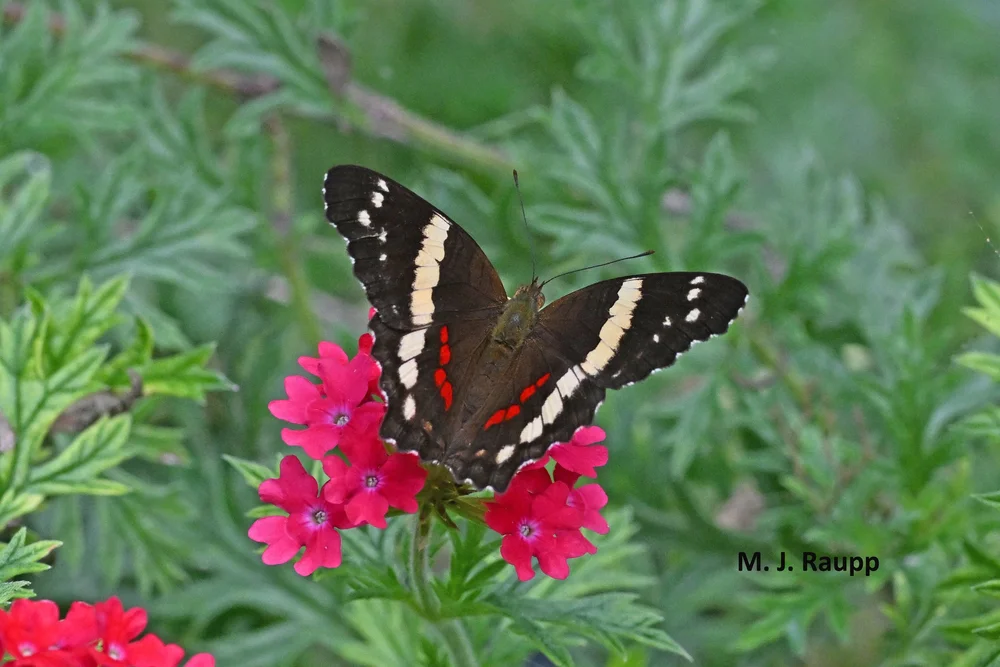
Contrasting colors of dorsal wing bars make the banded peacock one of the most beautiful butterflies in the rainforest.
Following a week where Old Man Winter socked-it-to much of North America with bone chilling temperatures and mountains of snow, let’s return to the warm embrace of the rainforests of Belize where we last visited tasty conehead termites. Last week we met squirty termites in the dark rainforest. This week we move to a sunlit meadow to meet members of the brush-footed butterfly clan known as peacocks. Our first guest, the beautiful white peacock butterfly, Anartia jatrophae, is a resident not only of Central America, but also much of South America and as far north as Florida and Texas in the United States. The banded peacock, Anartia fatima, is also a resident of Central America and wanders into the United States, where it sometimes visits Texas and has been found occasionally as far north as Kansas.
Glorious banded peacock butterflies and pretty white peacock butterflies with spots on their wings use a rather small menu of tropical plants as food plants for their larvae. Males spar to defend patches of these host plants to court potential mates seeking food for their young. While I was unable to record these fast-moving battles, I hope that watching these tropical beauties might bring some cheer to you on these chilly and dreary winter days.
Throughout much of their range, peacocks can be found almost year-round in disturbed open meadows and swampy areas where food plants for the larvae are found. Food plants for caterpillars of the white and banded peacocks include water hyssop, blechum, frogfruit, and wild petunia. Tropical rainforests are among the most biologically diverse of all ecosystems on our planet, housing an astounding array of plant species. The Nature Conservancy estimates roughly 1500 species of flowering plants exist in a four-square mile area of tropical rainforest. The fidelity of female peacock butterflies to a relatively small number of plants on which she places her eggs has resulted in an interesting strategy employed by male peacock butterflies to secure a mate.
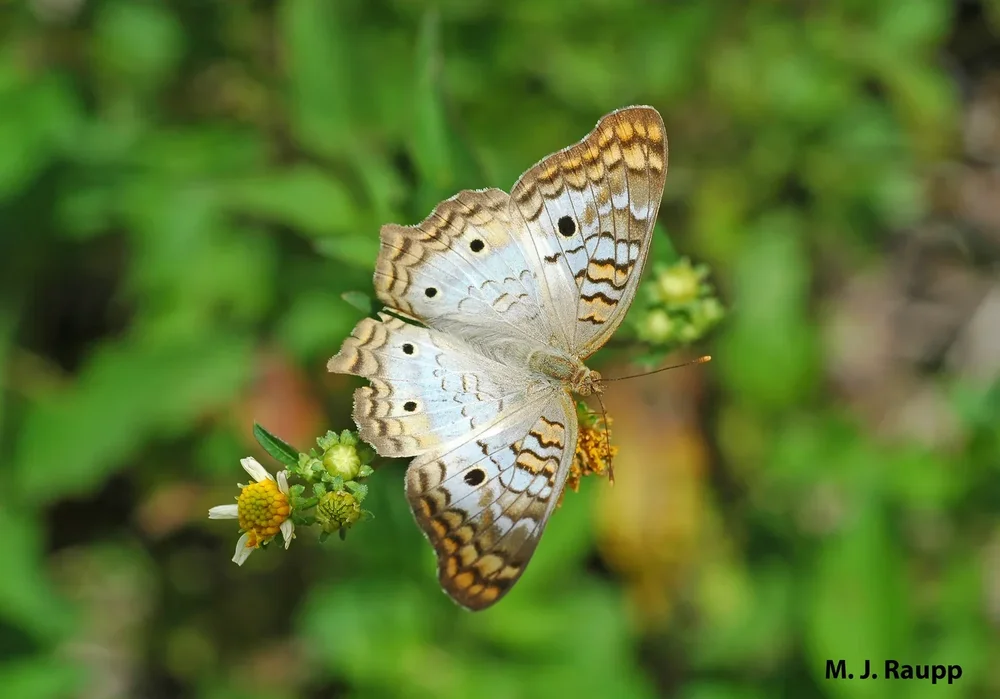
When not seeking mates or larval food plants, white peacocks tank up on carbohydrate-rich tropical flowers like lantana.
In a fascinating series of studies, Robert Lederhouse and his colleagues observed male white peacock butterflies patrolling roughly circular zones of vegetation in swampy areas in the Florida everglades. When other male peacocks, or any flying insects for that matter, entered the 15-meter diameter no-fly zone of a male, the interloper was summarily harassed and chased from the area. On closer examination, the scientists discovered water hyssop, the food plant needed for larval development, in each of the defended no-fly zones. A similar behavior of chasing away interloping males was also observed in the banded peacock butterfly. If you are a male peacock butterfly, it appears that one way to get a mate is to hang around the plant where the female must come to find requisite food for her babes. Sounds a little like an episode of Seinfeld, doesn’t it? Remember the one called “The Bookstore” where Jerry provides dating advice to George? “GEORGE: I read somewhere that this Brentano's is the place to meet girls in New York. JERRY: First it was the health club, then the supermarket, now the bookstore.” Why does it often seem that insects figure these things out before we do?

On the steps of the high pyramid of Caracol students from the University of Maryland explore the wonders of tropical rainforests and Mayan civilizations. Image credit: Luis Godoy
Acknowledgements
We thank the hearty crew of BSCI 339M, Belize: Tropical Biology and Mayan Culture, for providing the inspiration for this episode. Thanks to Luis Godoy for sharing a picture of the adventurous students. Special thanks to the staff of the Toucan Ridge Ecology and Education Society for allowing us to learn about insects in their rainforest reserve. The interesting article “Host plant-based territoriality in the white peacock butterfly, Anartia jatrophae (Lepidoptera: Nymphalidae)” by Robert C. Lederhouse and colleagues, and “Caterpillars of Eastern North America” by David L. Wagner were used as a references.

No comments:
Post a Comment