Monday, 23 February 2026

Destination Toucan Ridge, Belize, to meet one of the largest beetles in the Americas: Elephant beetle, Megasoma elephas

Elephant beetles are one of the largest beetles in the Americas. Would it be a thrill or a terror to have one on your shoulder?

Last week we visited pseudoscorpions, one of the tiniest arachnids in Belize, measuring roughly 8 mm in length. This week we flip the hero of the story and meet an insect almost 150 times larger than the pseudoscorpion, the gigantic elephant beetle. These titans are not encountered on a regular basis, but good fortune smiled on our Belizean crew when we erected a broad white cloth on a large stanchion and illuminated the cloth with powerful lights after dark. The attraction of night-flying insects to light is legendary and within hours of sunset hundreds of rainforest insects found their way to the lighted cloth and the surrounding vegetation.

After colliding with a student while on its way to rendezvous with an illuminated cloth, this giant elephant beetle landed on a lawn. While delivering a gentle touch to this marvelous scarab, the beetle displayed an interesting behavior of dipping its body toward the ground and seemingly rotating its impressive horn in the direction of an offending finger. Perhaps this tilting behavior is designed to protect the beetle’s delicate underbelly while the impressive horn parries the attacker away. Caught someplace between terror and joy, bold students couldn’t resist wearing and holding one of the largest insects on earth. The chance to see and hold this marvelous creature is a memory not to be forgotten.

While one student stood marveling at the panoply of six-legged wonders, she was pelted by an enormous rhinoceros beetle nearly the size of a softball that collided with her back. Rhinoceros beetles are members of the scarab beetle clan, and are renowned for their remarkable size and the large horns that adorn the males. Her visitor was an elephant beetle, one of the five largest beetles in Central and South America. Males use their horns in fierce battles with other males for access to mates and food. Some say the large central horn of the rhinoceros beetle resembles the trunk of an elephant, hence its name.  
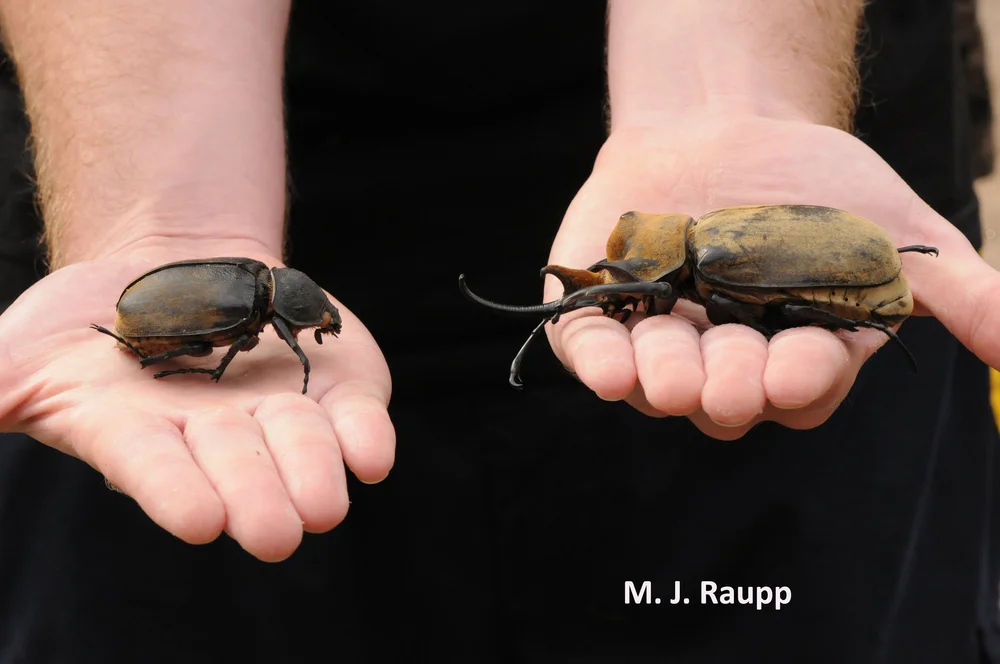
Female elephant beetles lack horns and can be much smaller (left) than enormous horned male beetles (right).

Adult beetles dine on fallen fruit and exudates from trees, and their offspring dine on decomposing vegetation like the remains of fallen trees. Beetle larvae are shaped like the letter “C” a characteristic common throughout the scarab clan. Three years may pass before they reach maturity, while the adults live only three or four months. An encounter with this goliath of the insect world is memorable. Tips of its powerful legs bear sharp claws which embed in clothing and flesh, making the removal of the beetle from a human an awkward and uncomfortable challenge. Placing a finger aside the giant causes it to tilt toward the groun,d apparently to prevent the offending finger from poking beneath its body. Perhaps this behavior has evolved to thwart lateral attacks by predators to the less protected belly of the beetle.

Imagine how big elephant beetle larvae will be when fully developed. These two are only about halfway grown.

Our oversized visitor eventually arrived on the top of the white cloth near the bright light where it rested beyond the late hour that students and faculty retired for the night. By dawn the next morning, the elephant beetle and other visitors to the lights had departed to continue their assignments in the rainforest. The chance to see and hold this marvelous creature remains a memory not to be forgotten.
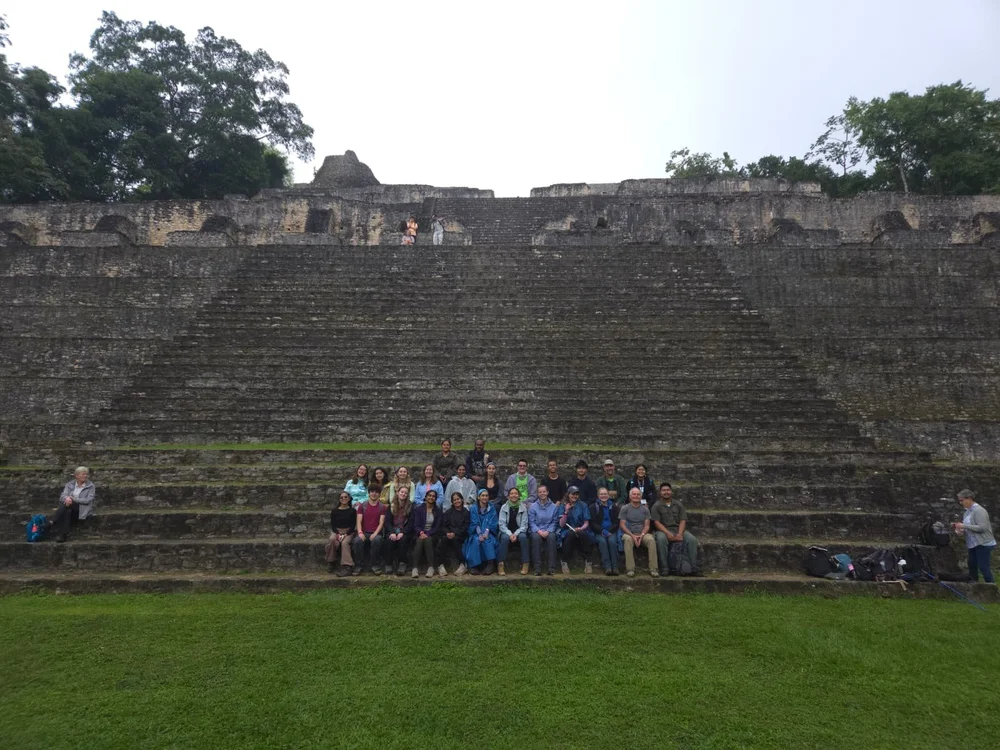
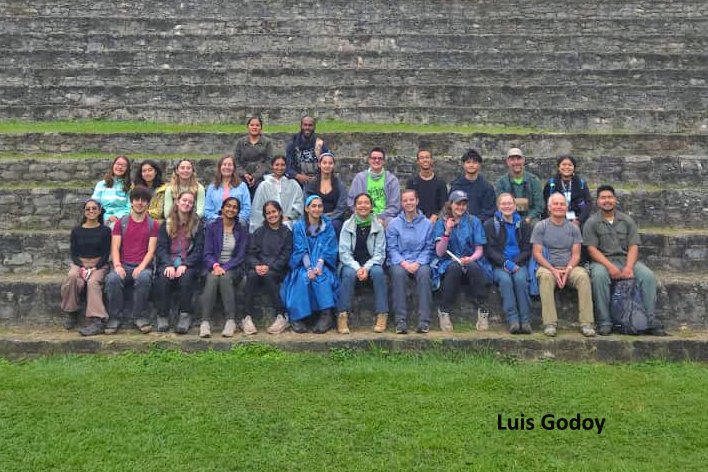
On the steps of a pyramid at Caracol, students from the University of Maryland explore the wonders of tropical rainforests and Mayan civilizations. Image: Luis Godoy

Acknowledgements  

Bug of the Week thanks the adventurous students and faculty of BSCI 339M, Belize: Tropical Biology and Mayan Culture, for providing the inspiration for this episode. Special thanks to Adèle and Erron Murphy for allowing me to record and share their encounters with this remarkable beetle. Special thanks to the staff of the Toucan Ridge Ecology and Education Society for allowing us to learn about insects in their rainforest reserve.


Monday, 16 February 2026

Destination Caracol, Belize: Tiny scorpions on the tree bark? Nah, false scorpions, Pseudoscorpiones

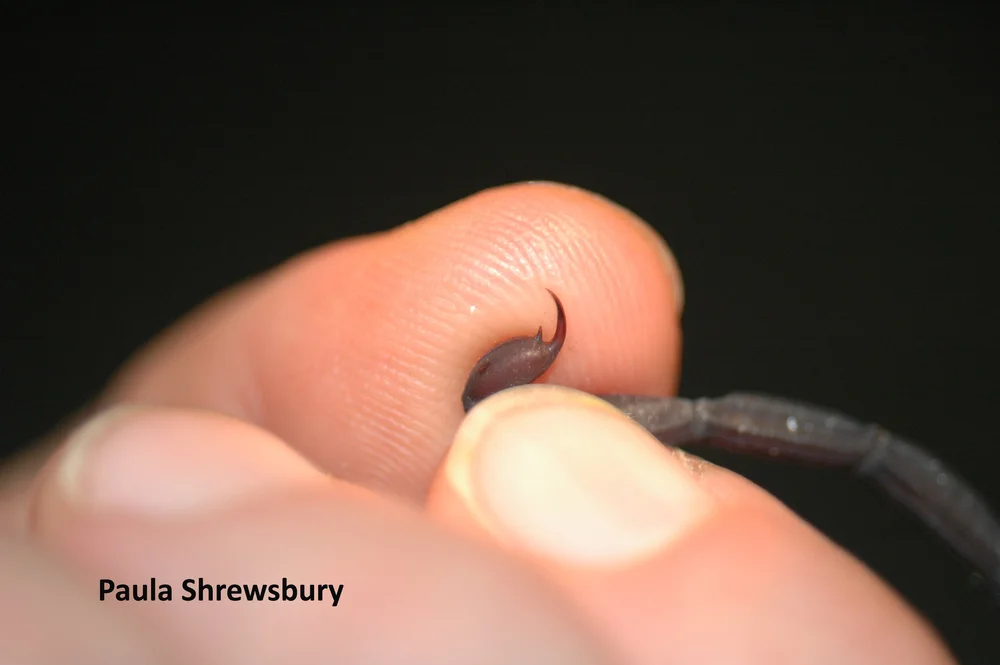
Large, impressive pinchers of the pseudoscorpion immobilize and dismember small arthropods that are prey for these tiny, fierce predators. Some species may be found in homes in temperate regions, where they pose no threat to humans or pets.

This week we continue our adventure in Belize where we previously met tasty termites, pretty peacock butterflies,  and stinging scorpions. On the bark of an ancient sapodilla tree, we spotted a busy colony of tiny scorpion-like creatures milling about on the surface of the trunk. These tiny arachnids had impressive pinchers known as pedipalps that closely resembled those of their distant cousins, scorpions. Pedipalps of many pseudoscorpions contain venom used to paralyze prey prior to being dismembered and consumed. They secrete proteolytic enzymes designed to predigest their victims before slurping up the liquified tissues of their prey. I’m glad they are not as big as wolves.

On the bark of an ancient rainforest tree a colony of adult pseudoscorpions with dark pinchers and bodies mingled with their lightly colored offspring. Lacking stingers like their cousins, true scorpions, pseudoscorpions rely on venomous pinchers to subdue and dismember prey.

Beyond the much smaller size of pseudoscorpions compared to their true scorpion kin (most pseudoscorpions are less than 8 mm long), the most striking difference is the absence of the elongated tail and painful stinger of the true scorpion. The abdomen of the pseudoscorpion is slightly rounded. Some species are known to travel about by hitching a ride attached to the body of another insect like a fly or a beetle in a behavior known as phoresy. In addition to the rainforests of Belize, pseudoscorpions can be found in homes right here in the DMV where they hunt booklice, carpet beetle larvae, mites, and other minute arthropods found in and around homes. While these curious creatures pose no threats to humans or pets, they are fierce and interesting members of a miniature world in the tropical rainforest.

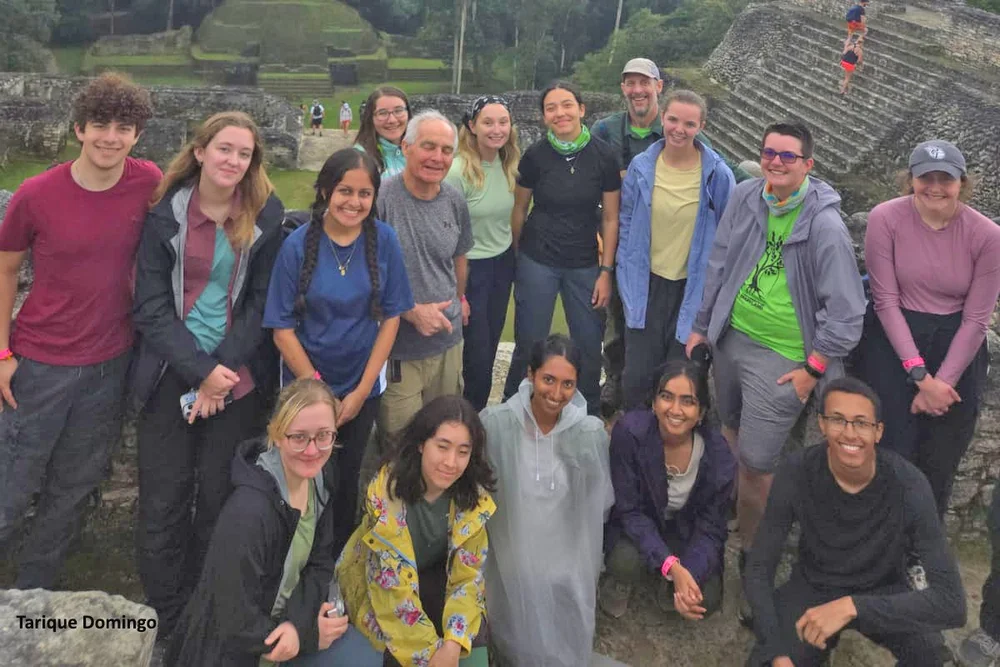
On the steps of a pyramid at Caracol, students from the University of Maryland explore the wonders of tropical rainforests and Mayan civilizations. Image: Luis Godoy

Acknowledgements

The interesting articles “Pseudoscorpions” by Jeffrey Hahn and “Pseudoscorpions of the World” by M. S. Harvey were used as references for this episode.   We thank the hearty crew of BSCI 339M, Belize: Tropical Biology and Mayan Culture and our fearless guide Luis Godoy for providing the inspiration for this episode.


Monday, 9 February 2026

Destination Toucan Ridge, Belize to experience the fluorescence and sting of rainforest scorpions, Centruroides spp.

A scorpion is revealed amongst leaves on the rainforest floor as it fluoresces bluish-green when illuminated by rays of a blacklight.

In previous episodes we visited tasty termites and beautiful butterflies during the daylight hours in the rainforest of Belize. This week we go dark on a nocturnal foray into the heart of a tropical rainforest. This escapade can produce memorable encounters. During one such foray we were amazed to see a beautiful brown scorpion turn a gorgeous blue-green when a trail guide moved a fallen leaf and cast the beam of a blacklight on the scorpion. Being a youth of the 60’s, I was instinctively struck to understand what my blacklight posters shared with this stinging eight-legged rainforest predator. It turns out that blacklight posters contain compounds, phosphors, capable of capturing the high energy photons of UV light and releasing their energy in longer and less energetic forms of visible light, producing dazzling, glowing hues. Scorpion glow results when UV light is captured by two compounds, beta-carboline and 4-methyl-7-hydroxycoumarin, found in the scorpion’s exoskeleton. Once captured, UV’s energy is released in the form of eerie blue-green florescence.  

Scorpions are not insects. They belong to another part of the arthropod clan called arachnids and are relatives of spiders and ticks. The scary pinchers on the front end of the scorpion are its pedipalps. They are used for grasping and dismembering insects and spiders that comprise most of the scorpion’s meals.

In a series of clever studies, Dr. Douglas Gaffin and his colleagues discovered that the scorpion’s entire body may act as a photoreceptor or universal “eye” used to detect different levels of light. Light in the UV range directed at scorpions produced bouts of rapid movement. These researchers suggested that the scorpion’s whole-body “eye” might help it move to places where light no longer illuminates its body, such as locations beneath vegetation where the searching eyes of larger predators were less likely to spot it. Whole-body photoreceptors might also be used by scorpions to detect the waning light levels of twilight, the signal to exit hideouts and start their nocturnal hunt for prey.

A failed attempt to capture a rather large scorpion on the rainforest floor provided a memorable sting to my right thumb. A second successful attempt with my left hand let us get up close and personal with this powerful nocturnal predator. Its sharp stinger delivers a witch’s brew of neurotoxins and other pain-enhancing compounds. Under the glare of white and red flashlights the scorpion’s color was a chocolate brown. But under the beams of a UV-black light, the scorpion fluoresces an eerie blue-green. UV light receptors on the scorpion’s body may help it detect sunlight and initiate movement to dark hiding places during daylight hours, or they may help the scorpion detect the absence of sunlight, signaling the safe time to emerge from cover to hunt prey during the cloak of night. Video credits: M. J. Raupp and Asmita Brahme

The business end of the scorpion is the sting, an enlarged segment at the end of the scorpion’s tail that contains a venom gland and a needle-like poker to deliver the poison. The sting is used to immobilize and kill prey and as a means of defense against larger animals. For some inexplicable reason, I was moved to pick up a scorpion we discovered on a rainforest trail while searching for reptiles. My first attempt to grab the scorpion by its tail was a miss that resulted in a painful and memorable sting to my right thumb. The pain was similar to that of a large wasp or honeybee. It lingered for several minutes then dulled to a mild nuisance for a few hours.  A novel element of this misadventure was notable swelling to my thumb which lasted through the next day. As seen in the video, my second attempt to capture the scorpion using my left hand was a success. Holding this largish rascal was a bit scary but pretty good fun. I learned that scorpions move surprisingly fast, but the venom of this Centruroids scorpion is not generally life threatening. However, some relatives of Centruroids, including those in the genus Tityus, are very dangerous and their venom can be fatal to humans. This is not an endorsement for anyone to hold a scorpion as reactions to any foreign protein, including scorpion venom, can be serious and sometimes life-threatening.

If this sting gets you, you will be sending out an SOS to the world.

On another tropical adventure in the rainforests of Belize I had the good fortune to encounter scorpions in a somewhat different context. After a long day of feeding mosquitoes and avoiding crocodiles with a group of students on a study abroad, the prospect of enjoying a little shut eye in the bunkhouse was most appealing. Unfortunately, one student climbed into her lower bunk bed and was surprised to see a rather impressive scorpion beneath the mattress of the upper bed just a few inches above her head. She tested the potency of the scorpion’s sting when she grabbed the one lurking over her bunk and was stung. She summarily hurled said scorpion out the door of her cabin. Her assessment of the experience: “It only hurt a little and that thing was really annoying me”. You go girl!

On the steps of a pyramid at Caracol, students from the University of Maryland explore the wonders of tropical rainforests and Mayan civilizations. Image: Luis Godoy

Acknowledgements

We thank the hearty crew of BSCI 339M, Belize: Tropical Biology and Mayan Culture, for providing the inspiration for this episode. Thanks to our guide Ren for discovering a scorpion on the rainforest floor. Special thanks to Asmita for sharing the video of a bug geek nervously capturing a rather large scorpion. Luis Godoy graciously provided the image of the students at Caracol. Many thanks to Dr. Jeff Shultz for an enlightening discussion about scorpion glow. The fascinating article “Scorpion fluorescence and reaction to light” by Douglas D. Gaffin, Lloyd A. Bumm, Matthew S. Taylor, Nataliya V. Popokina, and Shivani Manna provided much background information for this episode.


Monday, 2 February 2026

Destination Toucan Ridge, Belize to visit beautiful peacock butterflies: White peacock butterfly, Anartia jatrophae, and banded peacock butterfly, Anartia fatima and learn their dating games

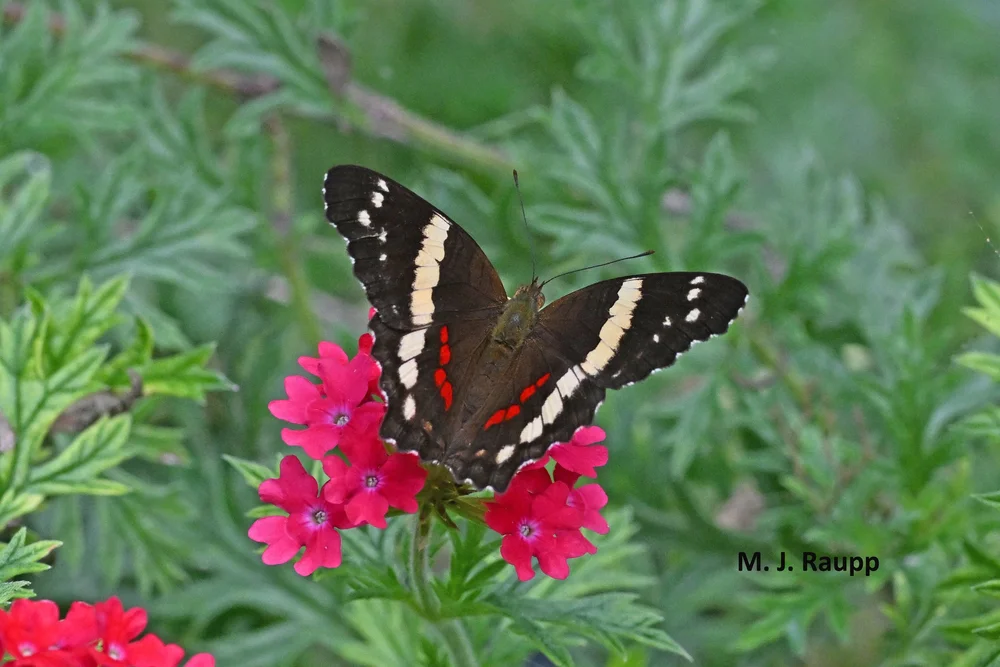
Contrasting colors of dorsal wing bars make the banded peacock one of the most beautiful butterflies in the rainforest.

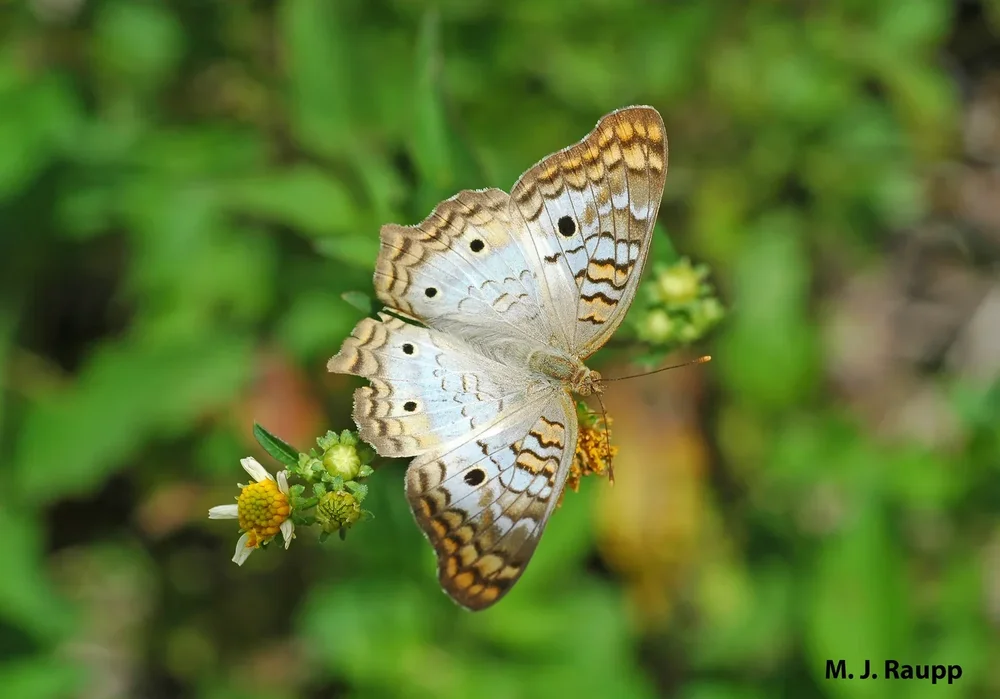
Following a week where Old Man Winter socked-it-to much of North America with bone chilling temperatures and mountains of snow, let’s return to the warm embrace of the rainforests of Belize where we last visited tasty conehead termites. Last week we met squirty termites in the dark rainforest. This week we move to a sunlit meadow to meet members of the brush-footed butterfly clan known as peacocks. Our first guest, the beautiful white peacock butterfly, Anartia jatrophae, is a resident not only of Central America, but also much of South America and as far north as Florida and Texas in the United States. The banded peacock, Anartia fatima, is also a resident of Central America and wanders into the United States, where it sometimes visits Texas and has been found occasionally as far north as Kansas.

Glorious banded peacock butterflies and pretty white peacock butterflies with spots on their wings use a rather small menu of tropical plants as food plants for their larvae. Males spar to defend patches of these host plants to court potential mates seeking food for their young. While I was unable to record these fast-moving battles, I hope that watching these tropical beauties might bring some cheer to you on these chilly and dreary winter days.

Throughout much of their range, peacocks can be found almost year-round in disturbed open meadows and swampy areas where food plants for the larvae are found. Food plants for caterpillars of the white and banded peacocks include water hyssop, blechum, frogfruit, and wild petunia. Tropical rainforests are among the most biologically diverse of all ecosystems on our planet, housing an astounding array of plant species. The Nature Conservancy estimates roughly 1500 species of flowering plants exist in a four-square mile area of tropical rainforest. The fidelity of female peacock butterflies to a relatively small number of plants on which she places her eggs has resulted in an interesting strategy employed by male peacock butterflies to secure a mate.

When not seeking mates or larval food plants, white peacocks tank up on carbohydrate-rich tropical flowers like lantana.

In a fascinating series of studies, Robert Lederhouse and his colleagues observed male white peacock butterflies patrolling roughly circular zones of vegetation in swampy areas in the Florida everglades. When other male peacocks, or any flying insects for that matter, entered the 15-meter diameter no-fly zone of a male, the interloper was summarily harassed and chased from the area. On closer examination, the scientists discovered water hyssop, the food plant needed for larval development, in each of the defended no-fly zones. A similar behavior of chasing away interloping males was also observed in the banded peacock butterfly. If you are a male peacock butterfly, it appears that one way to get a mate is to hang around the plant where the female must come to find requisite food for her babes.  Sounds a little like an episode of Seinfeld, doesn’t it? Remember the one called “The Bookstore” where Jerry provides dating advice to George? “GEORGE: I read somewhere that this Brentano's is the place to meet girls in New York. JERRY: First it was the health club, then the supermarket, now the bookstore.” Why does it often seem that insects figure these things out before we do?

On the steps of the high pyramid of Caracol students from the University of Maryland explore the wonders of tropical rainforests and Mayan civilizations. Image credit: Luis Godoy

Acknowledgements

We thank the hearty crew of BSCI 339M, Belize: Tropical Biology and Mayan Culture, for providing the inspiration for this episode. Thanks to Luis Godoy for sharing a picture of the adventurous students.  Special thanks to the staff of the Toucan Ridge Ecology and Education Society for allowing us to learn about insects in their rainforest reserve. The interesting article “Host plant-based territoriality in the white peacock butterfly, Anartia jatrophae (Lepidoptera: Nymphalidae)” by Robert C. Lederhouse and colleagues, and “Caterpillars of Eastern North America” by David L. Wagner were used as a references.