Monday, 27 October 2025

Bug in orange and black: Milkweed tussock moth, Euchaetes egle, and its caterpillars have tricks but no treats for hungry predators

This hairy milkweed tussock moth caterpillar has a scary trick but no treat for predators.

One of my favorite insects decked out in Halloween colors of black, orange, and white is the shaggy tussock moth caterpillar, which dines on members of the milkweed plant family. Every time I see one, it reminds me of the irascible creature Cousin Itt, of Adam’s Family fame. Hordes of these leaf-munchers are often seen in late summer and autumn consuming leaves of milkweeds. These caterpillars are the offspring of a species of moth known as the milkweed tussock moth or milkweed tiger moth. To understand why they present a scary meal to would-be predators, let’s review a little bit of the biology of milkweed plants and milkweed-feeding caterpillars.

Milkweed gets its name from the sticky white sap exuded from stems or leaves when their surface is broken by hungry insects or curious humans. Milky sap and cells within the leaves contain nasty chemicals called cardiac glycosides. As the name implies, these compounds have something to do with the heart. At higher concentrations, cardiac glycosides can be heart poisons, bringing death to animals like horses that eat the plants containing them. However, many insects that eat milkweeds have evolved mechanisms to deal with these toxins and have the ability to consume leaves of milkweed without being poisoned. In fact, they obtain cardiac glycosides from their food and then store these noxious compounds in their bodies. Caterpillars of both the monarch butterfly and milkweed tussock moth obtain cardiac glycosides and retain them as they develop into a butterfly or moth, respectively.

Milkweed tussock moth caterpillars devour leaves of milkweeds. As they feed, toxic cardiac glycosides found in milkweeds are ingested and stored in their bodies. Caterpillars become a noxious meal. Their orange and black coloration warns predators not to mess with them.

What is all of this chemical chicanery about? Birds are important predators of many kinds of insects,  including caterpillars and butterflies. Scientists discovered that cardiac glycosides found in monarch butterflies caused predators such as blue jays to vomit dramatically following an attempted monarch meal. Blue jays exposed to monarchs soon learned to recognize the monarch by sight and avoided eating these beautiful, but nasty tasting butterflies. Many of the insects that live on milkweed and consume its leaves display vivid patterns of orange and black as both juveniles and adults. This convergence on a similar, easily recognizable color pattern by two or more nasty-tasting insects is called Müllerian mimicry. Other milkweed feeders that participate in the milkweed mimicry ring include milkweed longhorned beetles, milkweed bugs, and milkweed leaf beetles we met in previous episodes. Like the larvae of the monarch, caterpillars of the milkweed tussock moth obtain cardiac glycosides from milkweeds and retain them as adults.

While the caterpillars of this tiger moth boldly wear the characteristic warning colors of orange and black as they feed during the day, the adult moth is comparatively drab at first glance, with pale brown wings. Nevertheless, its impressive abdomen sports the Halloween colors orange and black. The fact that caterpillars of the milkweed tussock moth store cardiac glycosides for use as adults is somewhat perplexing. Primary predators of these night-flying moths are fearsome bats that hunt using sound rather than sight to locate prey. Orange and black coloration may have little value in defeating these night-hunting predators. However, the cardiac glycosides stored in the body of the moth are put to good use. The resourceful milkweed tiger moth evolved an organ that emits an ultrasonic signal easily detected by bats. The signal warns that an attack will be rewarded with a noxious distasteful meal and bats soon learn to avoid tussock moths as prey. For many bugs in orange and black there are no treats for hungry predators.   

Adult milkweed tussock moths sport Halloween colors and warn bats of their distastefulness with a spooky sound.

Acknowledgements

Bug of the Week thanks Chris Sargent and several Bug of the Week viewers for providing the inspiration for this week’s episode. Two delightful references “Sound strategy: acoustic aposematism in the bat–tiger moth arms race” by Nickolay I. Hristov and William E. Conner and “Secret Weapons” by Thomas Eisner, Maria Eisner, and Melody Siegler provided valuable insights into the mysterious ways of this week’s star.


Monday, 20 October 2025

Thread-waisted wasps traveling in tandem - what’s that about? Thread-waisted wasp, Eremnophila aureonotata

Male thread-waisted wasps travel in tandem with their mate. Females visit blossoms searching for nectar to fuel her hunt for caterpillars, the food for her young.

Spotted horsemint rocks with pollinators on late summer and early autumn days.

One of my favorite late summer and early autumn bloomers is spotted horse mint, Monarda punctata. During this season horsemint attracts an amazing variety of pollinators, including several species of remarkable wasps including  great black wasps, mason wasps, and potter wasps. Among the most interesting and beautiful of these visitors are thread-waisted wasps in the family Sphecidae. One of the most common members of the sphecid clan visiting horsemint is Eremnophila aureonotata, hunter of caterpillars. Caterpillars serve as food for her larvae. Locating and subduing caterpillars requires loads of energy, and frequent trips to flowers for carbohydrate-rich nectar are regular daily activities. When not feeding on flowers, Eremnophila search foliage to find caterpillars, the food for their young. Upon finding a potential victim such as a prominent caterpillar, the female wasp wrestles with the larva and delivers a paralyzing sting. The immobilized victim is then transported to a subterranean nursery and placed beneath the ground. An egg deposited on the hapless victim hatches into a legless larva that consumes the living but powerless prey. Before leaving her young, the mother carefully arranges debris, pebbles, and dirt over the burrow to disguise the entry to her nest. This probably keeps other insects from making a meal of her young or their provisions of caterpillars.  

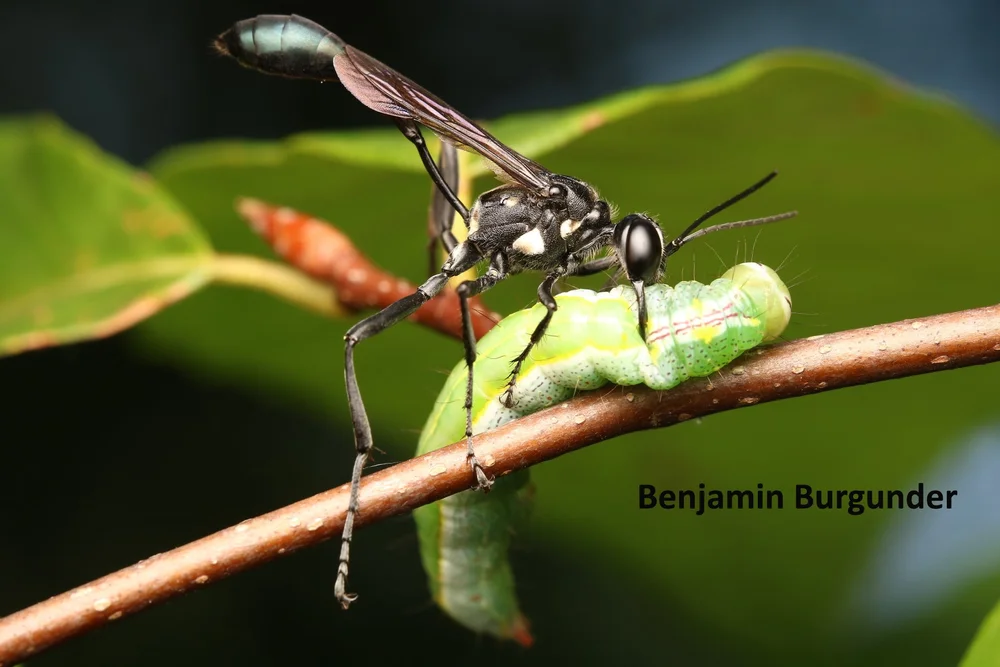
Caterpillars stung and paralyzed by female thread-waisted wasps will become fresh meat for the wasp youngsters as they develop underground. Eremnophila aureonotata in Anne Arundel Co., Maryland (8/24/2024). Image: Benjamin Burgunder, some rights reserved (CC BY).

Mating behaviors of Eremnophila include prolonged coupling of the blissful pair with the male grasping his mate by the neck as she saunters from blossom to blossom. This prolonged tandem linkage likely ensures that the sperm of the lucky suitor will be the ones that fertilize eggs carried by his mate, sort of a behavioral guarantee of paternity. This prolonged copulatory guarding is seen in many other species of insects, such as dragonflies and damselflies. In addition to spotted horsemint, thread-waisted wasps frequent goldenrods and other members of the aster family. When your late summer and early autumn rambles take you to the meadow, try to catch a glimpse of these clever hunters as they fly in tandem amongst the blossoms.    

Spotted horse mint is a dynamite attractor of many kinds of pollinators. Watch as this female thread-waisted wasp searches blossoms for carbohydrate-rich nectar. Nectar powers her mission to find caterpillars that will be stung, paralyzed, and consumed by her offspring as they develop in subterranean galleries. Her piggy-backing mate isn’t just there for the ride. Prolonged copulation ensures that his sperm will be the ones to fertilize eggs of his mate, a behavioral insurance policy of paternity. But I wonder, does he really have to grab her by the neck?

 Acknowledgements

 Interesting and entertaining accounts of thread-waisted wasps including “The habits of aculeate Hymenoptera” by William Ashmead, “Sleep in insects: An ecological study” by Phil and Nellie Ray, “Insects: Their natural history and diversity” by Stephen Marshall, and “Predatory Wasps (Hymenoptera) of the Yucatan Peninsula” by Maximiliano Vanoye-Eligio, Virginia Meléndez Ramírez, Ricardo Ayala, Jorge Navarro and Hugo Delfin-González, were used as references for this episode. With thanks to Ben Burgunder for generously allowing use of his fine image of a thread-waisted wasp capturing a caterpillar.


Monday, 13 October 2025

Sad fate for a beautiful sphinx: Catalpa sphinx, Ceratomia catalpae


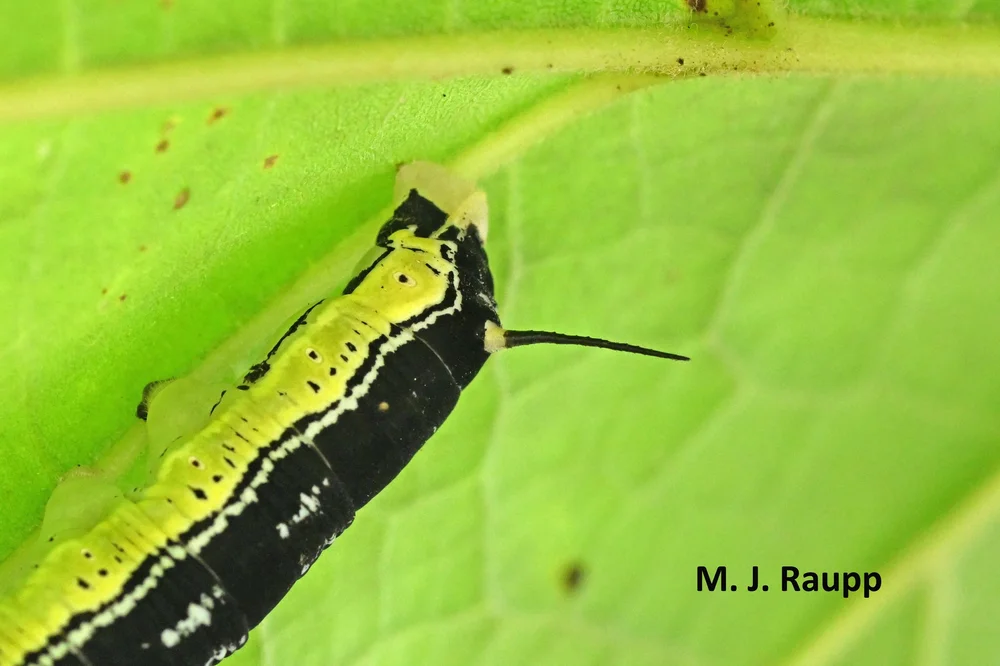
Beautiful catalpa sphinx caterpillars are among the largest caterpillars found in the DMV.


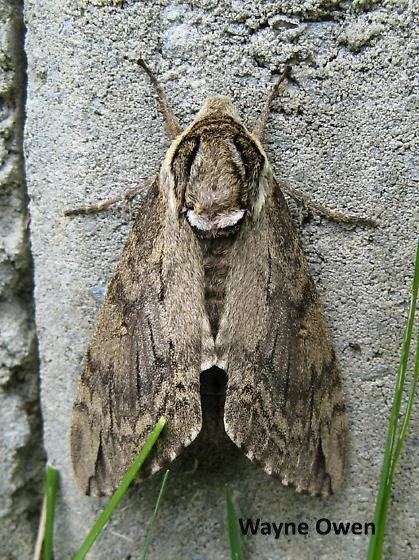
Adult catalpa sphinx moths blend in with substrates like the brown bark of trees. Thanks to Wayne Owen for the use of his great image.

Several members of the moth family called the Sphingidae are known as sphinx moths owing to the defensive behavior of larvae which rear upright presenting a visage reminiscent of the lion-headed Great Sphinx of Gaza. Often accompanying this display is a vomitous regurgitation of partially digested catalpa leaves meant to deter would be predators. This performance certainly would deter me from eating one.

The female sphinx moth lays batches of eggs often numbering in the hundreds on the leaves of both northern and southern catalpa trees. After hatching, larvae feed gregariously for the first several instars of their life before feeding singularly in their latter stages. Fully developed larvae wander from the plant to the soil where they form a pupa. Two or three generations are present annually throughout the range of the moth and winter is spent as a pupa in the soil near its catalpa host. Under ideal conditions for survival of adults and larvae, large populations may defoliate portions of catalpa trees.

Catalpa trees are host to the larvae of the catalpa sphinx moth. These larvae are one of the largest and most striking of all caterpillars in North America. Early stages are a chummy lot and feed gregariously. Their feeding generates waste called frass that piles up on leaves and the ground below. Watch as this one nibbles off the tip of a leaf. Ah, but like other sphinx moth caterpillars they are attacked by small parasitoid Cotesia wasps. After completing development inside the caterpillar, wasp larvae emerge through the caterpillar’s skin and spin small silken cocoons on the caterpillar’s surface. You may have seen Cotesia cocoons on a hornworm caterpillar on your tomatoes. Parasitoids like this make me glad I’m not a caterpillar.   

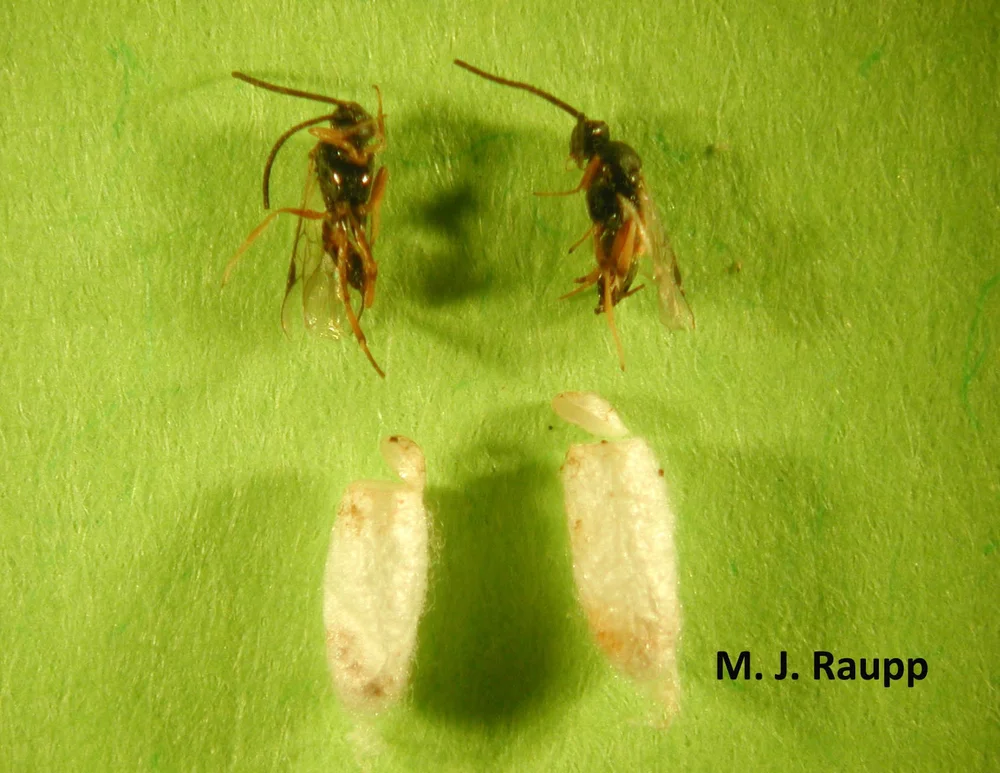
Small Cotesia wasp larvae develop inside catalpa sphinx caterpillars before emerging through the cuticle and spinning white cocoons on the surface of their hapless host.

As with many caterpillars and other herbivorous insects, when populations become locally dense, natural enemies often arrive to take advantage of the bounty of fresh meat. A small parasitoid braconid wasp, Cotesia congregata, attacks and kills larvae of several species of caterpillars including tobacco and tomato hornworms in addition to those of the catalpa sphinx. We met clever Cotesia parasitoids attacking larvae of saddleback caterpillars in a previous episode. Check out that episode to see these alien-like creatures emerging from the skin of their host - truly creepy. Another moniker for caterpillars in the family Sphingidae is horn worm. One legend has it that the prodigious horn on its rear end is poisonous. Well, I tempted fate with one of the large catalpa sphinx caterpillars and found the horn to be rather tickly but certainly not capable of delivering any type of venom.

Can this horn on the rearend of a catalpa sphinx caterpillar deliver an awful sting? Nope.

Acknowledgements

Bug of the Week thanks eagle eyed Erika and the wonderful Cylburn Arboretum for allowing me to visit their catalpa sphinx caterpillars that inspired this story. The fact-filled “Caterpillars of Eastern North America” by David Wagner was used a reference for this story. Special thanks to Wayne Owens for allowing the use of his image of the catalpa sphinx through Creative Commons.


Monday, 6 October 2025

Yellow picnic pests: Yellowjackets, Vespula


Uh oh, better check that soda can to see if a zesty yellow surprise awaits inside.


The last two episodes focused on the Yin and Yang of yellow jacket wasps. Well, with delightful autumn weather upon us, with fall festivals, picnics, and tailgates in full swing, it is time to visit an episode from a few years ago to avoid some nasty surprises brought to you by stinging insects. So, here is a throw-back to 2021 to help you avoid some pain.

If this episode of Bug of the Week reads like a public service announcement, well, that’s because it is. While our usual episodes demystify insects and revel in their curious and marvelous behaviors, every now and then something a bit unseemly pops up and warrants attention. In past episodes we have quelled fears of murder hornet invasions in the DMV, provided information to thwart mosquitoes and ticks, and addressed autumnal invasions of stink bugs, spiders, and other creepy creatures. This week we aim to help you avoid a nasty surprise at your October picnic.

On a recent outing to a park, my granddaughter was frightened when yellowjackets swarmed her blueberry flavored shave ice. A second unnerving tale arose when a colleague took a swig from a soda can and imbibed a yellowjacket. Fortunately, the angry vespid stung her tongue, not her throat, prior to ejection from her mouth. Lucky her, to only suffer a swollen tongue and not a life-threatening occlusion of the throat. Yellowjackets are among the most aggressive of all stinging insects in the DMV. During late summer and early autumn yellowjackets operate at a fevered pitch as workers try to gather food to maximize the production of brood back at the nest. Unlike the nests of honey bees, yellowjacket nests contain no honey or pollen. These rascals are meat eaters that also gain carbohydrates from fruits, flowers, and sometimes human-made sources. At sunny October picnics and tailgating parties, yellowjackets visit plates and battle you for bites of barbecued chicken. Meaty protein will be taken back to the hive for the developing brood. Yellowjacket larvae are fed meat and carbohydrate rich foods provided by the workers. Natural prey items of yellowjackets are other insects such as caterpillars and beetles that plague garden and landscape plants. In this regard, yellowjackets are highly beneficial.

October is a month when stinging insects hunt for food. In the wild, caterpillars are a regular source of protein, and carbohydrate rich honeydew supplies energy for yellowjacket workers and brood. Human-made sources like peanut butter and jelly sandwiches are on the menu and sweet soft drinks are favorite sources of sugar. Soda cans may contain nasty surprises, wasps or bees, so be careful and consider pouring drinks into cups. Open cups provide a chance to look before you sip. For children, consider using cups with reusable straws and tight-fitting lids for soft drinks.

By late summer and early autumn, colonies may contain thousands of workers and their subterranean or aerial nests can attain the size of a football. Under extraordinary circumstances, nests may persist for more than one year and become enormous. There are reports of monster yellowjacket nests in southern states reaching the size of a “Volkswagen Beetle”. In late summer, back in the nest, the yellowjacket assembly line switches from production of workers to the production of queens and drones. Foraging occurs at a frenetic pace. Queens produced in autumn leave the nest and seek protected locations under tree bark or in other outdoor refuges to escape the ravages of winter before founding new colonies next spring. You can learn a bit more about yellowjackets in a previous episode entitled “Be careful around yellowjackets: Eastern yellowjackets, Vespula maculifrons”. Bumble bees, carpenter bees, and honey bees are also on the prowl for sugar sources during the waning days of autumn. In addition to natural sugar sources, sweet soft drinks are also on the menu. Liquid sugar sources are guzzled and stored in the bee’s specialized honey stomach. Carbohydrate rich liquids are fed to brood, other bees, or turned into honey upon returning to the hive.


Apple sauce in a cup is an irresistible source of sugar for a yellowjacket in autumn.


What can you do to avoid confrontations with these stingers? Choose picnic and tailgating spots carefully. Do not set up your picnic near a trash container or dumpster where yellowjackets and bees may be foraging for discarded barbeque or half-full cups of cans of sugary soft drinks. Bring a covered container to stow your trash and to keep hungry foragers away from food scraps and partially filled drink containers. Keep food covered. This reduces recruitment by foragers that accumulate around accessible food sources. Drink from clear bottles or pour drinks into clear cups. This will allow you to observe stinging insects doing a backstroke in your drink before you down them. Bees and yellowjackets often find their way into pop-top cans and can disappear down your gullet without being seen. Instead of canned drinks, try juices in drink boxes equipped with tight fitting straws. These are great for children who often place canned soft drinks down for a while before returning to finish them. Better yet, for your youngsters, pour soft-drinks into one of those cleverly designed drink containers with tight fitting lids and reusable sippy straws (good for the environment too!). If yellowjackets try to sneak a bite of your food, gently brush them away rather than engaging in hysterical slapping and squealing. Quick movements and non-lethal blows can incite painful stings. Oh, and you may have heard that yellowjackets are capable of multiple stings. This is only partially true. Contrary to common belief, some yellowjackets have barbed stingers like our friends the honey bees. Yellowjackets may lose their stingers and be eviscerated in the process. If you are stung, apply ice to the site of the sting to reduce swelling and pain. If you are stung and experience symptoms such as shortness of breath, difficulty breathing or swallowing, hives on your body, disorientation, lightheadedness or other unusual symptoms, seek medical attention immediately. Enjoy outdoor feasts with friends and families on these glorious October days. By taking a few precautions you can avoid nasty surprises from yellowjackets and busy bees.

Acknowledgements

We thank Dr. Shrewsbury for drinking a yellow jacket and living to tell about it, and Eloise for braving out the feisty wasp’s attack on her shave ice. We also thank Dr. Nancy Breisch for sharing her expertise and knowledge about stinging insects.