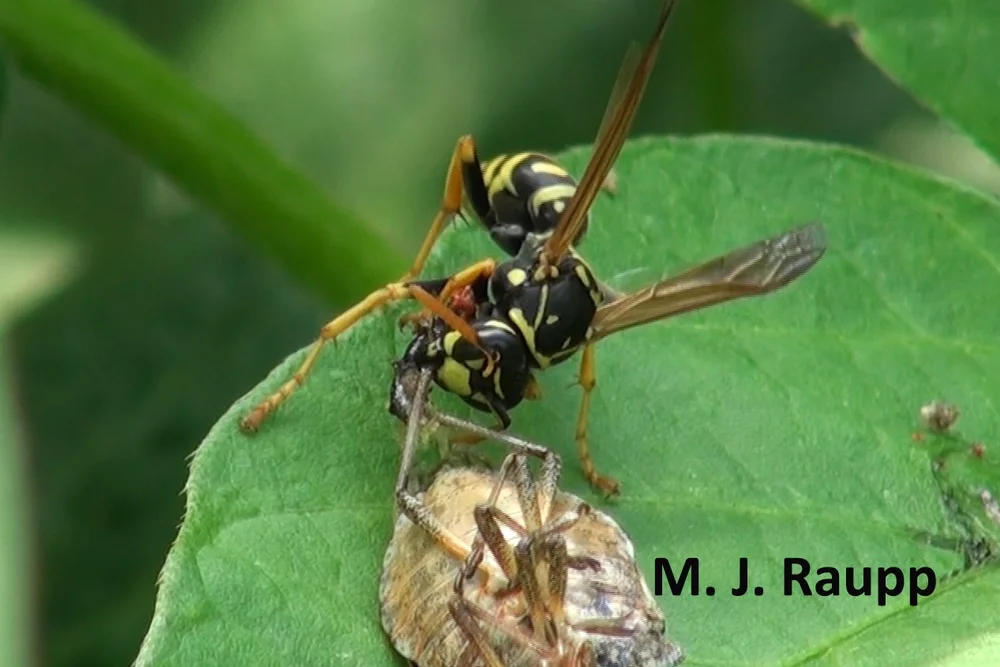
Yellowjackets find invasive species like brown marmorated stink bugs quite tasty.
Last week we met fierce southern yellowjackets schooling my neighbor on what it meant to get just a little too close to their nest while trimming some grass. This week let’s explore a couple more things about yellowjackets and try to imagine their good side. The inspiration for this episode comes from James Key, an avid naturalist who shot a segment of the video that accompanies this episode.
Spotted lanternflies captured serious attention last month as they took wing in numbers so large that they appeared on weather radar. We know that many predators, including spiders, Carolina mantises, and Chinese mantises, enjoy dining on spotted lanternflies and help contribute to biological control of these dastardly invaders. But did you know that wasps where the second most important group of insect predators attacking spotted lanternflies according to a study by scientists at Penn State? One of the most common groups of predatory wasps associated with invasive spotted lanternflies are members of the yellowjacket clan. Like bees, paper wasps and hornets, yellowjackets are attracted to copious amounts of honeydew excreted by lanternflies as they feed.
Yellowjacket amongst the lanternflies. Is she there for honeydew or a lanternfly snack?
In addition to sweet carbohydrates in the honeydew, yellowjackets are also intent on gathering protein, a nutrient critical to the production of next year’s queens being produced back in the nest during autumn. Watch as a yellowjacket gnaws off the rear end of a spotted lanternfly and zooms back to the colony to feed rump of lanternfly to the developing brood.
First at normal speed and then at half speed, watch as a yellowjacket removes the rear end of a spotted lanternfly and carries the booty back to the nest. In addition to killing spotted lanternflies, yellowjackets also help reduce populations of native pests like caterpillars of fall webworm.Video by James Key and Michael Raupp
In addition to terrorizing invasive spotted lanternflies, yellowjackets help reduce populations of native pests like the fall webworms which build those nests that will soon cloak terminal of branches of walnuts, crabapples, and more than 100 other species of plants. As with many other insects, yellowjackets have a downside as we learned last week (just ask my neighbor), but an upside by providing biological control of some pests; the natural Yin and Yang of living creatures.
Next week we will again visit yellowjackets and some of their stinging cousins to see how you might avoid getting stung at your October picnic or game day tailgate.
Acknowledgements
Bug of the Week thanks James Key for providing the crazy, funny video of a spotted lanternfly losing its rearend to a yellowjacket.
After their paper nest was disturbed by a hedge trimmer, fierce southern yellowjackets were raring to attack anything that moves.
Like many of you, the Bug Guy has encountered yellowjackets on more than one occasion. These misadventures often took place while mowing a lawn where native eastern yellowjackets had set up shop in a subterranean burrow. A few weeks ago, I had the opportunity to meet another native yellowjacket, the southern yellowjacket, when my neighbor had the bad luck of hitting an aerial nest of southern yellowjackets while trimming a cluster of ornamental grasses in his backyard. Unlike the hidden buried nest of eastern yellowjackets, this papery nest about the size of a soccer ball was nestled amongst the stems of tall grass. By late summer and early autumn, southern yellowjacket colonies may contain thousands of workers and, under extraordinary circumstances, some nests in the south may persist for more than one year and reach gigantic proportions. There are reports of monster yellowjacket nests in southern states reaching the size of a “Volkswagen Beetle”.
Historically found mostly in the south, southern yellowjackets continue to move north and are now common in the DMV. While trying to trim this patch of grasses, my neighbor disturbed a nest of southern yellowjackets. Hours after he escaped with several painful stings on head, arms, and other unmentionable body parts, these fierce wasps were still ready to attack. Elsewhere, two southern yellowjacket workers tried to dismantle an annual cicada. Their feisty dispositions were apparent as they squabbled over the feast. As the world warms, don’t be surprised to see more southern species heading north.
When disturbed by a hedge trimmer, fierce southern yellowjacket workers descended on my neighbor and delivered about a dozen memorable stings. Levels of yellowjacket aggression seem to increase during late summer and autumn, when nests have legions of maniacal workers willing to die to defend the colony. If you blunder upon a nest in the lawn or in a bush, walk away as quickly as possible with a minimum of swatting and arm waving. Walking through a bush (no, not one with the nest) may help throw the pursuing workers off your trail and help you escape with fewer stings. When attacking, yellowjackets release a chemical signal called an alarm pheromone into the air. Like a charge call from a bugle, it incites other yellowjackets to enter the fray with deadly intent. The venom of yellowjackets and their kin has evolved to bring maximum pain to vertebrates like skunks or bears that pillage their nests. Encounters with these fierce ladies confirm that their venom brings agony to humans as well. Yellowjackets are capable of multiple stings, but only to a limited extent. Contrary to common belief, they have barbs on their stingers and many lose their stingers and internal organs during a fatal attack. My unfortunate neighbor had several stingers removed from his body after escaping from the attack.
Several suicidal southern yellowjackets embedded their stingers into the flesh of my unfortunate neighbor. Image credit: Matt Sutton.
If you are stung, apply ice to the site of the sting to reduce some of the damage and pain. Sting relieving ointments and creams are available in pharmacies and sporting goods stores and may help reduce the pain and itching. If you know that you are allergic and are stung, seek medical attention immediately. If you are stung and experience symptoms such as shortness of breath, difficulty breathing or swallowing, hives on your body, disorientation, lightheadedness or other unusual symptoms, call 9-1-1 and seek medical attention immediately. Desensitization therapy has proven very helpful to many people with allergies to stings of bees and wasps.
Mating pairs of southern yellowjackets may soon be seen as overwintering females (larger female wasp on bottom) are coupled with their mates (smaller male wasp on top). Image credit: Ginny Brace
As with other pests like ticks, mosquitoes, and fire ants, southern yellowjackets are expanding their geographic range northward. In 1984, researchers reported the distribution of southern yellowjackets to include the eastern United States from Iowa, south to Texas and eastward to the Atlantic seaboard. As of this writing, the current distribution reported in iNaturalist includes the upper peninsula of Michigan, upstate New York, and most of Massachusetts. Clearly, southern yellowjackets are firmly entrenched in the DMV. In our warming world, insects with historically southern distributions will continue to make their presence known in more northern realms.
Acknowledgements
Bug of the Week thanks our neighbor Matt for sharing his harrowing adventure with southern yellowjackets and allowing us to visit his landscape and post his pictures of his attackers and their stingers. Ginny Brace provided the image of the mating pair of yellowjackets. Dr. Nancy Breisch provided expertise and knowledge about stinging insects for this episode. The wonderful articles “Yellowjackets” by Tawny Simisky and Nicole Bell, and “Nesting Biology of the Southern Yellowjacket, Vespula squamosa (Hymenoptera: Vespidae): Social Parasitism and Independent Founding” by John F. MacDonald and R. W. Matthews provided great background material for this episode.
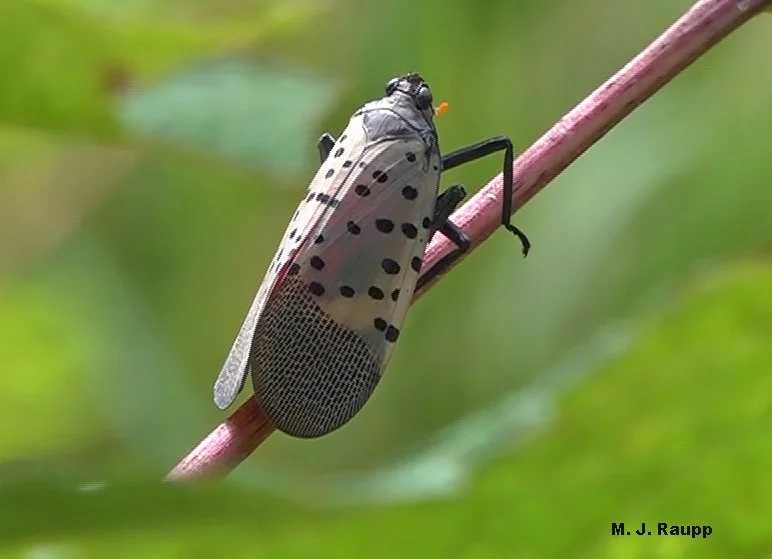
Slender spotted lanternflies like this one that landed on a small twig just before I snapped this photo are often flight capable, unmated females searching for suitable host plants on which to feed and produce batches of eggs.
Last week weather radar stations reported unusual low altitude clutter over several locations in the Mid-Atlantic region. News outlets including the Washington Post proclaimed that “So many spotted lanternflies are out right now, you can see it on radar.” To catch up with this story a bit, this week we will update parts of an episode first published in September 2020.
Lanternfly adults and their youngsters, called nymphs, remove large quantities of phloem sap from woody plants as they feed. The excess is excreted from their rear end in copious amounts as a sugary waste product called honeydew. More than 100 plant taxa of woody and herbaceous plants serve as hosts for spotted lanternflies. Spotted lanternflies can be severe pests of fruit and shade trees, grapes, and hops. Massive infestations in vineyards have withstood repeated applications of insecticides and still caused the demise of entire vineyards. In home landscapes, hundreds of these rascals have been observed feeding on a single plant, where they rain scads of honeydew onto vegetation and the earth below. As with honeydew produced by other phloem feeders such as soft scales and aphids, the honeydew excreted by lanternflies fouls foliage, fruit, and underlying plants, and serves as a substrate for the growth of a fungus known as sooty mold. Honeydew makes leaves sticky and fruit unmarketable, and sooty mold further disfigures leaves and fruit and may impair photosynthesis. This presents a huge economic problem for growers of apples, cherries, peaches, and grapes. Sweet honeydew and its fermentation products also attract a variety of stinging insects like yellowjackets and paper wasps.
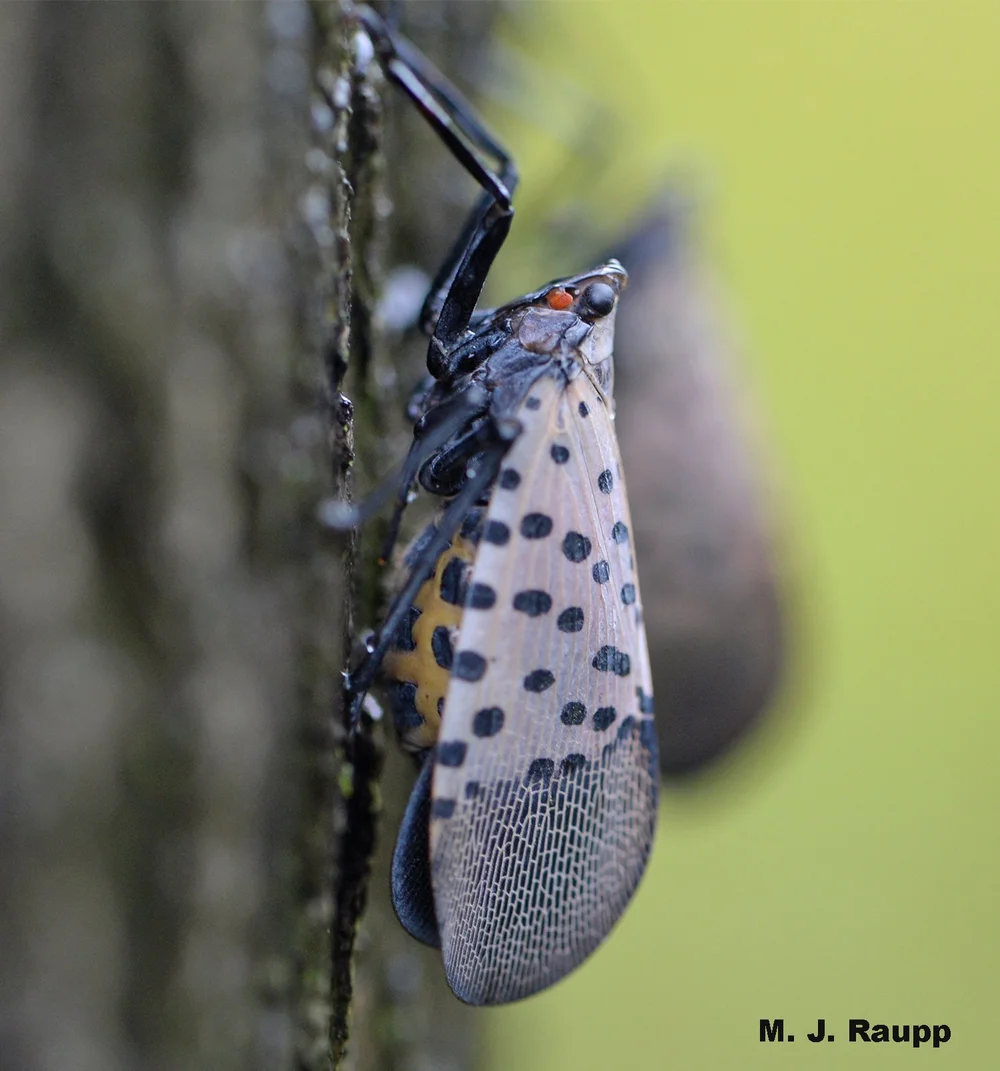
Rotund spotted lanternflies like this one with a bright yellow underbelly are generally mated females with limited flight ability.
How far do spotted lanternflies move? The immature stages called nymphs don’t move all that far. A clever study conducted by Kelli Hoover and her colleagues at Penn State found that some spotted lanternfly nymphs travel as much as 213 feet in their quest to find a suitable host, but only about half traveled 56 feet. However, studies by scientists in Pennsylvania reveal some of the secrets to the longer distance autumnal movements of adult spotted lanternflies. Thomas Baker and his colleagues at Penn State discovered that slim fancy flyers are primarily unmated females capable of flights ranging from roughly 30 to 150 feet. Their spontaneous flights are believed to be quests to find suitable host plants that will supply sufficient nutrients for them to fatten up and deposit a complete complement of eggs before cold weather puts an end to their mischief. The Penn State team also assessed the flight worthiness of plump yellow-bellied lanternflies commonly found on hosts like tree of heaven. A vast majority of these heavy females had successfully mated but their ability to fly was weak and limited to only about 12 feet when launched into the air.
To see spotted lanternflies in flight and see why they are showing up on radar, please click this here (Courtesy of Cornell Integrated Pest Management). Radar sightings of insects are not all that unusual. Four years ago in 2021, during the emergence of Brood X periodical cicadas, cicadas in flight were captured on radar in the DMV. Swarms of devastating locusts in Africa and Asia are often tracked on radar.
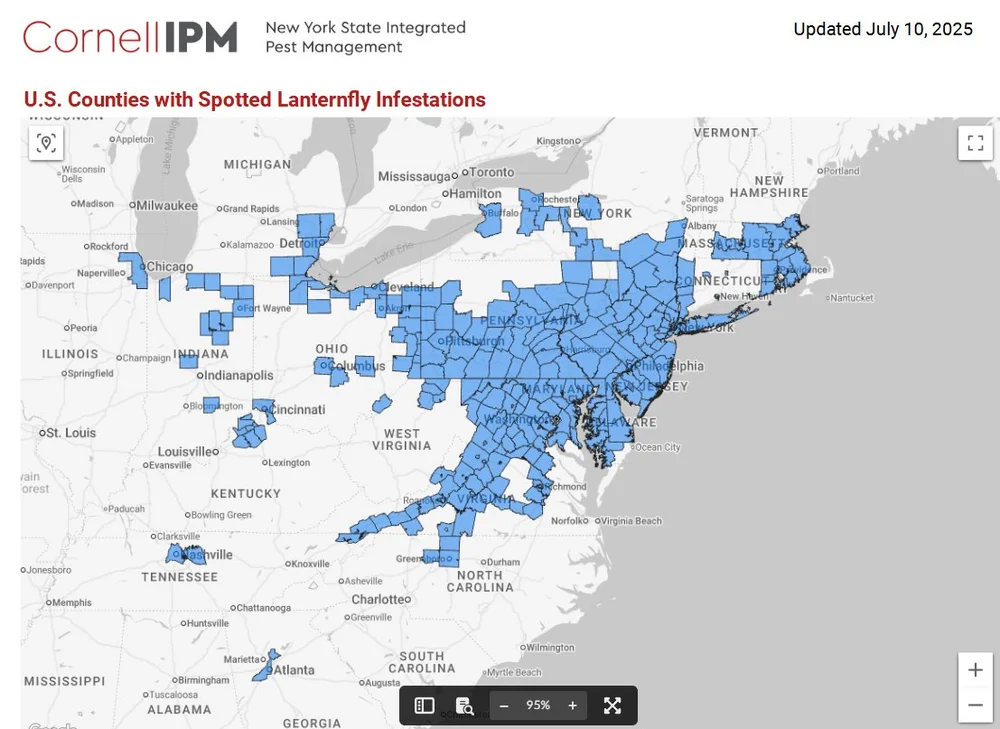
While spontaneous autumnal flights have been witnessed on a regular basis, these relatively short distance flights of hundreds of feet likely account for only a minor component of the spotted lanternflies’ prodigious spread in the eastern United States. From their initial discovery point in Berks County in 2014, it has moved more than 650 miles and established populations of spotted lanternflies have been discovered in Connecticut, Delaware, Georgia, Illinois, Indiana, Kentucky, Maryland, Massachusetts, Michigan, New Jersey, New York, North Carolina, Ohio, Pennsylvania, Rhode Island, South Carolina, Tennessee, Virginia, West Virginia and, of course, the District of Columbia.
This map shows the current locations of established infestations of spotted lanternflies (blue counties) throughout the eastern United States. Map courtesy of Brian Eshenaur and the New York State Integrated Pest Management Program of Cornell University.
Spotted lanternflies are on the wing to find new host plants, bringing them in contact with the human-built world where they will wander buildings and benches in search of food. Many will perish of starvation or dehydration on sidewalks and in parking lots. Others will be squashed beneath feet and automobile tires. Some may visit shoppers and diners briefly before flying off, while others will be snared and killed by urban spiders. Before you leave a parking area infested with lanternflies, inspect your car to make sure these clever vagabonds are not hitching a ride with you.
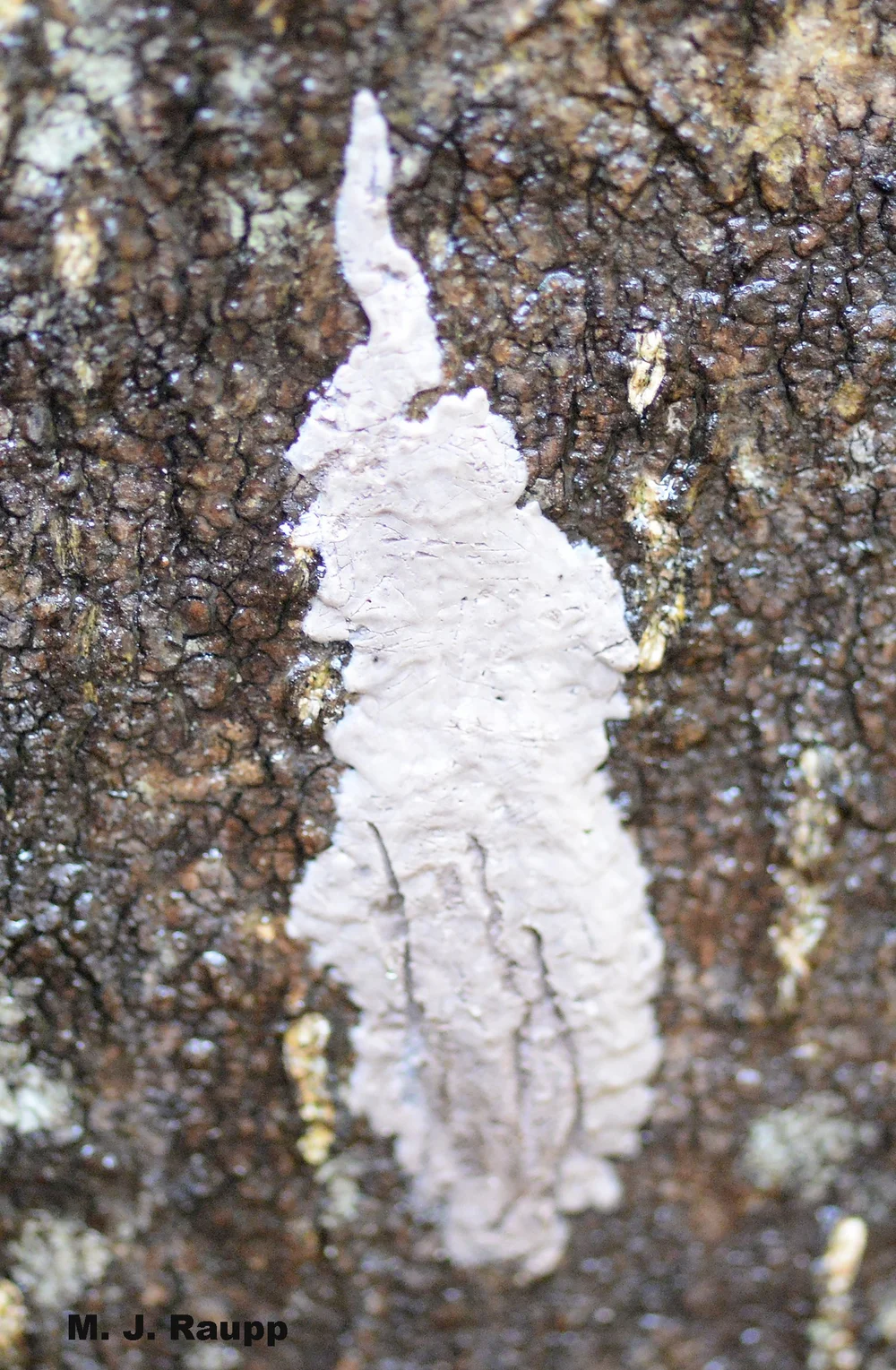
Non-descript lanternfly egg masses are easily overlooked.
According to entomologist Julie Urban, the most likely explanation for these long-distance peregrinations lies in human-assisted transport of lanternfly eggs. It is believed that spotted lanternflies arrived in Pennsylvania around 2012 from Asia in a shipment of stone products bearing lanternfly eggs, a trip of some 7,000 miles. Unlike many herbivorous insects that lay eggs on food plants for their young, spotted lanternfly mothers often deposit egg masses on human-made non-host objects including stones, cinder blocks, lawn furniture, pallets, and vehicles, in addition to trees. These rather nondescript egg masses are easily overlooked on natural and human-made items and transported inadvertently by road or rail, moving this invasive pest significant distances and accounting for a major component of the long-range spread of spotted lanternflies.
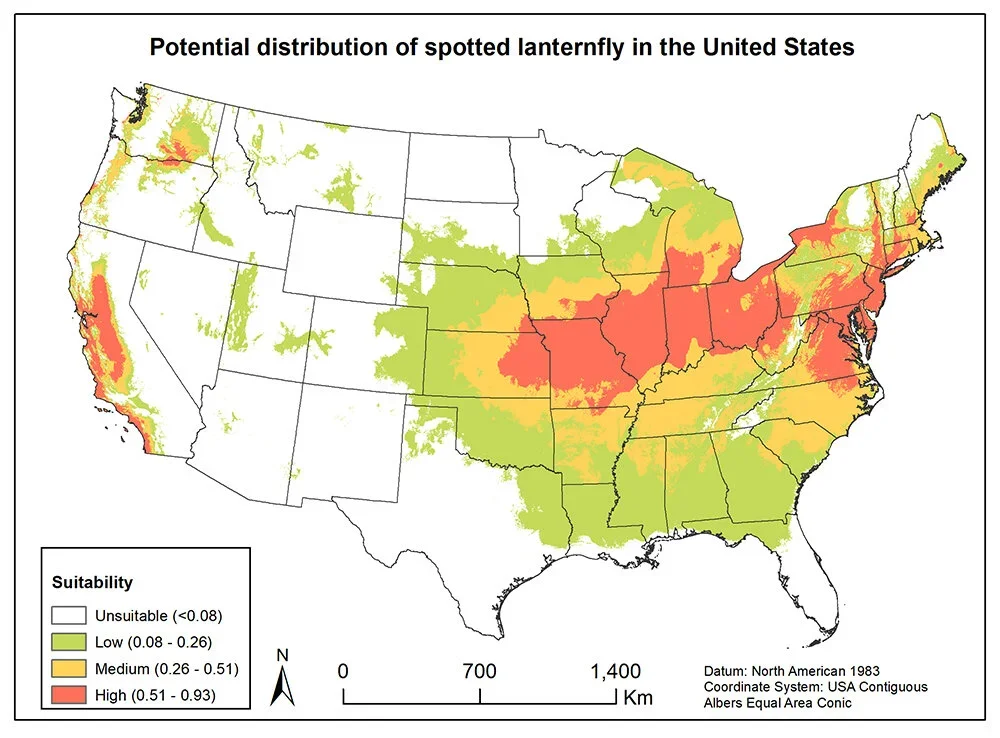
So, how far will spotted lanternfly spread in the US? Based on climatic data from the US and Asia, scientists suggest that much of the eastern United States and portions of California, Oregon, and Washington State have climates suitable for the survival of spotted lanternfly. This is not good news for the magnificent and economically important grape growing regions in our western states. Will spotted lanternflies soon be coming to your neighborhood? Time will tell, but as I have often heard, you can usually bet on the bug.
This map shows the potential distribution of spotted lanternfly in the United States based on climatological data. Areas with the highest probability of supporting lanternflies appear in dark orange and areas unsuitable for lanternflies are white. Map courtesy of the Entomological Society of America at Entomology Today, October 3, 2019.
To learn more about spotted lanternfly please visit the brilliant, fact-packed Penn State Cooperative Extension Website at this link: https://extension.psu.edu/spotted-lanternfly
Acknowledgements
Bug of the Week thanks Dr. Shrewsbury for spotting and wrangling spotted lanternflies for this episode. Thanks to Jessica Kronzer for providing inspiration for this story. We acknowledge the great work of scientists contributing to our knowledge of this pest, with particular thanks to authors of articles used as references, including Flight “Dispersal Capabilities of Female Spotted Lanternflies (Lycorma delicatula) Related to Size and Mating Status” by Michael S. Wolfin, Muhammad Binyameen, Yanchen Wang, Julie M. Urban, Dana C. Roberts, and Thomas Charles Baker, “Worldwide Feeding Host Plants of Spotted Lanternfly, With Significant Additions from North America” by Lawrence Barringer and Claire M. Ciafré, “Perspective: shedding light on spotted lanternfly impacts in the USA” by Julie M. Urban, “Dispersal of Lycorma delicatula (Hemiptera: Fulgoridae) Nymphs Through Contiguous, Deciduous Forest” by Joseph A. Keller, Anne E. Johnson, Osariyekemwen Uyi, Sarah Wurzbacher, David Long, and Kelli Hoover, and “The Establishment Risk of Lycorma delicatula (Hemiptera: Fulgoridae) in the United States and Globally” by Tewodros T. Wakie, Lisa G. Neven, Wee L. Yee, and Zhaozhi Lu. Thanks to Brian Eshenaur and the entire team at the New York State Integrated Pest Management Program of Cornell University for providing the updated maps of spotted lanternfly in the US and to the Entomological Society of America for providing the map of the potential distribution of spotted lanternfly in the US.
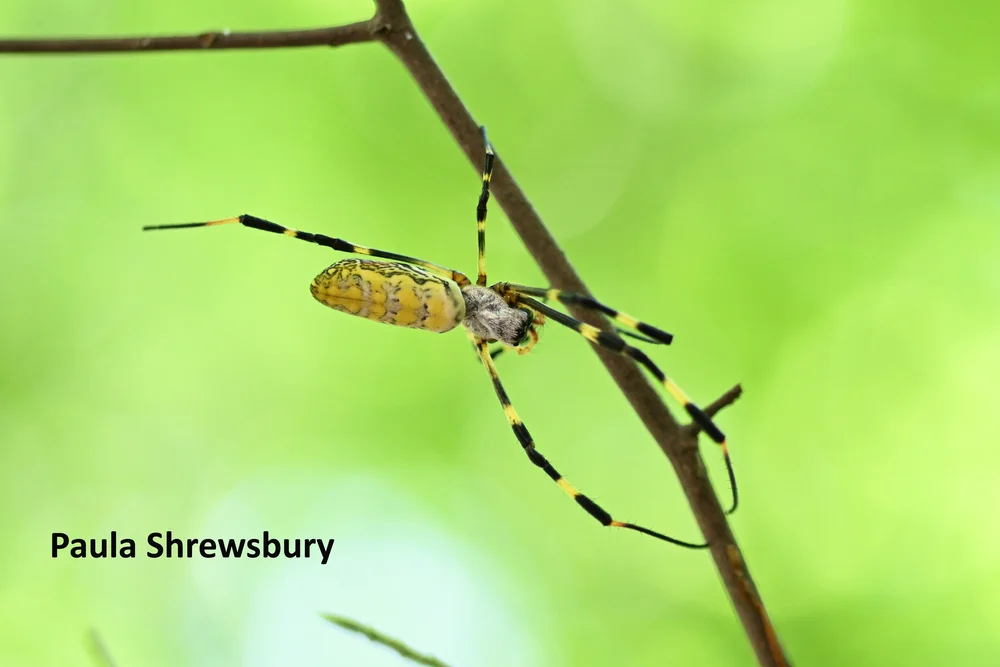
This is just one of the lovely Jorō spiders that now call Maryland home. Image credit: Paula Shrewsbury, PhD
We first visited the Jorō spider in March of 2022 and wondered if there was any chance that it would make its way to the DMV. Little did we know that in September of 2022 two observations of Jorō spiders in eastern Howard County would be reported to iNaturalist. Three years and some 40 sightings later, we know that Jorō spiders are happy and doing just fine in several Howard County locations, including Ilchester, West Elkridge, and Elkridge. A week or so ago, a team of scientists from the University embarked on a mission to access the spread of an awful disease known as beech leaf disease (BLD) that is killing our ultra valuable beech trees in the DMV and eastern US. Their sortie took them to a state forest in eastern Howard County near Elkridge. While searching for BLD, they discovered a remarkable colony of Jorō spiders thriving amongst the beech trees. The recent discoveries of Jorō spiders thriving in Maryland confirms a prognostication made by scientists Davis and Frick that physiological plasticity might allow Jorō spiders to escape the relative warmth of areas it has invaded in the southeastern US and expand its range northward along the eastern seaboard. With Jorō spiders merely 20 minutes away from home, how could one resist the opportunity to visit these amazing predators? The tales of how Jorō spiders and their cousin, the golden silk spider, arrived in the US can be found in previous episodes posted in 2022 and 2024.
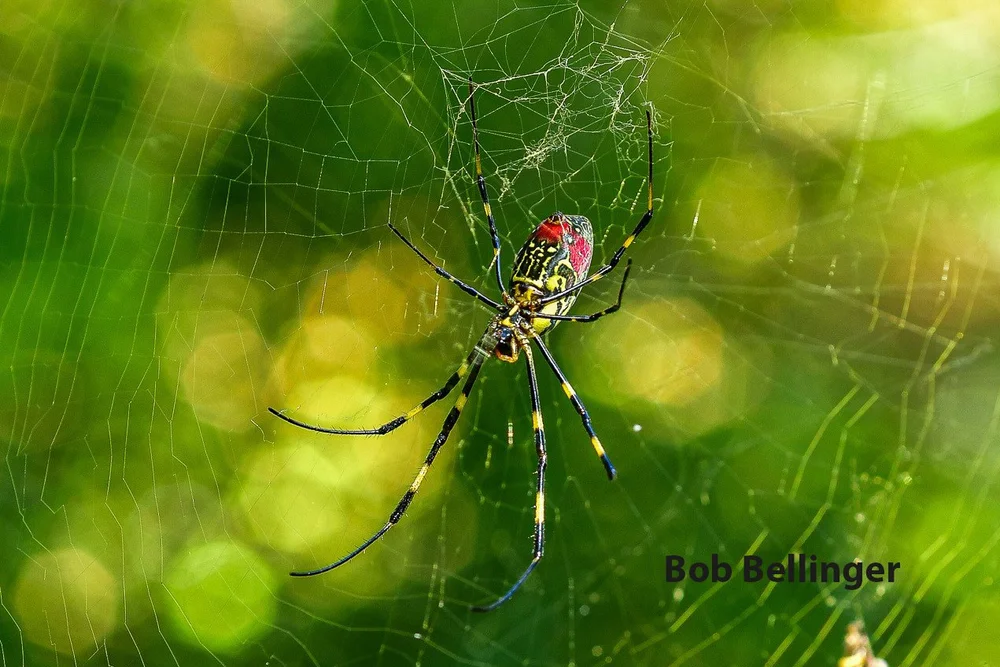
The underside of the Jorō spider has striking red markings. Image credit: Bob Bellinger.
However, to reduce some angst associated with a large non-native spider establishing in the DMV, here are a few things you should know. These facts were first presented in a past episode. The bite of the “venomous” Jorō spider will be terrible and painful, right? Nah, according to expert Rick Hoebeke, the risks to humans and pets are small due to the puny size of Jorō’s fangs, which are unlikely to pierce our skin. As you will see in this week’s video, I have visited Jorō and found the large females to be completely non-aggressive.
A secondary forest in eastern Howard County has been colonized by Jorō spiders. Their haphazard webs a littered with the remains of former victims, leaves, and shed exoskeletons. The much larger female Jorō spider dwarfs her mate, positioned just above her. See if you can spot a strand of silk produced by the spinnerets on the underside of her abdomen near the red mound. Relative to my hand, you can see how large and how docile Jorō is. We will wait and see what the Jorō spider means to ecosystems here in the DMV. Maybe they will help other spiders put a beat-down on invasive pests like stink bugs and spotted lanternflies. Video by Mike Raupp and Paula Shrewsbury
These spiders are passive hunters that build enormous webs, larger than a meter in diameter, to capture prey snared in the silk. For arachnophobes these may be scary, but for arachnophiles these are beautiful spiders which may provide important ecosystem services including biological control of crop pests such as brown marmorated stink bugs or spotted lanternflies, with which they have an ancient association in their native range in Asia. Jorō spiders may be likened to Hannibal Lecter "having an old friend over for dinner" when they reunite with the stink bug or lanternfly here in the US.
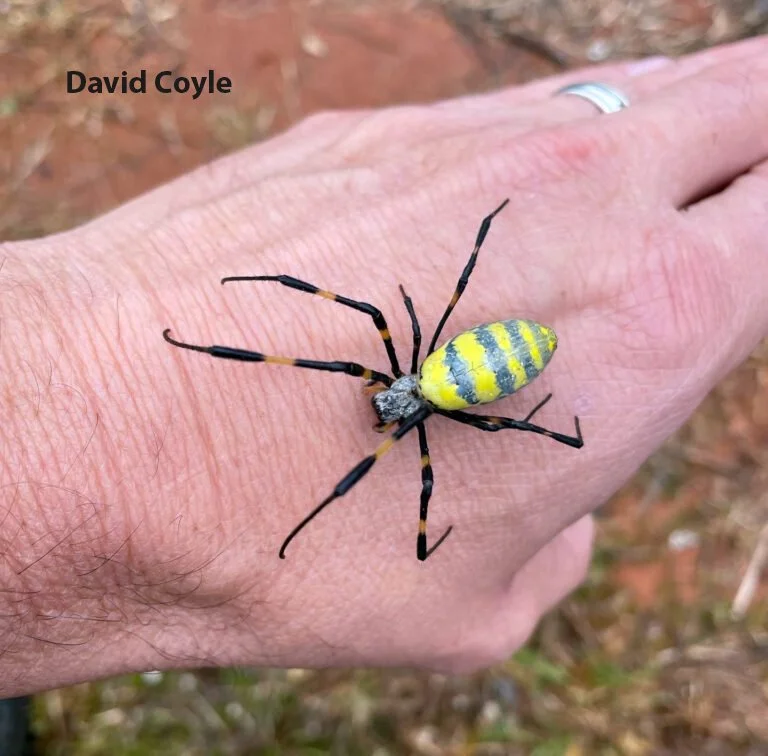
Despite what you may have heard, the Jorō spider is docile and poses no known threat to humans or pets. Image credit: David Coyle
Large spiders like these may also become juicy prey items for feathered and non-feathered reptiles. As with all non-native species that arrive in our land, it is difficult to predict what impact they will have on our ecosystems but experts suggest that beyond their somewhat scary mien, they may give our indigenous large orb weavers like the black and yellow garden spider, marbled orb weaver, and spotted orb weaver a run for their money. In locations in other parts of the world where Jorō is established, it often becomes the most abundant and dominant orb weaver. What will it mean for our resident spiders and their ecosystems? Only time will tell.
One final tidbit about Jorō comes from Japanese folklore. Jorō is a shapeshifter known as Jorō-gumo. Jorō-gumo turns into a beautiful woman, seduces men, binds them with silk, and devours them. Yikes! Sounds like a bad date to me.
Acknowledgements
Bug of the Week thanks Rick Hoebeke for identifying Jorō as it arrived in the US and for providing insights into the ways of these large, beautiful spiders. We also thank David Coyle and Bob Bellinger for sharing great images and knowledge of Jorō. Fascinating studies entitled “Veni, vidi, vici? Future spread and ecological impacts of a rapidly expanding invasive predator population” by David R. Nelsen, Aaron G. Corbit, Angela Chuang, John F. Deitsch, Michael I. Sitvarin and David R. Coyle, “Physiological evaluation of newly invasive Jorō spiders (Trichonephila clavata) in the southeastern USA compared to their naturalized cousin, Trichonephila clavipes” by Andrew K. Davis and Benjamin L. Frick, “Nephila clavata L Koch, the Joro Spider of East Asia, newly recorded from North America (Araneae: Nephilidae)” by E. Richard Hoebeke, Wesley Huffmaster, and Byron J Freeman, and “The Life Cycle, Habitat and Variation in Selected Web Parameters in the Spider, Nephila clavipes Koch (Araneidae)” by Clovis W. Moore ND provided the inspiration for this story and details surrounding the stars of this episode. We thank Dr. Dave Clement, Miri Talabac, and Maddie Potter for hooking us up with the colony of Jorō spiders.